Ransomware attacks on the automotive industry more than doubled in 2025, constituting 44% of all cyber incidents within the sector, according to a new report by cybersecurity firm Halcyon. This surge isn't just targeting corporate networks; connected vehicles themselves are becoming direct attack surfaces, enabling remote control and significantly escalating the potential for disruption and economic damage. The financial impact is already severe, with supply chain dependencies creating an attractive target for financially motivated threat actors.
What Happened
The automotive ransomware landscape saw a dramatic shift in 2025, with attacks specifically targeting this sector rising sharply. These incidents involve threat actors infiltrating systems, encrypting critical data, and demanding payment for its release, often coupled with data exfiltration for double extortion. A significant incident in October of an unspecified year, for example, forced Jaguar Land Rover to halt global production for over three weeks, resulting in an estimated $2.5 billion in economic damage CBT News. Prior to this, the Russia-linked BlackSuit criminal organization crippled operations at approximately 15,000 dealerships for two weeks after compromising a major dealership management platform, incurring collective losses estimated at $1 billion CBT News. Consumer data is also a prime target; an automotive IT provider suffered a compromise in early 2025 that exposed personal information, including Social Security numbers, for 2.7 million vehicle owners CBT News.
Why It Matters
The automotive industry's appeal to ransomware groups stems from the immense financial pressure caused by operational shutdowns. Production lines and supply chains are highly interdependent and operate on tight schedules, making any disruption extremely costly. The industry's rapid integration of connected technology – vehicle platforms, over-the-air (OTA) software updates, and cloud-based systems – has expanded the attack surface far beyond traditional corporate IT. Crucially, connected vehicles themselves are now direct targets, allowing attackers to potentially seize remote control of individual cars. This capability represents a significant escalation, moving from corporate data exfiltration and operational disruption to potential physical control and safety implications. The ongoing nature of these threats means the automotive industry continues to face significant risks into 2026 and beyond, as illustrated by Comparitech's daily updated ransomware tracker Comparitech, which shows a continuous stream of incidents across various sectors.
Technical Breakdown
Attackers frequently leverage initial access vectors like spearphishing (MITRE ATT&CK: T1566.001 Spearphishing Attachment or T1566.002 Spearphishing Link) to gain a foothold within automotive networks. Once inside, they often exploit unpatched vulnerabilities in public-facing applications (MITRE ATT&CK: T1190 Exploit Public-Facing Application) or use valid accounts (MITRE ATT&CK: T1078 Valid Accounts), potentially acquired through credential dumping (MITRE ATT&CK: T1003 OS Credential Dumping) from compromised systems. Lateral movement within these highly interconnected environments, often involving dealership management platforms or supply chain partners, allows them to reach critical operational technology (OT) systems or connected vehicle platforms.
Consider a distributed car manufacturing network: gaining access to a central update server via a compromised credential can be analogous to obtaining the master key to a city's entire public transit system. One single point of compromise could theoretically cascade to thousands of endpoints. Once persistence is established, perhaps through scheduled tasks (MITRE ATT&CK: T1053 Scheduled Task/Job), the final stage often involves data encryption for impact (MITRE ATT&CK: T1486 Data Encrypted for Impact) and inhibiting system recovery (MITRE ATT&CK: T1490 Inhibit System Recovery) by deleting backups or shadow copies.
For defending against such attacks, robust endpoint detection and response (EDR) solutions like CrowdStrike Falcon or SentinelOne are crucial for identifying anomalous activity and preventing lateral movement. Implementing strong authentication policies, managed via tools like 1Password or YubiKey, and adhering to NIST SP 800-53 control IA-2 Identification and Authentication (Organizational Users) are fundamental steps to mitigate initial access risks. Continuous monitoring (NIST SP 800-53: CA-7 Continuous Monitoring) and rigorous incident handling (NIST SP 800-53: IR-4 Incident Handling) are essential for rapid detection and recovery.
Historical Context
The automotive industry has faced cyber threats for years, though the scale and nature have evolved. In 2015, for example, security researchers demonstrated remote compromise of a Jeep Cherokee, showcasing how vulnerabilities in connected car technology could be exploited. This incident, publicized by Wired, involved researchers Charlie Miller and Chris Valasek remotely disabling the vehicle's transmission and brakes. While this was a controlled demonstration and not a ransomware event, it highlighted the nascent but growing attack surface of connected vehicles. The difference today is that such capabilities are now being actively productized by ransomware groups, shifting from proof-of-concept to financially motivated exploitation. The economic impact is also far greater now, with the $2.5 billion in damages from the Jaguar Land Rover incident dwarfing earlier estimates.
Data at a Glance
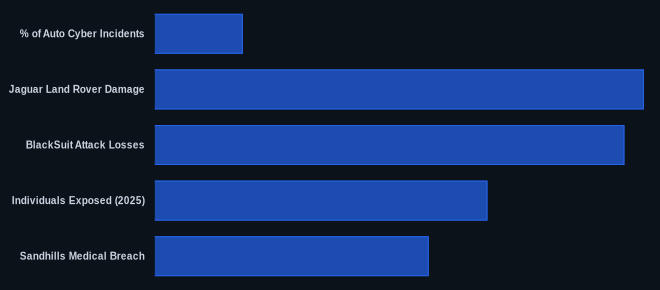
| Metric | Value | Source |
|---|---|---|
| Ransomware Attacks (2025) | Doubled | CBT News |
| % of Auto Cyber Incidents | 44% | CBT News |
| Jaguar Land Rover Damage | $2.5 billion | CBT News |
| BlackSuit Attack Losses | $1 billion | CBT News |
| Individuals Exposed (2025) | 2.7 million | CBT News |
| Sandhills Medical Breach | 170,000 | SecurityWeek |
Our Take
We're seeing a maturation of ransomware targeting critical infrastructure, and the automotive sector is a prime example. The shift from IT network encryption to directly targeting vehicle platforms via OTA updates or embedded systems is a game-changer. It means that traditional network segmentation alone isn't enough; we need to treat every connected vehicle as a potential endpoint and apply Zero Trust principles, potentially leveraging solutions like Cloudflare Zero Trust, from the assembly line to the dealership. The economic disruption alone makes the sector a high-value target, but the potential for kinetic impacts raises the stakes considerably.
The CVEDaily Take
The interconnectivity that drives modern automotive innovation has become its Achilles' heel against automotive ransomware. The industry must move beyond reactive patching and invest in proactive threat intelligence, secure-by-design principles for embedded systems, and robust incident response playbooks that account for both IT and OT environments. Has your team conducted a comprehensive tabletop exercise simulating a connected vehicle ransomware incident involving remote control scenarios?
FAQ
Q: Why is the automotive industry particularly vulnerable to ransomware?
A: The automotive industry is highly appealing to ransomware attackers due to its tight production deadlines and complex, interconnected supply chains, making operational shutdowns extremely costly. Its rapid adoption of connected technologies, including vehicle platforms and OTA updates, has also expanded the attack surface significantly.
Q: Are individual cars truly direct targets for ransomware?
A: Yes, the increasing interconnectedness of modern vehicles means that attackers can now target and potentially gain remote control of individual cars, moving beyond traditional enterprise IT systems. This allows for new vectors of disruption and potential safety risks.
Q: What are some immediate steps automotive organizations can take to mitigate this risk?
A: Organizations should implement robust EDR solutions, enforce strict access controls and multi-factor authentication, regularly back up critical data (using solutions like Veeam or Acronis), develop comprehensive incident response plans, and conduct regular penetration testing on both IT and OT systems, including connected vehicle platforms.