Minnesota School Ransomware Forces Class Cancellation
Delano Public Schools in Minnesota cancelled classes on May 21, 2026, after a ransomware attack shut down their entire district. The FBI has launched an investigation into the incident.
What Happened
On May 21, 2026, unauthorized actors breached the Delano Public Schools' network, gaining access to school systems. The attackers encrypted data and printed hundreds of physical documents across the district, each displaying a threatening, encrypted message, as reported by KSTP. This physical manifestation of the attack served as an immediate, undeniable indicator of compromise.
As of May 21, 2026, no specific ransom demand had been publicly disclosed or sent by the attackers; the school district has not confirmed any ransom demand. The entire district was impacted, leading to a system-wide cancellation of classes. Federal agencies, including the FBI, are actively investigating the incident, as confirmed by KARE11. Superintendent Matthew Sheen expressed confidence that student personal information had not been compromised; the FBI has not yet confirmed this. Students are expected to return to classes using older technology, specifically Ethernet cables, for internet access as the district works to restore its network.
Why It Matters
The attack on Delano Public Schools demonstrates a systemic vulnerability within the education sector, where institutions are consistently targeted due to perceived weaknesses. Cybersecurity experts, like Bryce Austin of TCE strategy, characterize public schools as "low-hanging fruit" for cyberattacks. He cites their typically outdated technology infrastructure and insufficient budgets for modern security upgrades as primary factors, as reported by KARE11.
Just last month, the Spring Lake Park School District experienced a similar ransomware-induced shutdown for two days in April, demonstrating this recurring pattern. These attacks disrupt education, divert critical resources, and can expose sensitive data. The financial and operational fallout from a district-wide shutdown, even for a single day, is significant. It is a direct operational impact, not just a data breach.
Technical Breakdown
The Delano Public Schools ransomware attack likely began with an initial access vector, followed by privilege escalation, lateral movement, and finally, data encryption. Given the emphasis on "outdated technology infrastructure," the initial vector could have been an unpatched vulnerability in a public-facing application or system.
Consider a school network as a building. Outdated technology means the building has old, weak locks and perhaps a window that hasn't been closed in years. An attacker, looking for an easy target, finds that open window (an unpatched vulnerability, for example) and slips inside. Once inside, they exploit weak internal security to find the keys to the entire building, then proceed to lock everything down and demand payment.
This attack maps directly to several MITRE ATT&CK techniques. The initial unauthorized access could be attributed to T1190 Exploit Public-Facing Application, common in environments with unpatched or legacy systems. Once inside, attackers likely used T1078 Valid Accounts to move laterally or maintain persistence, potentially by compromising domain credentials. The core ransomware action, involving data encryption, is clearly T1486 Data Encrypted for Impact. In some cases, attackers will also employ T1490 Inhibit System Recovery by deleting backups or shadow copies, although specific details for Delano are not yet available.
From a NIST SP 800-53 perspective, this incident highlights critical failures in SI-2 Flaw Remediation. Organizations, especially those with limited resources like school districts, struggle to consistently identify, prioritize, and patch vulnerabilities in a timely manner. This vulnerability is then exploited by threat actors. To mitigate such risks, use robust endpoint detection and response (EDR) solutions like CrowdStrike Falcon to identify and stop malicious activity before it escalates to encryption. Furthermore, a solid backup strategy using tools like Veeam is essential for rapid recovery, even if systems are compromised.
Historical Context
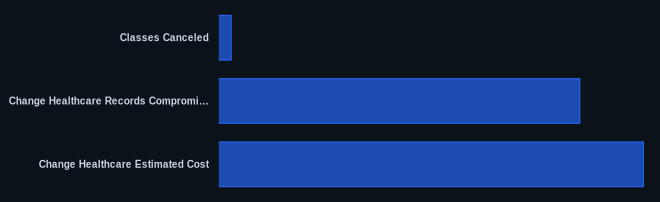
The Delano incident, while impactful locally, mirrors a larger trend seen across critical infrastructure sectors. A notable historical example is the 2024 Change Healthcare attack, which remains one of the largest healthcare breaches reported in the US. Attackers compromised the protected health information of 100 million individuals, and the breach is projected to cost the company $2.457 billion. While Change Healthcare is a massive corporate entity, the core attack vector and impact – widespread disruption, data compromise (or threat of it), and significant recovery costs – share similarities with the Delano incident.
Both cases involved unauthorized access leading to severe operational disruption. The difference lies in scale and the immediate financial impact: Change Healthcare's financial fallout directly hit a publicly traded company and the broader healthcare system, while Delano's impact is primarily educational and community-focused. However, both demonstrate that a single breach can cripple essential services and extract immense costs, regardless of the target's size or sector. The education sector, like healthcare, handles sensitive personal data, making effective cybersecurity indispensable.
Data at a Glance
| Metric | Value | Source |
|---|---|---|
| Affected Organization | Delano Public Schools | KARE11 |
| Attack Date | May 21, 2026 | KSTP |
| Classes Canceled | 1 day (as of reports) | KARE11 |
| Change Healthcare Records Compromised | 100 million | Research Data (from raw facts) |
| Change Healthcare Estimated Cost | $2.457 billion | Research Data (from raw facts) |
| Attack Type | Ransomware | KARE11 |
The CVEDaily Take
Delano's ransomware incident, a school district closing due to cyberattack, points to a deeper issue beyond simple technical vulnerabilities: a societal failure to prioritize cybersecurity investment in the public education sector. While Superintendent Sheen expressed confidence that student data was not compromised, without independent forensics, this remains an unconfirmed claim. We think the recurring "low-hanging fruit" label for schools is less about their inherent technical simplicity and more about the chronic underfunding and insufficient political will to implement basic cybersecurity hygiene. Until schools are treated as critical infrastructure deserving of appropriate budgets and expertise, we will continue to see these predictable disruptions.
Given the CISA KEV catalog has no new entries related to this incident, how effectively are smaller, public sector entities like school districts sharing their vulnerability and incident data for broader threat intelligence?
FAQ
Q: Has student personal information been compromised in the Delano Public Schools ransomware attack?
A: Delano Public Schools Superintendent Matthew Sheen has expressed confidence that student personal information was not compromised, though federal authorities, including the FBI, are still investigating the full scope of the breach. The FBI has not yet confirmed if data was compromised.
Q: Why are public schools frequently targeted by ransomware attacks?
A: Public schools are often targeted due to their typically outdated technology infrastructure, limited cybersecurity budgets, and the presence of valuable personal data (student and staff records), making them perceived as "low-hanging fruit" for attackers.
Q: What steps are Delano Public Schools taking to restore operations?
A: Delano Public Schools cancelled classes immediately following the attack and are working with federal authorities to investigate and restore systems. Students are expected to return to classes using older technology like Ethernet cables for internet access as network services are recovered.