
cPanel CVE-2026-41940 Actively Exploited Since February
A critical cPanel zero-day authentication bypass, CVE-2026-41940, has been under active exploitation since February 23, 2026, months before its public disclosure and the release of patches on April 28, 2026, by cPanel. This vulnerability, boasting a CVSS score of 9.8, grants administrative access to vulnerable cPanel & WHM servers, posing a severe risk to the estimated 1.5 million internet-accessible instances identified by Shodan. The post-disclosure period has seen rapid, diverse exploitation, including a previously unknown threat actor targeting government, military, and hosting providers across multiple continents.
What Happened
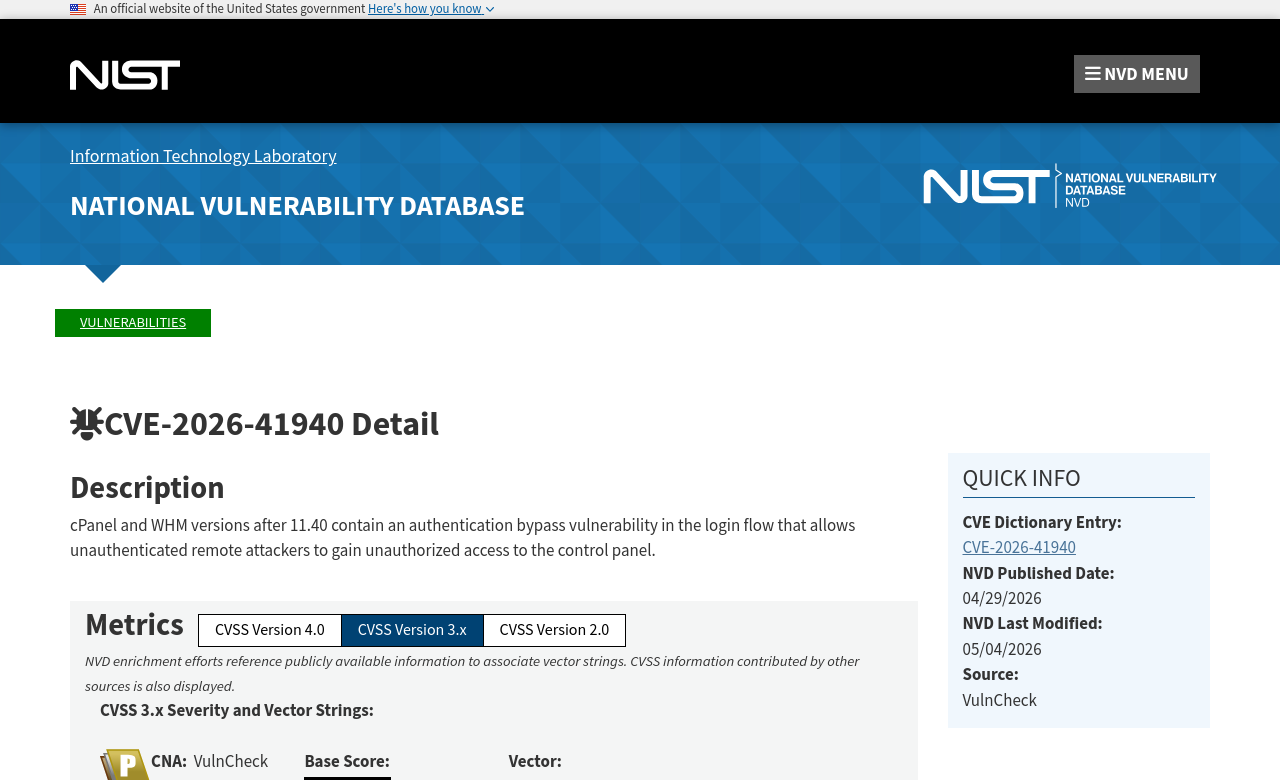
cPanel disclosed the critical authentication bypass CVE-2026-41940 on April 28, 2026, urging immediate patching for all affected cPanel & WHM versions after 11.40, and WP Squared version 136.1.7. Technical analysis by firms like WatchTowr soon revealed the full scope of the vulnerability and its pre-disclosure exploitation timeline. Prior to this public announcement, the zero-day had been actively exploited for over two months, dating back to February 23, 2026.
Patches were quickly released on the same day as the advisory, including cPanel & WHM versions 11.86.0.41, 11.110.0.97, 11.118.0.63, 11.126.0.54, 11.130.0.19, 11.132.0.29, 11.136.0.5, and 11.134.0.20, along with WP Squared 136.1.7. Following the disclosure, major hosting providers such as KnownHost, HostPapa, InMotion, and Namecheap immediately responded by blocking cPanel & WHM ports and initiating patch deployment. However, a new threat actor, identified by Ctrl-Alt-Intel on May 2, 2026, began actively exploiting CVE-2026-41940, focusing on government and military entities in Southeast Asia, and MSPs and hosting providers in the Philippines, Laos, Canada, South Africa, and the U.S. CISA has issued an emergency directive to federal agencies, mandating patching by May 5, 2026, as reported by BleepingComputer.
Why It Matters
This cPanel zero-day is particularly concerning due to the widespread deployment of cPanel & WHM in shared hosting environments and its critical impact. Gaining administrative access to a cPanel server allows attackers to control not only the host system and its configurations but also potentially compromise every website hosted on that server. This translates to data theft, website defacement, malware distribution, and further lateral movement within compromised networks.
The exploitation by a previously unknown threat actor against a diverse set of high-value targets—including government and military organizations, alongside hosting providers—demonstrates the immediate weaponization of such critical vulnerabilities. For example, the targeting of MSPs could lead to supply chain attacks, granting attackers access to numerous downstream clients. The potential for large-scale compromise, given the 1.5 million internet-accessible cPanel instances reported by Shodan, makes this a high-priority remediation for IT and security teams. Tools like CrowdStrike Falcon could help detect post-exploitation activities, even if initial access has been achieved.
Technical Breakdown
The vulnerability CVE-2026-41940 is a logic flaw within the cPanel service daemon (cpsrvd), specifically a missing authentication check for a critical function. The attack chain leverages how cpsrvd handles failed login attempts and session file creation.
When a user attempts a login that fails, cpsrvd writes a pre-authentication session file to disk. Attackers can manipulate the whostmgrsession cookie by omitting an expected segment of its value. This manipulation bypasses the normal encryption process for values provided by the attacker. By injecting specific characters via an authorization header, attackers can then write their controlled credentials in plaintext directly to this session file. A subsequent reload of this session file allows the attacker to authenticate using these injected credentials, effectively gaining administrative access without ever having to solve a legitimate challenge.
Think of it like a faulty hotel key card system. You try to use your card, it fails, and the system logs the attempt, but also writes down your requested room number. A malicious actor, knowing this flaw, can then submit a malformed key request that causes the system to write their own desired room number directly into the log file in plaintext. Then, if they can trigger a "refresh" of that log, the system will read their desired room number and grant them access, bypassing the actual key card verification process entirely.
This attack maps to MITRE ATT&CK technique T1190 Exploit Public-Facing Application for initial access, followed by T1078 Valid Accounts as they gain administrative privileges using injected credentials. From a NIST SP 800-53 perspective, this highlights a failure in IA-2 Identification and Authentication (Organizational Users) due to the authentication bypass, and SI-10 Information Input Validation due to the lack of proper validation on the whostmgrsession cookie. Organizations should also consider their SI-2 Flaw Remediation processes for addressing such critical vulnerabilities rapidly.
Historical Context
The immediate and widespread exploitation of CVE-2026-41940 echoes the rapid weaponization seen with the Log4Shell vulnerability (CVE-2021-44228) in December 2021. Log4Shell, a critical RCE vulnerability in the ubiquitous Apache Log4j logging library, was also quickly exploited globally after public disclosure, leading to widespread compromise across various sectors.
Similarities include the high CVSS score, the pervasive nature of the affected software (cPanel for web hosting, Log4j for numerous applications), and the speed with which threat actors moved to exploit the flaw. Both vulnerabilities granted significant control over affected systems. However, the cPanel zero-day differs in that its exploitation was confirmed months prior to public disclosure, meaning attackers had a substantial head start. This emphasizes the challenge of patching systems that are critical to online infrastructure, especially when a vulnerability remains private for an extended period. The Log4Shell incident, while devastating, primarily saw exploitation accelerate after public knowledge.
Data at a Glance
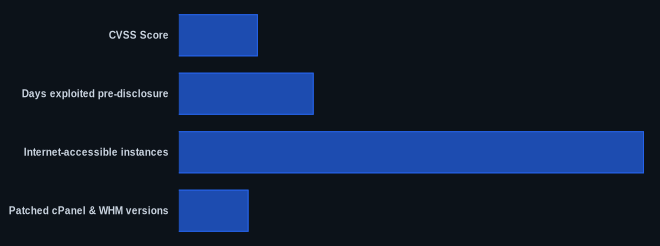
| Metric | Value | Source |
|---|---|---|
| CVSS Score | 9.8 | cPanel Advisory |
| Days exploited pre-disclosure | 64 days | WatchTowr |
| Internet-accessible instances | 1.5 million | Shodan |
| Patched cPanel & WHM versions | 8 versions | cPanel Advisory |
| CISA patch directive deadline | May 5, 2026 | BleepingComputer |
Our Take
The cPanel CVE-2026-41940 situation is a prime example of why secure development lifecycles and proactive vulnerability management are non-negotiable. We're seeing a highly reliable authentication bypass that allows attackers to write their way into administrative access, bypassing fundamental security controls. The fact that it was exploited for over two months before disclosure means a significant number of systems were likely compromised silently, and the recent surge in activity from a new threat actor underscores the ongoing danger.
The CVEDaily Take
This isn't just another critical vulnerability; it's a stark illustration of how shared hosting environments present a consolidated target for high-impact attacks. The ease and reliability of this authentication bypass, coupled with active targeting of critical infrastructure, should prompt every organization running cPanel to treat this with extreme urgency, beyond standard patch cycles. Have you implemented specific compensating controls for your cPanel instances while awaiting patching?
FAQ
Q: Which specific cPanel & WHM versions are affected by CVE-2026-41940?
A: All cPanel & WHM versions after 11.40 are affected. Patches have been released for specific versions including 11.86.0.41, 11.110.0.97, 11.118.0.63, 11.126.0.54, 11.130.0.19, 11.132.0.29, 11.136.0.5, and 11.134.0.20, as per cPanel's advisory.
Q: What is the primary impact of successful exploitation of this vulnerability?
A: Attackers can gain administrative access to vulnerable cPanel & WHM servers. This allows them to modify server configurations, potentially compromise all websites hosted on shared servers, and gain control over the cPanel host system and its databases.
Q: Is there any specific mitigation for CVE-2026-41940 beyond patching?
A: While immediate patching is the definitive solution, hosting providers initially blocked access to cPanel & WHM ports as a temporary measure. Implementing robust network segmentation and utilizing a solution like Cloudflare Zero Trust to restrict access to cPanel interfaces to known trusted IPs or users can reduce the attack surface. Consistent auditing of administrator logs and server configurations is also crucial for detecting post-exploitation activity.