
Microsoft Exchange Server [CVE-2026-42897] Zero-Day Exploited In-The-Wild
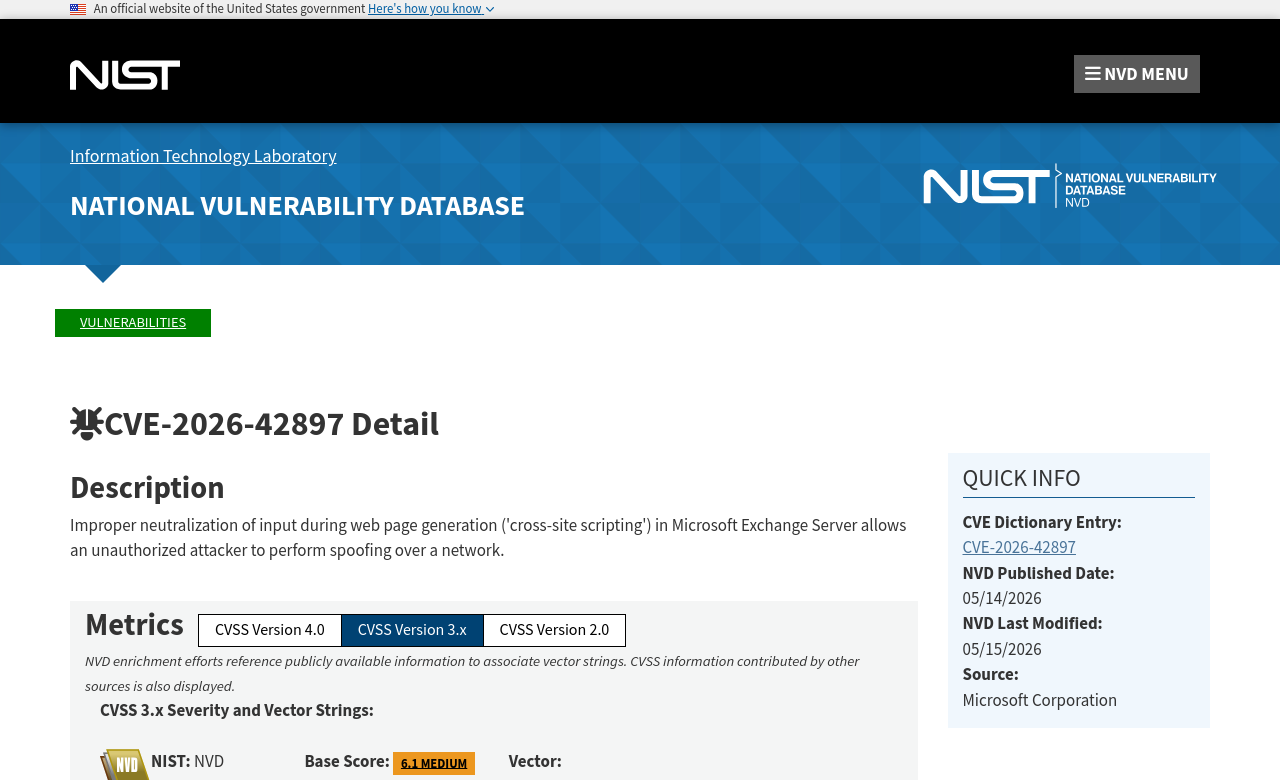
On May 14, 2026, Microsoft publicly disclosed CVE-2026-42897, a high-severity cross-site scripting (XSS) zero-day affecting on-premises Microsoft Exchange Server products. This vulnerability is actively exploited in the wild, enabling attackers to perform spoofing and session abuse. Immediate application of temporary mitigations like the Exchange Emergency Mitigation Service (EEMS) or Exchange On-premises Mitigation Tool (EOMT) is critical for affected organizations, as Microsoft has not yet released a permanent patch.
What Happened
A high-severity zero-day cross-site scripting (XSS) vulnerability, tracked as CVE-2026-42897, exists in on-premises Microsoft Exchange Server products and is actively exploited. Attackers use it to achieve network spoofing against users, SecurityWeek reports.
The vulnerability impacts Microsoft Exchange Server 2016, Exchange Server 2019, and Exchange Server Subscription Edition (SE), regardless of their current update levels. Exchange Online remains unaffected, as BleepingComputer reported.
CVE-2026-42897 carries a CVSS score of 8.1, categorizing it as high severity by NVD. The core issue is an "Improper neutralization of input during web page generation ('cross-site scripting')" within the server's handling of web content.
The timeline for this zero-day:
- May 14, 2026: Microsoft publicly disclosed CVE-2026-42897, confirming active exploitation.
- May 15, 2026: CISA added the vulnerability to its Known Exploited Vulnerabilities Catalog (KEV).
- May 29, 2026: CISA set this as the due date for Federal Civilian Executive Branch agencies to apply necessary mitigations.
While no permanent patch is yet available, Microsoft has provided temporary mitigations. Enabling the Exchange Emergency Mitigation Service (EEMS), which is typically enabled by default, automatically applies a URL rewrite configuration to block known exploit vectors. For environments where EEMS isn't an option, such as air-gapped systems, the Exchange On-premises Mitigation Tool (EOMT) offers a scripted solution, as The Hacker News explained.
Why It Matters
The active exploitation of CVE-2026-42897 means attackers are already targeting systems. Successful exploitation could allow attackers to steal session data, install malware, or hijack a victim's computer, running with the same permissions as the browser itself. This could lead to lateral movement and deeper compromise.
Microsoft has not publicly disclosed specific details about the threat actors or the full scale of attacks. The absence of packet-level or forensic Indicators of Compromise (IOCs) makes proactive threat hunting harder, SecurityWeek stated. Check your EDR logs for suspicious activity.
The reliance on temporary mitigations like EEMS and EOMT presents a difficult tradeoff. While they block the immediate threat, they come with known side effects, such as inline images not displaying correctly in Outlook Web Access (OWA) or issues with printing calendars. This impacts user experience and can generate helpdesk tickets, but it's a necessary compromise to protect the server.
Technical Breakdown
The exploit mechanism for CVE-2026-42897 is a client-side XSS attack delivered via email. An attacker crafts a malicious email. If a user opens this email in Outlook Web Access (OWA) and specific interaction conditions are met (often just viewing the email, but sometimes requiring a click or hover), arbitrary JavaScript can execute within the user's browser session. This malicious script operates in the context of the user's OWA session, granting the attacker the ability to perform spoofing, abuse the session, and access browser-accessible data. The payload is the malicious email content itself, not a separate attachment or file.
Consider an email you receive where the content itself, when viewed in OWA, can run code directly within your browser. Your OWA browser session is compromised, and the malicious email content executes code in your trusted environment.
From a MITRE ATT&CK perspective, the initial vector here aligns with T1566.001 Spearphishing Attachment, where the specially crafted email itself carries the malicious content directly to the victim. The subsequent execution of JavaScript in the user's browser falls under client-side exploitation. Once executed, the malicious JavaScript can then initiate activities like session hijacking (e.g., stealing cookies) or further data exfiltration.
To address the root cause of this vulnerability, patch CVE-2026-42897. The underlying issue is an "Improper neutralization of input," which directly points to the NIST SP 800-53 control SI-10 Information Input Validation. Implementing and enforcing this control is fundamental to preventing XSS vulnerabilities. For detecting post-exploitation activities, even simple XSS can lead to more severe compromises. An EDR solution can identify unusual process activity or network connections initiated by a compromised OWA browser session, providing crucial visibility beyond the initial exploit.
Historical Context
Microsoft Exchange Server has a storied and often challenging history as a target for nation-state actors and cybercriminals. The exploitation of CVE-2026-42897 echoes past incidents, most notably the ProxyLogon vulnerabilities (CVE-2021-26855, CVE-2021-26857, CVE-2021-26858, CVE-2021-27065) discovered and widely exploited in March 2021. That incident saw the HAFNIUM threat group exploit multiple server-side vulnerabilities to achieve remote code execution and full server compromise on an unprecedented scale.
Both ProxyLogon and CVE-2026-42897 were actively exploited as zero-days in the wild, necessitating immediate and widespread mitigation efforts from organizations globally. Both underscored the critical importance of keeping Exchange servers fully patched and monitored.
However, there are key differences. ProxyLogon involved several server-side vulnerabilities that allowed for unauthenticated RCE, leading to complete control over the Exchange server itself. CVE-2026-42897, conversely, is a client-side XSS vulnerability primarily affecting OWA. Its immediate impact centers on session abuse, data theft within the browser context, and client-side code execution, rather than direct server compromise. The consistent targeting of Exchange highlights its enduring appeal as a high-value asset for attackers.
Data at a Glance
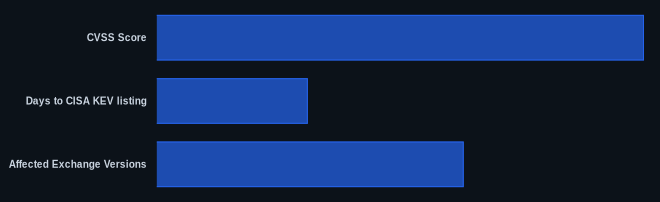
| Metric | Value | Source |
|---|---|---|
| CVE ID | CVE-2026-42897 | NVD |
| CVSS Score | 8.1 | NVD |
| Days to CISA KEV listing | 1 day | Microsoft, CISA |
| Affected Exchange Versions | 3 versions | BleepingComputer |
| Permanent Patch Available | No | SecurityWeek |
The CVEDaily Take
The persistent targeting of on-premises Exchange, culminating in zero-day exploitation like CVE-2026-42897, vividly illustrates the architectural debt many organizations carry. Relying on temporary mitigations while awaiting a full patch underscores a brittle security posture. For many, this incident should be the final push to accelerate migration strategies away from legacy Exchange. What specific OWA features has your team seen break after applying the EEMS/EOMT mitigations?
FAQ
-
Q: Is Exchange Online affected by CVE-2026-42897?
A: No, Microsoft states that Exchange Online is not impacted by this vulnerability, according to BleepingComputer. The zero-day exclusively targets on-premises Exchange Server deployments, so cloud users are safe from this specific threat. -
Q: What are the primary mitigations for this zero-day?
A: Microsoft recommends enabling the Exchange Emergency Mitigation Service (EEMS), which applies a temporary URL rewrite configuration to block known exploit vectors. For air-gapped systems or environments where EEMS is unavailable, the Exchange On-premises Mitigation Tool (EOMT) provides a scripted mitigation, as detailed by SecurityWeek. A permanent security update is still under development. -
Q: What is the impact of successful exploitation of CVE-2026-42897?
A: Successful exploitation allows attackers to execute arbitrary JavaScript within the victim's browser context during an OWA session. This can lead to spoofing, session abuse, theft of browser-accessible data (like session cookies), and potentially the installation of malware or hijacking of the victim's computer with browser-level permissions, per NVD.