
ShinyHunters ransomware has catastrophically disrupted Instructure's Canvas LMS, with login pages defaced and the threat of a massive 3.65 TB data leak by May 12, 2026, impacting millions of students and faculty during critical finals periods.
What Happened
On May 7, 2026, students and faculty at numerous institutions worldwide began reporting defaced Canvas login pages, which displayed a ransom message from the ShinyHunters ransomware group. This message explicitly threatened to release sensitive data if a ransom wasn't paid by the end of May 12, 2026, as reported by BleepingComputer.
Instructure, the operator of Canvas LMS, initially acknowledged a cybersecurity incident involving certain user data like names, email addresses, and student ID numbers, stating they found no evidence of compromised passwords, dates of birth, government identifiers, or financial information. However, despite Instructure's claims of containment and restoration by early May 8, many California campuses, including UCLA, continued to block access due to persistent security concerns, according to The Long Beach Post.
ShinyHunters, a group known for high-profile breaches against Ticketmaster and AT&T, claims responsibility for the attack, asserting they stole approximately 275 million records related to students, teachers, and staff, totaling 3.65 terabytes of data, including private messages. This would make it the largest educational security breach on record as of May 8, 2026.
Why It Matters
This incident has profoundly impacted the education sector, affecting 41% of higher education institutions in the U.S. alone, along with K-12 schools, and approximately 8,809 universities and educational ministries globally. The timing, during final exams, has exacerbated the disruption. Penn State University, which serves roughly 30 million users, saw its students locked out of Canvas accounts, leading to the cancellation of all digital final exams at the Pollock Testing Center.
The university is offering professors the option to provide deferred grades for impacted classes, though graduating students with such grades won't be eligible for their diplomas, a critical blow to academic progression. The affected data includes identifying user information, and ShinyHunters' claim of having private messages between students and teachers raises significant privacy concerns. Institutions like Long Beach Unified, Cal State Long Beach, and Long Beach City College were among those where teachers and students were locked out of grading systems.
Technical Breakdown
The ShinyHunters attack on Canvas LMS demonstrates a sophisticated intrusion likely involving initial access, data exfiltration, and then the deployment of ransomware for impact. While the exact initial vector isn't publicly detailed, the rapid defacement of login pages suggests a compromise of web server infrastructure or content delivery mechanisms after gaining unauthorized access to Instructure's network.
One way to think about this is like a squatter who not only breaks into a large apartment building (the Canvas infrastructure) but then quickly changes all the locks on individual apartment doors (login pages) and posts a public notice on the main entrance (the defaced page) demanding payment to give residents their keys back. Meanwhile, they've also copied personal documents from many of the apartments.
The attack maps to several MITRE ATT&CK techniques. Initial access likely involved T1190 Exploit Public-Facing Application or T1133 External Remote Services if the group compromised an external service used by Instructure. Following initial access, the group probably engaged in T1078 Valid Accounts to gain deeper access within the network. Data exfiltration, as claimed by ShinyHunters, aligns with T1567 Exfiltration Over Web Service or T1041 Exfiltration Over C2 Channel, moving the 3.65 TB of data out of Instructure's control. Finally, the defacement and ransom demands clearly align with T1486 Data Encrypted for Impact and potentially T1490 Inhibit System Recovery by disrupting core services like login pages.
This incident also highlights the critical need for robust controls under NIST SP 800-53, particularly IR-4 Incident Handling and IR-6 Incident Reporting for a swift and transparent response. The disparity between Instructure's initial statement and the ongoing disruption and threat from ShinyHunters points to challenges in these areas. Additionally, SC-7 Boundary Protection and SC-8 Transmission Confidentiality and Integrity are crucial to preventing such large-scale data exfiltration. Tools like CrowdStrike Falcon could provide advanced endpoint detection to identify and mitigate such intrusions early in the kill chain.
Historical Context
This Canvas LMS breach echoes the Blackbaud ransomware attack in May 2020, which affected numerous universities, non-profits, and healthcare organizations globally. In that incident, Blackbaud, a cloud software provider, detected and contained a ransomware attack, paying the ransom to prevent data exposure. Blackbaud, like Instructure, initially downplayed the scope, confirming that only a subset of customers' data was exfiltrated, primarily names, addresses, phone numbers, and donation history.
However, a key difference with ShinyHunters on Canvas is the immediate, public defacement of login pages and the explicit, visible ransom threat, which created instant and widespread operational disruption. Blackbaud's attack was more contained internally before disclosure, focusing on data exfiltration rather than widespread system defacement. Both incidents underscore the systemic risk of third-party cloud providers holding vast amounts of sensitive user data for multiple organizations.
Data at a Glance
| Metric | Value | Source |
|---|---|---|
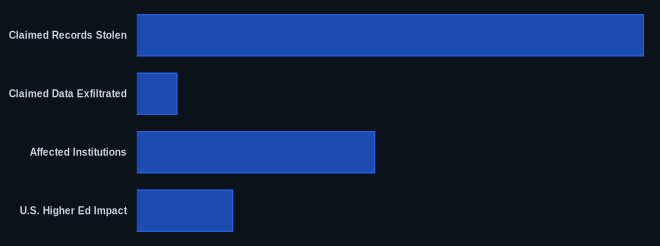
| Claimed Records Stolen | 275 million | BleepingComputer |
| Claimed Data Exfiltrated | 3.65 terabytes | BleepingComputer |
| Ransom Deadline | May 12, 2026 | BleepingComputer |
| Affected Institutions | 8,809 | BleepingComputer |
| U.S. Higher Ed Impact | 41% | The Long Beach Post |
Our Take
We're seeing a clear pattern here: threat actors are going after single points of failure that serve vast ecosystems. Instructure, as a critical SaaS provider for education, became a prime target. The discrepancy between Instructure's initial containment claims and the reality of ongoing access issues and the aggressive ShinyHunters campaign highlights a communication and incident response breakdown that users simply can't afford, especially during high-stakes academic periods. It's a reminder that SaaS providers need more than just recovery; they need transparent, real-time threat intelligence sharing and robust, independently verifiable security controls. Teams using services like Cloudflare Zero Trust for their own network perimeters can limit the impact of compromised external applications by segmenting access, but the core issue remains within the provider's domain.
The CVEDaily Take
This Canvas LMS incident isn't just about data loss; it's a direct assault on academic continuity and trust. The educational sector's reliance on centralized platforms for critical functions makes it a high-value target, and Instructure's initial response appears to have underestimated the threat's scope.
Is your organization's third-party risk assessment mature enough to vet the incident response capabilities of your critical SaaS vendors, or are you just checking the box?
FAQ
Q: What specific data does ShinyHunters claim to have stolen?
A: ShinyHunters claims to have stolen approximately 275 million records totaling 3.65 terabytes of data, including names, email addresses, student ID numbers, and private messages between students and teachers.
Q: Has Instructure confirmed all of ShinyHunters' claims regarding the breach?
A: Instructure initially confirmed a cybersecurity incident involving some user data (names, email addresses, student ID numbers) but stated it found no evidence of compromised passwords, dates of birth, government identifiers, or financial information. They have not publicly confirmed the 275 million record figure or the 3.65 terabyte data volume claimed by ShinyHunters as of May 8, 2026.
Q: How did this attack impact educational institutions during finals?
A: The disruption led to students and faculty at dozens of campuses, including Penn State and UCLA, losing access to coursework and assignments during finals preparations. Penn State specifically canceled all digital final exams at its Pollock Testing Center and is allowing professors to offer deferred grades for impacted classes, with implications for graduating students.
