
ShinyHunters Ransomware Disrupts Canvas LMS for Millions Amid Finals
The Canvas learning management system (LMS), operated by Instructure, experienced a significant data breach and service disruption attributed to the ShinyHunters ransomware group, impacting millions of students and faculty during a critical academic period. The attack, which became widely apparent around May 7-8, 2026, caused widespread chaos during finals week for numerous institutions nationwide.
What Happened
Instructure initially disclosed a hack by a 'criminal threat actor' at the end of April, claiming to have contained the situation after exploiting a vulnerability in its Free-For-Teachers service. However, service disruption and data breach evidence emerged around May 7th and 8th, 2026, directly contradicting the earlier containment claims KrebsonSecurity. ShinyHunters claimed responsibility for the incident, reportedly defacing the Canvas login page with their ransom demand KVUE. The group initially set a ransom deadline of May 6, which was subsequently extended to May 12 Cybernews. Instructure later confirmed that the stolen information included names, email addresses, student ID numbers, and private messages between users. The company stated there was no evidence of passwords, dates of birth, government identifiers, or financial information being compromised SecurityWeek.
The threat actor was reportedly present in Instructure's systems for approximately four days before detection, highlighting the 'considerable fog of war' that often characterizes the initial 24-48 hours of a major cyberattack KrebsonSecurity. Despite the severe disruption, Canvas services were largely restored by May 7th and 8th.
Why It Matters
This incident impacted thousands of schools and universities, including Austin ISD, Texas A&M University, and the University of Houston, disrupting access to critical course materials, assignments, and grades during finals week CBS8. The timing of the attack maximized leverage for ShinyHunters, demonstrating a strategic move to target critical infrastructure during peak operational periods. ShinyHunters claims to have stolen data from 275 million students and faculty across nearly 9,000 educational institutions Cybernews. While Instructure confirmed the breach of names, email addresses, student ID numbers, and private messages, the vast scope of the alleged data exfiltration underscores the potential for widespread identity-related issues and phishing campaigns targeting the educational sector.
Northeastern University officials confirmed on May 9, 2026, that they had not observed compromised university accounts or activity beyond what Instructure publicly shared KrebsonSecurity. This highlights the varied impact across institutions and the ongoing efforts to assess the full extent of the compromise.
Technical Breakdown
The initial breach reportedly exploited a vulnerability in Instructure's Free-For-Teachers service. While the specific CVE isn't public, such an exploit would typically fall under T1190 Exploit Public-Facing Application within the MITRE ATT&CK framework. Initial access via an unpatched web application can then lead to further internal network compromise.
Once inside, threat actors often move laterally to gain a deeper foothold. For instance, the use of stolen credentials to access additional systems or services would align with T1078 Valid Accounts. If the attackers managed to extract credentials, perhaps from system memory, this would map to T1003 OS Credential Dumping. For example, a common technique for credential dumping involves targeting the Local Security Authority Subsystem Service (LSASS) memory, falling under T1003.001 LSASS Memory.
Imagine an unpatched web application as a small, unlocked window in a large, otherwise secure building. An attacker, instead of breaking down the front door (which is likely well-protected), finds this window. They slip in quietly and, once inside, they don't immediately cause a ruckus. Instead, they look for internal maps or keys to other rooms, like user directories or administrative access points. This initial subtle entry via a known flaw, followed by internal reconnaissance and privilege escalation, is a typical chain of events. A robust identity and access management solution, such as 1Password or Bitwarden, coupled with multi-factor authentication, helps mitigate the impact of compromised credentials by protecting subsequent access attempts even if initial credentials are stolen.
The NIST SP 800-53 control SI-2 Flaw Remediation is particularly relevant here. This control mandates that organizations identify, report, and correct information system flaws. Timely patching of vulnerabilities in public-facing applications, like the one in Instructure's Free-For-Teachers service, is critical to prevent such initial access points. Instructure's claim of containment followed by widespread disruption suggests a potential gap in their flaw remediation process or an underestimation of the initial compromise's scope.
Historical Context
This incident echoes the Blackbaud ransomware attack in early 2020, which also targeted the education and non-profit sectors. In that breach, a cloud software provider serving universities, charities, and healthcare organizations, suffered a ransomware attack that led to the exfiltration of customer data. Similar to the Canvas incident, Blackbaud initially claimed to have paid the ransom and secured the data, stating that no personally identifiable information (PII) had been exfiltrated Blackbaud Statement. However, it later confirmed that some unencrypted data, including names, addresses, phone numbers, and donation history, had been accessed.
The key similarity lies in the targeting of a central service provider to a wide range of educational institutions, and the initial, potentially understated, disclosure by the victim company. The difference with ShinyHunters on Canvas LMS is the direct impact on critical academic operations during a peak period, leading to immediate widespread service disruption, whereas Blackbaud's impact was primarily on data privacy with less direct operational disruption for end-users at the time of the breach. The Blackbaud incident also highlighted the challenges of accurate incident response and disclosure in the face of complex cyberattacks.
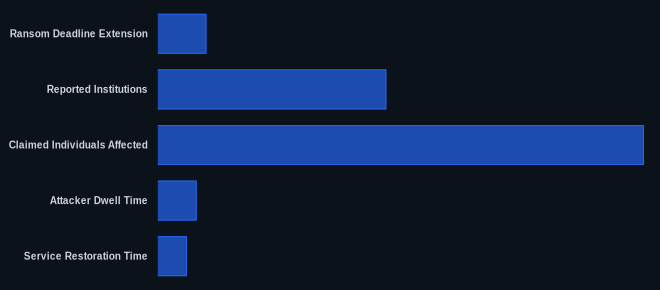
Data at a Glance
| Metric | Value | Source |
|---|---|---|
| Ransom Deadline Extension | 6 days | Cybernews |
| Reported Institutions | 9,000 | Cybernews |
| Claimed Individuals Affected | 275 million | Cybernews |
| Attacker Dwell Time | ~4 days | KrebsonSecurity |
| Service Restoration Time | ~2 days | Houston Chronicle |
Our Take
We're seeing a clear strategic shift where ransomware groups aren't just encrypting data for ransom but leveraging operational disruption as a core component of their extortion model. The ShinyHunters attack on Canvas LMS during finals week is a perfect example of this. Instructure's initial "containment" claim, quickly followed by widespread disruption, highlights the difficulty in truly assessing an attacker's foothold in the early stages, especially when dealing with sophisticated groups. Teams need to assume breach and continuously monitor for anomalous behavior, even post-containment claims. Technologies like CrowdStrike Falcon or SentinelOne for endpoint detection and response could be critical for gaining visibility into persistence and lateral movement, even after an initial entry point is secured.
The CVEDaily Take
The Canvas LMS breach underscores the critical need for robust incident response planning that accounts for extended attacker dwell times and the potential for misjudged containment. Organizations providing critical services, especially to vulnerable populations like students, must prioritize continuous monitoring and transparent communication. Has your team conducted a tabletop exercise simulating a ransomware attack during your peak operational period?
FAQ
Q: What specific information was confirmed to be stolen in the Canvas LMS breach?
A: Instructure confirmed that names, email addresses, student ID numbers, and private messages between users were stolen. They stated there was no evidence of passwords, dates of birth, government identifiers, or financial information being compromised SecurityWeek.
Q: How did the ShinyHunters ransomware group gain initial access to Canvas LMS?
A: Instructure initially disclosed that the attack exploited a vulnerability in its Free-For-Teachers service SecurityWeek. The specific CVE was not publicly detailed, but it suggests a weakness in a publicly accessible web application.
Q: What was the primary impact of the Canvas LMS disruption during finals week?
A: The disruption prevented millions of students from accessing course materials, submitting assignments, and checking grades, causing widespread chaos and academic stress across thousands of educational institutions nationwide KrebsonSecurity.
