
A critical local privilege escalation (LPE) vulnerability, dubbed "Dirty Frag," was publicly disclosed on May 8, 2026, allowing local attackers to achieve root privileges on nearly all major Linux distributions since 2017. This zero-day chains two distinct kernel flaws, CVE-2026-43284 and CVE-2026-43500, expanding on previous bug classes like "Dirty Pipe" by offering highly reliable attack paths that do not depend on race conditions or distribution-specific behaviors.
What Happened
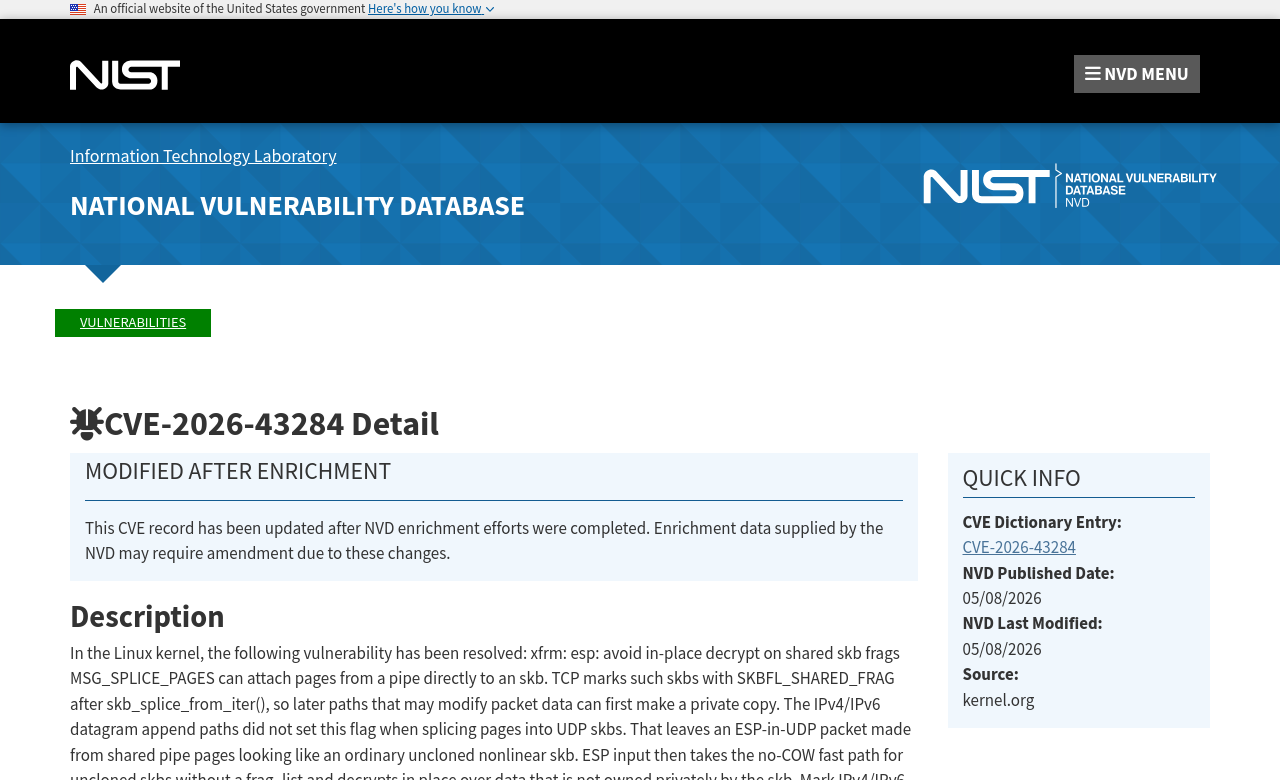
The "Dirty Frag" vulnerability was brought to light on May 8, 2026, by security researcher Hyunwoo Kim, who also published a proof-of-concept (PoC) exploit demonstrating its effectiveness. This LPE is tracked under two distinct CVEs: CVE-2026-43284 for the xfrm-ESP Page-Cache Write vulnerability and CVE-2026-43500 for the RxRPC Page-Cache Write vulnerability. According to Kim, the underlying flaw was introduced approximately nine years ago in the Linux kernel's algif_aead cryptographic algorithm interface, meaning it has persisted in the codebase since around 2017.
Affected systems encompass a broad range of recent Linux systems, including kernel 7.0.4 and all versions released since 2017. Major distributions such as Ubuntu, Red Hat Enterprise Linux, CentOS Stream, AlmaLinux, openSUSE Tumbleweed, and Fedora are all confirmed to be vulnerable. The Linux Kernel Organization released patches to fix CVE-2026-43284 on the same day, May 8, 2026. However, patches for CVE-2026-43500 were not yet widely available at the time of disclosure, as reported by SecurityWeek. Microsoft Defender is actively monitoring for limited in-the-wild activity and provides detection coverage for attempts to exploit Dirty Frag; Microsoft has not released details on the scope or nature of this activity as of publication.
Why It Matters
Dirty Frag poses a significant risk due to its confirmed reliability and broad impact. An unprivileged local attacker can exploit this vulnerability to gain root privileges, which means full control over the compromised system. This level of access allows an attacker to manipulate protected system files in memory without authorization, potentially leading to complete data exposure, system manipulation, or further lateral movement within an environment.
Exploitation can occur after initial compromise, following various common methods such as SSH access, web shell deployment, container breakouts, or through compromised low-privileged accounts. The fact that the exploit is deterministic — meaning it does not rely on race conditions, kernel address leaks, or specific distribution quirks — makes it particularly dangerous. This eliminates many common hurdles for attackers, ensuring a high success rate upon execution.
CISA has previously highlighted local privilege escalation vulnerabilities as a "frequent attack vector for malicious cyber actors" that poses "significant risks to the federal enterprise." Their guidance advises organizations to "Apply mitigations per vendor instructions, follow applicable BOD 22-01 guidance for cloud services, or discontinue use of the product if mitigations are unavailable." This underscores the confirmed severity of LPEs and the immediate need for patching, especially for vulnerabilities like Dirty Frag that offer such reliable routes to root.
Technical Breakdown
The Dirty Frag vulnerability originates from a logic flaw within the Linux kernel's networking and memory-fragment handling components, specifically within the esp4, esp6, and rxrpc modules. These modules are responsible for managing Encapsulating Security Payload (ESP) for IPv4 and IPv6, and the RxRPC network protocol, respectively. The flaw allows an authenticated, unprivileged user to manipulate Linux page cache behavior in a way that bypasses memory protection mechanisms.
The kernel mistakenly grants write access to arbitrary, protected memory regions that an unprivileged process should not be able to modify. Unlike many LPEs that depend on unpredictable timing windows, Dirty Frag leverages a fundamental logical error. This consistently reproducible flaw in the access logic enables an attacker to directly modify critical system files, such as /etc/shadow or /etc/passwd, in the kernel's memory page cache. Once these in-memory files are altered—for instance, by adding a new root user or changing an existing user's password hash—the system's authentication mechanisms reflect these changes, granting the attacker root privileges.
This attack maps directly to T1068 Exploitation for Privilege Escalation within the MITRE ATT&CK framework. For detection, security teams should look for anomalous process execution by low-privileged users, especially any that attempt to modify kernel memory or critical system files. Endpoint detection and response (EDR) solutions like CrowdStrike Falcon or SentinelOne can offer deep kernel visibility to flag suspicious activity that deviates from normal user behavior or legitimate system calls. Addressing this vulnerability also aligns with NIST SP 800-53 control SI-2 Flaw Remediation, emphasizing the importance of timely patching and vulnerability management.
Historical Context
Dirty Frag shares striking similarities with the recently disclosed "Copy Fail" vulnerability (CVE-2026-31431) and the more widely known "Dirty Pipe" (CVE-2022-0778), both of which are Linux kernel local privilege escalations. Dirty Pipe, discovered in 2022, allowed local users to overwrite arbitrary read-only files in the page cache, leading to root access by modifying SUID binaries or /etc/passwd. It was a significant bug, impacting Linux kernels since version 5.8.
The key difference with Dirty Frag, as highlighted by Hyunwoo Kim to BleepingComputer, is its deterministic nature. Kim stated, "Dirty Frag is a case that extends the bug class to which Dirty Pipe and Copy Fail belong. Because it is a deterministic logic bug that does not depend on a timing window, no race condition is required, the kernel does not panic when the exploit fails, and the success rate is very high." While Dirty Pipe also involved page cache manipulation, its exploitation sometimes relied on specific timing or race conditions to ensure file corruption and privilege escalation. Dirty Frag, like Copy Fail, solidifies the attack path, making exploitation more reliable and less prone to failure. Copy Fail also impacted nearly all Linux distributions since 2017 and was notably discovered by Theori's AI system, Xint Code. Dirty Frag, however, introduces additional attack paths for expanded exploitation opportunities and improved reliability beyond what Copy Fail offered.
Data at a Glance
| Metric | Value | Source |
|---|---|---|
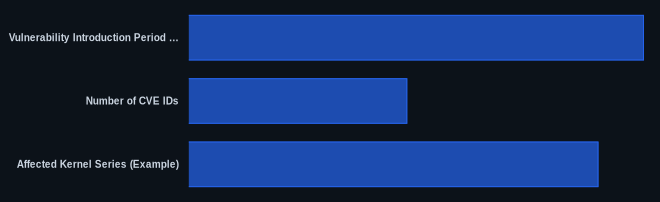
| Vulnerability Introduction Period (approx.) | 9 years ago | BleepingComputer |
| Number of CVE IDs | 2 | NVD (CVE-2026-43284), NVD (CVE-2026-43500) |
| Patch Release for CVE-2026-43284 (days from disclosure) | 0 days | SecurityWeek |
| Affected Kernel Series (Example) | 7.0.4+ | BleepingComputer |
| Exploit Reliability | Deterministic Logic Flaw | BleepingComputer |
Our Take
We view Dirty Frag as further evidence of how deeply ingrained memory and networking component flaws can be within the Linux kernel, highlighting the challenges of eliminating entire classes of vulnerabilities. The shift from race-condition-dependent exploits to deterministic logic bugs like this and Copy Fail suggests a growing sophistication in vulnerability research and exploitation techniques, moving beyond timing windows towards guaranteed privilege escalation paths. This evolution means that traditional defenses that rely on the unpredictability of race conditions are becoming less effective, pushing security teams to rethink their approach to LPE detection and prevention.
The CVEDaily Take
Dirty Frag proves that even widely audited codebases can harbor insidious flaws for nearly a decade. The Linux Kernel Organization's rapid patch for CVE-2026-43284 is commendable, but the lack of a widely available patch for CVE-2026-43500 at disclosure creates a critical window of vulnerability that attackers are likely to exploit. We expect to see more attacks leveraging this unpatched component, particularly against systems that do not employ advanced EDR or strict user privilege separation. Given this new threat, what specific compensating controls are you implementing to detect and prevent deterministic kernel LPEs, especially on unpatched systems?
FAQ
Q: What is Dirty Frag?
A: Dirty Frag is a critical local privilege escalation (LPE) vulnerability affecting the Linux kernel, publicly disclosed on May 8, 2026. It leverages two chained kernel flaws (CVE-2026-43284 and CVE-2026-43500) to allow an unprivileged local user to gain root access on a vulnerable system with a deterministic, reliable exploit.
Q: What Linux distributions are affected by Dirty Frag?
A: Nearly all major Linux distributions released since 2017 are confirmed to be affected, including Ubuntu, Red Hat Enterprise Linux, CentOS Stream, AlmaLinux, openSUSE Tumbleweed, and Fedora. Specifically, Linux kernel versions like 7.0.4 and all versions since approximately 2017 contain the vulnerability.
Q: How does Dirty Frag compare to Dirty Pipe or Copy Fail?
A: Dirty Frag is similar to Dirty Pipe (CVE-2022-0778) and Copy Fail (CVE-2026-31431) in that they are all Linux kernel local privilege escalations involving memory page cache manipulation. However, Dirty Frag's key distinction, like Copy Fail, is its deterministic nature; it exploits a logic flaw that does not rely on race conditions or timing windows, making it significantly more reliable and less prone to exploit failure than Dirty Pipe. Dirty Frag also introduces new, expanded attack paths compared to its predecessors.
