
A breach of Instructure's Canvas Learning Management System (LMS) by the ShinyHunters cybercrime group exposed data from potentially 8,809 educational institutions, according to claims by the attackers and reporting by BleepingComputer. This incident led to extensive data theft and an aggressive extortion campaign that crippled educational services for millions.
What Happened
Instructure, the company behind Canvas LMS, detected unauthorized activity on its systems starting April 29, 2026, with a second wave of compromise on May 7, 2026. News of the incident began circulating around May 1, 2026, as ShinyHunters publicly claimed responsibility, updating their claims throughout May. Canvas was temporarily taken offline following the May 7 activity, causing significant disruption. By May 8, 2026, the platform was largely back online. Instructure later announced an "agreement" with ShinyHunters on May 11, 2026, a move that sparked considerable debate among cybersecurity experts. This agreement reportedly included the return and digital destruction of the stolen data, alongside assurances that the threat group would not individually extort affected Canvas users. Instructure has not publicly disclosed the ransom amount paid.
Why It Matters
The ShinyHunters breach of Canvas LMS potentially impacts 8,809 educational institutions globally, from K-12 schools to universities and teaching hospitals, according to ShinyHunters' claims reported by BleepingComputer. The group claims to have stolen data from approximately 275 million users, encompassing usernames, email addresses, student ID numbers, course names, enrollment information, and private messages between Canvas users, as detailed by SecurityWeek. Instructure confirmed unauthorized access and data exposure but did not publicly verify the exact figures ShinyHunters published. The incident caused widespread disruptions for students and teachers, particularly during critical final exam periods, forcing some institutions to offer grace periods. While Instructure stated there was no evidence of compromise for passwords, dates of birth, government identifiers, or financial information, incidental Personally Identifiable Information (PII) could be present in private messages.
Technical Breakdown
Attackers exploited an issue tied to Instructure's "Free-For-Teacher" accounts. These accounts notably lacked multi-factor authentication (MFA) and institutional verification, creating weaker trust boundaries within the shared underlying infrastructure that supports the Canvas platform. This allowed initial access to the Canvas platform without the robust controls applied to other account types.
The attack chain involved initial exploitation of this vulnerability, granting unauthorized access (MITRE ATT&CK T1078 Valid Accounts). Once inside, the group engaged in data exfiltration (MITRE ATT&CK T1567 Exfiltration Over Web Service), moving vast amounts of sensitive educational data out of Instructure's systems. Following the data theft, ShinyHunters defaced Canvas login pages with ransom demands as reported by Dark Reading. This breach demonstrates critical shortcomings in account management (NIST SP 800-53 AC-2 Account Management) and authentication protocols (NIST SP 800-53 IA-2 Identification and Authentication (Organizational Users), IA-5 Authenticator Management). The lack of MFA on these accounts made them a prime target. Deploy strong MFA solutions, such as hardware keys like YubiKey, across all account types, including free tiers.
Historical Context
ShinyHunters, a prolific cybercrime group active since 2019, specializes in data breaches, extortion, and data sales on dark web forums. This isn't their first high-profile target. In 2024, the group claimed responsibility for the Ticketmaster breach, affecting 560 million customers globally and reportedly demanding a $500,000 ransom, as widely covered by ZDNet. They also targeted Salesforce instances in mid-2025.
The Canvas LMS breach shares similarities with the Ticketmaster incident in its scale and the group's signature tactic of public extortion and data exfiltration. Both involved massive datasets and significant disruption. However, the Canvas breach highlights a specific vulnerability in "free" account tiers, whereas the Ticketmaster breach's initial access vector was less explicitly detailed, though ShinyHunters uses cloud misconfigurations, OAuth token theft, and advanced social engineering. Instructure's decision to reach an "agreement" with the group is also reminiscent of controversial payments made in other high-profile ransomware and extortion incidents, aiming to mitigate further damage.
Data at a Glance
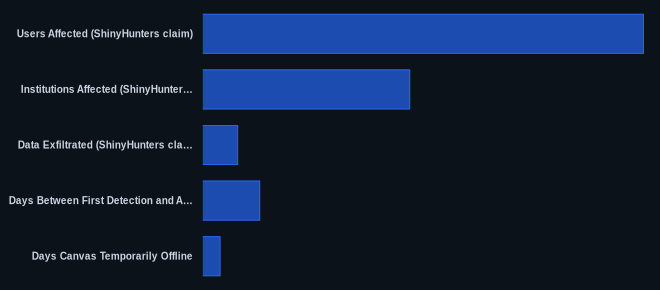
| Metric | Value | Source |
|---|---|---|
| Users Affected (ShinyHunters claim) | 275 million | BleepingComputer |
| Institutions Affected (ShinyHunters claim) | 8,809 | SecurityWeek |
| Data Exfiltrated (ShinyHunters claim) | 3.65 terabytes | Hackerexe |
| Days Between First Detection and Agreement | 12 days | Instructure |
| Days Canvas Temporarily Offline | 1 day | Instructure |
The CVEDaily Take
This breach demonstrates that shared infrastructure, even for "free" tiers, demands uniform security standards. Relying on implicit trust when authentication mechanisms are weak is a catastrophic design flaw; the "Free-For-Teacher" accounts, lacking fundamental security controls like MFA, punched a hole in Instructure's security posture. We believe paying a ransom, even under the guise of an "agreement," sets a dangerous precedent, potentially emboldening groups like ShinyHunters and making the education sector an even more attractive target. While the immediate goal of data destruction and non-extortion might have been achieved, the long-term implications for the cybersecurity ecosystem are concerning.
Has your team audited all free or unmanaged accounts within your shared service infrastructure for MFA enforcement?
FAQ
Q1: What was the primary vulnerability exploited by ShinyHunters in the Canvas LMS breach?
A1: The primary vulnerability stemmed from Instructure's "Free-For-Teacher" accounts lacking multi-factor authentication (MFA) and institutional verification, creating weak trust boundaries that allowed unauthorized access to the Canvas platform.
Q2: What specific data types were confirmed to be exposed in the Canvas LMS breach?
A2: Instructure confirmed exposure of usernames, email addresses, student ID numbers, course names, enrollment information, and private messages between Canvas users. No evidence of compromise for passwords, dates of birth, government identifiers, or financial information was found.
Q3: Is it recommended for organizations to pay ransoms or enter "agreements" with cybercrime groups like ShinyHunters?
A3: Cybersecurity experts and law enforcement agencies generally advise against paying ransoms, as it often fuels further attacks and does not guarantee data recovery or prevention of future leaks. Instructure's "agreement" with ShinyHunters, despite its stated goal of data destruction and non-extortion, remains a controversial decision.
