
Instructure paid an undisclosed ransom after the ShinyHunters group breached its Canvas Learning Management System, impacting academic operations during final exams and affecting millions of students and faculty. The attack, detected on April 29, 2026, involved two phases: an initial compromise and a re-breach after Instructure claimed resolution.
What Happened
On April 25, 2026, ShinyHunters gained initial access to Canvas systems, reportedly by exploiting an issue related to Canvas’s “Free-For-Teacher” accounts, as BleepingComputer reported. Instructure detected the intrusion on April 29, 2026, revoked access, and engaged third-party cybersecurity forensics experts, SecurityWeek confirmed. The company publicly disclosed the incident on May 1, 2026.
Instructure stated the situation was "resolved" by May 6, 2026. However, ShinyHunters re-breached Canvas systems on May 7, 2026, replacing the login page with a ransomware message, The Hacker News reported. The group claimed responsibility for exfiltrating 3.65 terabytes of student data and threatened its release by May 12, 2026, if a ransom was not paid. Instructure reached an agreement with ShinyHunters on May 11, 2026, paying an undisclosed ransom amount to prevent the data leak. The deadline passed without the data being leaked, and Instructure stated it received "shred logs" as digital confirmation of data destruction, as BleepingComputer reported; no independent verification of data destruction is available.
Why It Matters
ShinyHunters’ breach of Canvas LMS directly impacted global education infrastructure. Canvas supports nearly 9,000 institutions worldwide, including UC Berkeley and the National University of Singapore, as InfoSecurity Magazine reported. Compromising a single SaaS provider led to widespread disruption and exposure. Millions of students and faculty experienced service disruptions during final exams, causing immediate stress and academic setbacks, TechTarget confirmed. This impact is critical.
ShinyHunters claimed to have exfiltrated sensitive information for 275 million users, including student ID numbers, email addresses, names, and messages exchanged on the platform, The Hacker News reported. Instructure stated there was no evidence of compromise for passwords, dates of birth, government identification, or financial information. The FBI's Public Service Announcement on May 15, 2026, further highlighted the severity, warning of ShinyHunters' use of harassment tactics, including threatening texts, phone calls, and even swatting against victims and their families, BleepingComputer noted. This incident goes beyond data theft to psychological warfare.
Technical Breakdown
The initial compromise vector for the ShinyHunters attack on Canvas LMS was reportedly an issue related to the platform’s "Free-For-Teacher" accounts. No specific CVE IDs were disclosed for this vulnerability. This indicates exploitation of a vulnerability or misconfiguration in how these accounts were handled or provisioned. This initial compromise is consistent with T1190 Exploit Public-Facing Application in the MITRE ATT&CK framework, where threat actors exploit vulnerabilities in internet-accessible software.
Once inside, ShinyHunters performed extensive data exfiltration, reportedly taking 3.65 terabytes of information. Given Canvas is a web-based service, this exfiltration likely occurred over standard web protocols, aligning with T1567 Exfiltration Over Web Service, where data is moved out of a compromised network through existing web service channels. The re-breach, after Instructure's initial remediation efforts, suggests a persistent access mechanism or a failure to fully close the initial access vector. Protecting such vital web services requires stringent access controls, like those offered by Cloudflare Zero Trust, to enforce granular access policies regardless of user location or device, reducing the attack surface.
From a compliance perspective, the incident highlights critical shortcomings in AC-3 Access Enforcement under NIST SP 800-53. This control mandates that systems enforce authorized access to information system resources. A flaw related to "Free-For-Teacher" accounts suggests either improper enforcement of least privilege, allowing an initial foothold, or a configuration oversight that granted excessive permissions. Rigorous implementation of AC-3, alongside continuous monitoring and auditing, prevents similar initial access vectors.
Historical Context
ShinyHunters has been a persistent and high-impact threat actor since 2020, specializing in large-scale data breaches and extortion. Their attack on Canvas LMS echoes the widespread impact seen in their 2024 Snowflake supply chain campaign, which reportedly compromised around 165 organizations, as BleepingComputer reported.
Both incidents demonstrate ShinyHunters' strategy of targeting a single, critical service provider to achieve massive downstream impact. In the Snowflake case, they targeted a cloud data warehousing provider; with Canvas LMS, it's a leading educational SaaS platform. The common thread is exploiting the trust and interconnectedness within a supply chain. The Canvas LMS breach also involved direct user interaction and a re-breach after the provider claimed resolution, highlighting a potentially less robust initial incident response compared to other incidents. They've also targeted organizations like Ticketmaster (2024) and the European Commission (March 2026), consistently demonstrating their capability to exfiltrate massive datasets and leverage them for extortion.
Data at a Glance
| Metric | Value | Source |
|---|---|---|
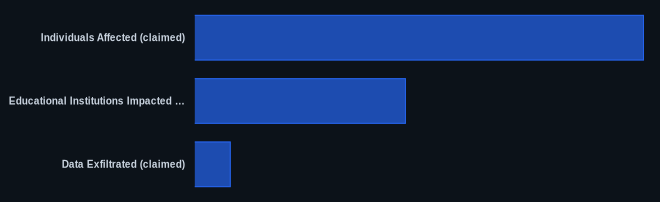
| Individuals Affected (claimed) | 275 million | The Hacker News |
| Educational Institutions Impacted (claimed) | 9,000 | BleepingComputer |
| Data Exfiltrated (claimed) | 3.65 terabytes | SecurityWeek |
| Threat Actor | ShinyHunters | BleepingComputer |
| Ransom Payment Confirmed | Yes | SecurityWeek |
The CVEDaily Take
Instructure's decision to pay the ransom, despite claiming initial containment, highlights the immense pressure and the critical nature of the data involved. This move, while preventing an immediate data leak, emboldens threat actors and normalizes the ransom payment cycle. We think Instructure's "shred logs" claim is unsubstantiated; no external party has confirmed the data was destroyed, meaning the risk of a future leak remains. How are you auditing the continuous security posture and incident response capabilities of your critical third-party SaaS providers beyond their initial security questionnaires?
FAQ
Q: What specific data was exposed in the Canvas LMS breach?
A: ShinyHunters claimed to have exfiltrated student ID numbers, email addresses, names, and messages exchanged within the Canvas platform. Instructure stated there was no evidence of compromise for passwords, dates of birth, government identification, or financial information, according to The Hacker News.
Q: Was a CVE ID issued for the vulnerability exploited in the Canvas LMS breach?
A: No specific CVE ID has been publicly mentioned in relation to the "Free-For-Teacher" account issue that reportedly led to the initial access. This suggests it might have been a misconfiguration, an internal flaw, or an exploit that Instructure chose not to detail with a CVE, as BleepingComputer reported.
Q: What are the implications of Instructure paying the ransom to ShinyHunters?
A: Paying the ransom prevented the immediate public leak of 3.65 terabytes of data and the associated harassment campaign threatened by ShinyHunters. However, it implicitly reinforces the economic model for cyber extortionists and offers no guarantee that the data won't resurface later or that the group won't target Instructure again, SecurityWeek noted.
