
On May 8, 2026, Ivanti released security updates for its Endpoint Manager Mobile (EPMM) product to address five vulnerabilities, including a high-severity zero-day, CVE-2026-6973, which Ivanti confirms has been actively exploited in targeted attacks. This response addresses ongoing, sophisticated activity aimed at compromising mobile device management (MDM) infrastructure.
What Happened
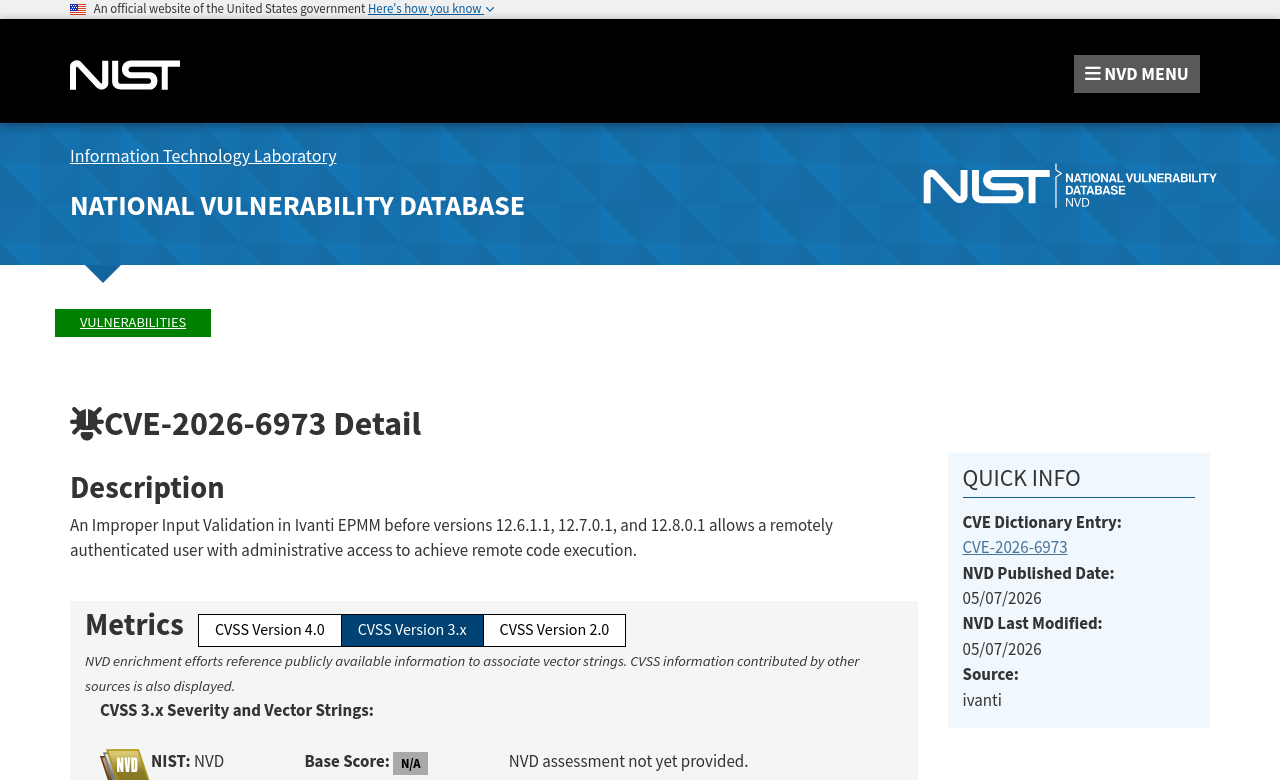
Ivanti released a series of security updates for its Endpoint Manager Mobile (EPMM) product on May 8, 2026, addressing five vulnerabilities in versions 12.8.0.0 and earlier. The most critical of these is CVE-2026-6973, a high-severity zero-day with a CVSS score of 7.2. This vulnerability, described as an improper input validation issue, allows for remote code execution (RCE) for authenticated administrative users.
Before the patches were publicly available, attackers actively exploited CVE-2026-6973 in a "very limited number of targeted attacks," Ivanti confirmed. In response, CISA swiftly added CVE-2026-6973 to its Known Exploited Vulnerabilities (KEV) catalog, mandating that all US federal agencies apply the fixes by May 10, 2026.
The patch release also included fixes for four other high-severity EPMM vulnerabilities:
- CVE-2026-5786 (CVSS 8.8): An improper access control flaw allowing a remote authenticated attacker to gain administrative access.
- CVE-2026-5787 (CVSS 8.9): An improper certificate validation issue enabling a remote unauthenticated attacker to impersonate registered Sentry hosts and obtain valid CA-signed client certificates.
- CVE-2026-5788 (CVSS 7.0): Another improper access control vulnerability allowing a remote unauthenticated attacker to invoke arbitrary methods.
- CVE-2026-7821 (CVSS 7.4): Improper certificate validation that permits a remote unauthenticated attacker to enroll a device, leading to information disclosure and impacting device identity integrity.
Why It Matters
Successful exploitation of Ivanti EPMM can lead to an attacker gaining complete control of the targeted Mobile Device Management (MDM) infrastructure. This potentially grants adversaries access to the management plane for every mobile device connected to the MDM.
Affected organizations include any running Ivanti Endpoint Manager Mobile (EPMM) versions 12.8.0.0 and earlier. Federal agencies in the US are among those potentially impacted, hence CISA's swift directive. Shadowserver tracks over 850 IP addresses with Ivanti EPMM fingerprints exposed online, with 508 in Europe and 182 in North America, as SecurityWeek reported.
SecurityWeek also highlighted that Chinese threat actors are frequently suspected behind zero-day attacks targeting Ivanti products. NHS England National CSOC assesses that further exploitation of CVE-2026-6973 is highly likely. If your organization rotated credentials after being exploited by earlier Ivanti vulnerabilities, your risk from CVE-2026-6973 is significantly reduced.
Technical Breakdown
CVE-2026-6973 stems from an improper input validation flaw. This vulnerability requires authenticated administrative access for successful exploitation. This detail strongly suggests that CVE-2026-6973 is likely being chained with other vulnerabilities or used after an initial compromise to gain administrative credentials. Caitlin Condon, VP of Security Research at VulnCheck, corroborated this, noting that such a requirement indicates it's likely part of a larger attack chain, as CyberScoop reported.
This zero-day isn't a flaw in a building's perimeter security that lets an unauthenticated attacker walk right in. Instead, it's like a defect in a specific, high-privilege safe inside that server room, one that only someone who already has a key to the server room itself can exploit to unlock the safe's contents without the combination. Attackers still need that initial key – the administrative credentials.
The MITRE ATT&CK framework categorizes the use of existing credentials as T1078 Valid Accounts. Attackers using CVE-2026-6973 would first need to acquire legitimate administrative credentials, perhaps through phishing, credential stuffing against exposed services, or exploiting another initial access vulnerability. From a compliance standpoint, the vulnerability type aligns directly with NIST SP 800-53 control SI-10 Information Input Validation, which emphasizes verifying input to prevent malicious data from compromising systems.
Ivanti has not yet shared specific atomic indicators of compromise (IoCs) related to the CVE-2026-6973 exploitation, making proactive hunting harder. Patch immediately. For securing administrative credentials to systems like EPMM, use strong password policies enforced by tools like 1Password or Bitwarden, alongside mandating FIDO2-compliant multi-factor authentication solutions like YubiKey to reduce the risk of credential theft.
Historical Context
This wave of Ivanti EPMM vulnerabilities and subsequent exploitation is a recurring pattern. In January 2026, Ivanti disclosed two other critical code-injection vulnerabilities, CVE-2026-1281 and CVE-2026-1340, also affecting EPMM, which were actively exploited as zero-days.
The fallout from these earlier vulnerabilities was substantial, impacting nearly 100 organizations, according to CyberScoop, including sensitive government entities like the Netherlands' Dutch Data Protection Authority and the Council for the Judiciary. Much like the current situation, exploitation of those vulnerabilities surged after public disclosure, making the window for patching critically short. This history of high-value targets and rapid exploitation after disclosure should put every Ivanti EPMM admin on high alert.
Data at a Glance
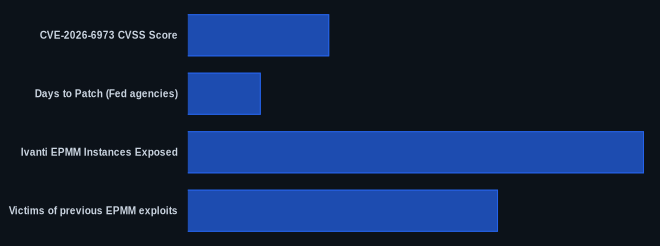
| Metric | Value | Source |
|---|---|---|
| CVE-2026-6973 CVSS Score | 7.2 | NVD |
| Patches Released | May 8, 2026 | Ivanti |
| CISA Mandate Deadline | May 10, 2026 | CISA KEV |
| Days to Patch (Fed agencies) | 2 days | CISA KEV |
| Ivanti EPMM Instances Exposed | 850+ | SecurityWeek (reporting Shadowserver data) |
| Victims of previous EPMM exploits | ~100 organizations | CyberScoop |
Our Take
The persistence of exploitation against Ivanti EPMM is concerning, especially the quick turnaround from patch release to CISA mandate. We're seeing a clear pattern of sophisticated adversaries, likely state-sponsored, prioritizing MDM infrastructure. The need for authenticated admin access for CVE-2026-6973 highlights that initial access vectors are likely being chained or credentials pre-stolen. This isn't just about patching; it's about a comprehensive strategy for endpoint security and credential hygiene, potentially using CrowdStrike Falcon or SentinelOne for enhanced endpoint detection and response capabilities, and even Cloudflare Zero Trust for securing access to admin interfaces.
The CVEDaily Take
Ivanti EPMM has become a perennial target. The combination of a high-value asset (MDM) and recurring vulnerabilities exploited as zero-days makes it a top-tier risk. We believe organizations running EPMM need to treat these systems as high-privilege jump boxes; monitor them constantly for anomalous behavior, especially around administrative accounts, and assume compromise until proven otherwise. Ivanti's consistent lack of granular IoCs also makes us question whether their incident response process provides enough actionable intelligence for customers to defend themselves proactively.
What specific anomaly detection rules have you implemented for administrative access to your Ivanti EPMM instances since the January 2026 exploits?
FAQ
-
What is CVE-2026-6973?
CVE-2026-6973 is a high-severity (CVSS 7.2) improper input validation vulnerability in Ivanti EPMM that allows remote code execution for authenticated administrative users. It's an actively exploited zero-day, meaning Ivanti confirmed attacks were observed before a patch was available. -
Which Ivanti EPMM versions are affected by these new vulnerabilities?
All Ivanti EPMM versions 12.8.0.0 and earlier are affected by CVE-2026-6973 and the other four patched vulnerabilities. Organizations should update to the latest available patched versions immediately to mitigate risk. -
What is the primary concern for organizations if their Ivanti EPMM instance is exploited?
Successful exploitation of Ivanti EPMM grants attackers complete control over the organization's Mobile Device Management (MDM) infrastructure. This allows for potential control over the management plane of every mobile device connected to the MDM, enabling broad lateral movement, data exfiltration, or further compromise of the internal network.