ShinyHunters claims to have exfiltrated data from Instructure's Canvas Learning Management System (LMS), impacting an alleged 275 million students and faculty across potentially 9,000 global educational institutions. This coordinated data extortion attack, which reportedly exploited a social engineering vector, significantly disrupted academic operations. The incident highlights the growing sophistication of data extortion against SaaS platforms and reignites discussions around third-party risk management and data sovereignty in cloud environments.
What Happened
Instructure detected unauthorized activity within its Canvas LMS platform on April 29, 2026, followed by additional suspicious page changes on May 7, 2026. Reports of a breach began circulating as early as May 8, 2026, according to BleepingComputer. The situation escalated dramatically on May 9, 2026, when the cybercrime group ShinyHunters launched a public data extortion campaign. They defaced Canvas login pages with a ransom demand and a deadline of May 12, 2026, threatening to release the allegedly stolen data if payment wasn't made, as reported by SecurityWeek. Instructure has not confirmed the nature or extent of the defacement.
In response, Instructure took the Canvas LMS platform offline for an unspecified period and proactively shut down Free-For-Teacher accounts to contain any potential further compromise. This swift action caused significant disruption across numerous academic institutions reliant on Canvas for their daily operations.
Why It Matters
The alleged Canvas LMS breach is a high-impact event due to the sheer volume of potentially affected individuals and the critical nature of the compromised platform. ShinyHunters claims to have stolen data from 275 million students and faculty, a figure cited by SecurityWeek and The Hacker News. Other reports, including BleepingComputer and Dark Reading, mention 231 million individuals across 9,000 schools. These figures are currently claims by the threat actor; Instructure has not publicly confirmed the scope of the exfiltration as of publication.
Affected institutions reportedly include major universities such as the University of Illinois Urbana-Champaign, University of Houston, University of Minnesota, University of Toronto, Duke University, and Liberty University, as detailed by BleepingComputer. The University of Illinois Urbana-Champaign, for instance, had to postpone final exams and assignments, directly affecting student academic progress.
ShinyHunters claims the data types exposed include names, personal email addresses, student identification information, and private teacher-student communications. Beyond academic data, there are significant concerns about corporate credentials if users registered with work email addresses and passwords, potentially creating downstream risks for other organizational systems; Instructure has not confirmed these data types were exposed.
Technical Breakdown
ShinyHunters used a data extortion campaign focused purely on data exfiltration, rather than system encryption, which is a common tactic for this group. The defacement of Canvas login pages indicates the attackers achieved significant access to Instructure's web infrastructure, suggesting more than a simple data dump.
Dark Reading reported a potential social engineering scheme as a key vector. Attackers allegedly manipulated an Instructure employee to obtain credentials for a CRM system, such as Salesforce. Gaining access to a CRM system, especially for a large SaaS provider, could offer a pivot point into other internal systems or provide administrative access to the primary product itself. Instructure has not confirmed this specific attack vector.
To understand the attack: Instead of picking the locks on a school's main server room door, the attackers convinced an authorized IT staff member to hand over the master key, believing they were an internal auditor. Once inside the IT office (the CRM system), they could then access the school's digital archives (the LMS data) and copy files directly. The defacement of the login page is akin to leaving a ransom note prominently displayed on the school's front gate after making off with the sensitive records.
This initial access aligns with MITRE ATT&CK T1566 Spearphishing (specifically, potentially T1566.004 Spearphishing Voice or T1566.002 Spearphishing Link if email-based) to acquire an employee's credentials. Once obtained, the threat actors would have used T1078 Valid Accounts to gain unauthorized access to internal systems. The subsequent large-scale data exfiltration from the LMS likely involved T1567 Exfiltration Over Web Service, leveraging the platform's native capabilities or compromised administrative tools.
From a defensive perspective, this incident highlights a gap in NIST SP 800-53 IA-2 Identification and Authentication (Organizational Users), particularly regarding the robustness of authentication mechanisms for critical internal systems and the susceptibility of employees to social engineering. Mandating FIDO2-compliant security keys such as YubiKey for all internal and administrative accounts could significantly raise the bar against such credential theft attempts.
Historical Context
ShinyHunters has a long and notorious history of data breaches and extortion campaigns. In May 2026, around the same time as the Canvas LMS incident, the group was also linked to claims of data breaches affecting Amtrak, as well as educational institutions like the University of Minnesota, University of Toronto, Duke University, and Liberty University, according to BleepingComputer. These other university claims might be related or entirely separate from the Canvas LMS breach, and Amtrak has not confirmed a breach by ShinyHunters.
Their typical modus operandi involves exfiltrating large volumes of data, followed by public ransom demands, often accompanied by threats to release the data on dark web forums if payment isn't made. This aligns perfectly with the Canvas LMS incident: data exfiltration, a clear ransom demand, and a public threat of data release. The key difference here is the target: a widely used LMS serving a global academic community, which elevates the potential for disruption and the sensitivity of the data, as opposed to a general corporate or government entity.
Data at a Glance
| Metric | Value | Source |
|---|---|---|
| Individuals Affected (Claimed) | 231-275 million | SecurityWeek, The Hacker News, BleepingComputer, Dark Reading |
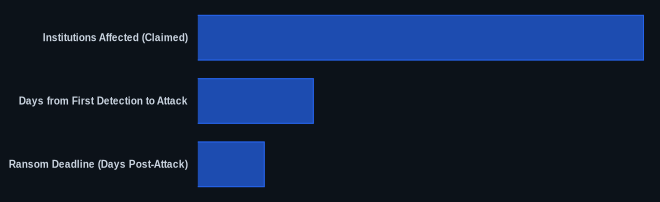
| Institutions Affected (Claimed) | 9,000 | BleepingComputer |
| Days from First Detection to Attack | 10 days | BleepingComputer |
| Ransom Deadline (Days Post-Attack) | 3 days | SecurityWeek |
| Attack Type | Data Exfiltration & Extortion | BleepingComputer |
| Alleged Data Exposed | Names, Emails, Student IDs, Communications | SecurityWeek |
| Attribution | ShinyHunters | BleepingComputer |
The CVEDaily Take
This Canvas LMS incident suggests that an external attack surface management program is only as strong as internal defenses against social engineering. If ShinyHunters successfully pivoted from a manipulated employee's CRM credentials to administrative access within a critical LMS, it exposes a critical flaw in Instructure's third-party risk management beyond purely technical audits. We find the scale of the claimed exfiltration – 275 million records – highly suspicious given that Instructure has not confirmed any specific breach size. It suggests a potential overstatement by ShinyHunters to increase pressure for a ransom payment. The expert commentary regarding "geopatriation" — pulling cloud services back to trusted national infrastructures — is a sentiment we're hearing more frequently, underscoring the intense scrutiny SaaS providers like Instructure now face regarding their third-party risk posture and data handling in a globally distributed cloud.
Has your team assessed potential lateral movement vectors between your CRM, HR, and core business applications, especially for your cloud service providers?
FAQ
Q1: What data did ShinyHunters claim to steal from Canvas LMS?
A1: ShinyHunters claims to have stolen names, personal email addresses, student identification information, and private teacher-student communications from the Canvas LMS platform. There are also concerns about corporate credentials if users registered with work email addresses. Instructure has not confirmed these claims.
Q2: What was the reported initial access vector for the Canvas LMS breach?
A2: A potential social engineering scheme was reported as the initial access vector. Threat actors allegedly manipulated an Instructure employee to obtain credentials for an internal CRM system (e.g., Salesforce), which could have then provided deeper access to the Canvas LMS. Instructure has not confirmed this attack vector.
Q3: What immediate actions should affected users take following the Canvas LMS breach claims?
A3: Although Instructure has not confirmed the full scope, users should immediately change passwords for their Canvas accounts and any other online services where they might have reused the same credentials. Additionally, users should enable multi-factor authentication (MFA) on all critical accounts and monitor for any suspicious activity or phishing attempts targeting their personal information.