West Pharmaceutical Services confirmed a ransomware attack on May 4, 2026, leading to significant disruption across its global manufacturing and shipping operations. Separately, the Nitrogen ransomware group claimed to have targeted Foxconn's North American factories and alleged the exfiltration of 8TB of sensitive intellectual property. This dual targeting of critical manufacturing components underscores an escalating architectural risk that extends beyond operational downtime, threatening the long-term integrity of product design and hardware ecosystems.
What Happened
West Pharmaceutical Services confirmed a ransomware attack that began on May 4, 2026, forcing the company to proactively shut down parts of its infrastructure to contain the incident. This led to widespread disruption across its manufacturing, shipping, and receiving operations globally. The company later confirmed both data exfiltration and the encryption of certain systems by the unauthorized party. While core enterprise systems are now restored and critical processes have restarted at some sites, a full restoration timeline remains pending. West Pharmaceutical Services engaged Palo Alto Networks' Unit 42 for incident response and system restoration efforts.
Separately, Foxconn confirmed a cyberattack affecting several of its North American factories. The Nitrogen ransomware group claimed responsibility for the Foxconn attack and alleged the theft of 8TB of data and over 11 million files from the company. The group claims to have stolen confidential project documentation, technical drawings, and internal instructions related to major customers such as Intel, Apple, Google, Dell, and Nvidia. Researchers reviewing samples provided by the group indicated some files contained hardware schematics and component details tied to customer projects, as detailed by The Hacker News. Foxconn stated that impacted facilities are returning to normal operations but has not confirmed specific customer data compromise in its public statements. The Nitrogen ransomware group is known for employing both data exfiltration and encryption tactics.
Why It Matters
These attacks show a specific trend: the manufacturing sector is among the most targeted in cybercrime, as emphasized by Dark Reading. Supply chains are high-value targets with low tolerance for downtime, making them attractive to ransomware groups. Arctic Wolf's 2026 "Threat Report" identified manufacturing as the most heavily targeted sector for ransomware, reporting nearly 70% more victims than the next industry.
The Nitrogen group's alleged theft of hardware schematics and network topologies from Foxconn's clients represents more than just a disruption; it's a "generational threat to the supply chain," according to one cybersecurity expert cited by The Hacker News. This moves the conversation from immediate operational impact to long-term architectural risk. Experts warn that such leaks could facilitate counterfeit manufacturing at scale or provide threat actors with detailed information to identify deep vulnerabilities within hardware and firmware ecosystems, potentially impacting future product generations. This erodes trust in the integrity of the supply chain itself.
Technical Breakdown
The Nitrogen ransomware attacks likely began with initial access through methods like T1190 Exploit Public-Facing Application or T1566.001 Spearphishing Attachment. Once inside, attackers use T1078 Valid Accounts to move laterally through the network, escalating privileges and mapping out critical systems. For instance, an adversary might compromise a poorly secured administrative workstation, then use that access to pivot to Active Directory and obtain credentials for other systems. This initial foothold is crucial.
From there, the group deploys their ransomware, first focusing on T1041 Exfiltration Over C2 Channel to steal valuable intellectual property like project schematics and internal documentation. Imagine a master architect's blueprint for a new city district getting stolen. It's not just about stopping construction for a few days; it's about giving adversaries the exact layout to find structural weaknesses or build their own counterfeits, long before the first brick is laid. This long-term threat is what makes this kind of IP theft so dangerous. Following exfiltration, the Nitrogen group then proceeds with T1486 Data Encrypted for Impact, locking down systems and files to cripple operations and force a ransom payment. This dual approach maximizes their leverage: hold data hostage, and profit from its theft.
Endpoint Detection and Response (EDR) solutions like SentinelOne provide visibility into these lateral movements and early detection of suspicious processes attempting data exfiltration or encryption, buying precious time for incident response teams. Organizations must prioritize NIST SP 800-53 SC-7 Boundary Protection to prevent initial compromise and SI-4 System Monitoring to detect anomalies post-intrusion. Without strong monitoring, an attacker can live in your network for weeks, mapping it out before the final payload drops.
Historical Context
The alleged architectural data theft in the Foxconn incident echoes the concerns raised by the SolarWinds supply chain attack of late 2020. While SolarWinds primarily involved the compromise of software updates to distribute malware, it demonstrated the ripple effect when a trusted component in the supply chain is breached. The similarity lies in the exploitation of trust within the broader technology ecosystem and the potential for a single point of failure (a vendor, a software update, or in this case, a critical manufacturer) to expose numerous downstream clients to significant risk.
However, the Foxconn incident, if the claims of schematic exfiltration are fully verified, presents a different vector of supply chain threat. SolarWinds focused on software integrity and backdoor access; Foxconn's alleged breach points to the theft of the physical blueprints and design IP. This could lead to a wave of counterfeit manufacturing or facilitate hardware-level exploits that are far more difficult to detect and remediate than typical software vulnerabilities. It’s a shift from malicious code being inserted into a product, to the core design of the product itself being compromised.
Data at a Glance
| Metric | Value | Source |
|---|---|---|
| West Pharma Attack Date | May 4, 2026 | SecurityWeek |
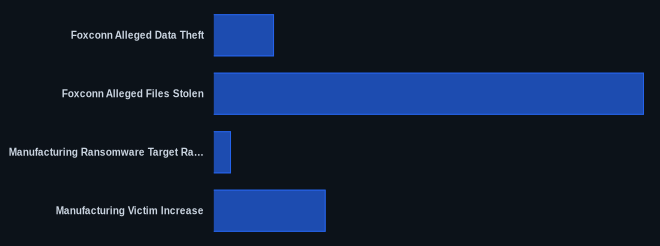
| Foxconn Alleged Data Theft | 8TB | BleepingComputer |
| Foxconn Alleged Files Stolen | 11 million files | BleepingComputer |
| Manufacturing Ransomware Target Ranking | #1 | Dark Reading |
| Manufacturing Victim Increase | 70% more | Dark Reading (citing Arctic Wolf 2026 Threat Report) |
Our Take
We've seen data breaches expose personal information or financial records countless times, but the alleged theft of hardware schematics from a manufacturer like Foxconn is a different beast entirely. This isn't just about operational recovery; it's about the erosion of trust in the supply chain at its most fundamental level. Losing internal instructions and technical drawings to state-backed groups or organized crime can have geopolitical and economic ramifications for years, impacting intellectual property and potentially even national security. We think IP theft in manufacturing needs to be treated as seriously as critical infrastructure attacks.
The CVEDaily Take
The Foxconn incident moves the goalposts for supply chain risk from "what if operations stop?" to "what if our next-gen product designs are already compromised?" This requires a shift in defensive strategy, prioritizing IP protection at every layer of the manufacturing process, not just preventing downtime. Has your team conducted a comprehensive IP audit across your supply chain partners since this news broke?
FAQ
Q: What is Nitrogen ransomware?
A: Nitrogen ransomware is a cybercriminal group known for deploying ransomware that not only encrypts systems for a ransom demand but also exfiltrates sensitive data prior to encryption, maximizing their leverage against victims.
Q: Why is the manufacturing sector such a frequent target for ransomware?
A: Manufacturing operations typically have a low tolerance for downtime due to tight production schedules and critical supply chain roles, making them more likely to pay ransoms. Additionally, they often possess high-value intellectual property and operational technology systems that can be lucrative targets.
Q: What is the primary concern with the alleged theft of hardware schematics from Foxconn?
A: The main concern is the long-term architectural threat: stolen schematics and technical drawings could facilitate counterfeit manufacturing, enable adversaries to identify and exploit hardware-level vulnerabilities, or give competitors an unfair advantage, impacting intellectual property and the integrity of future product generations.