
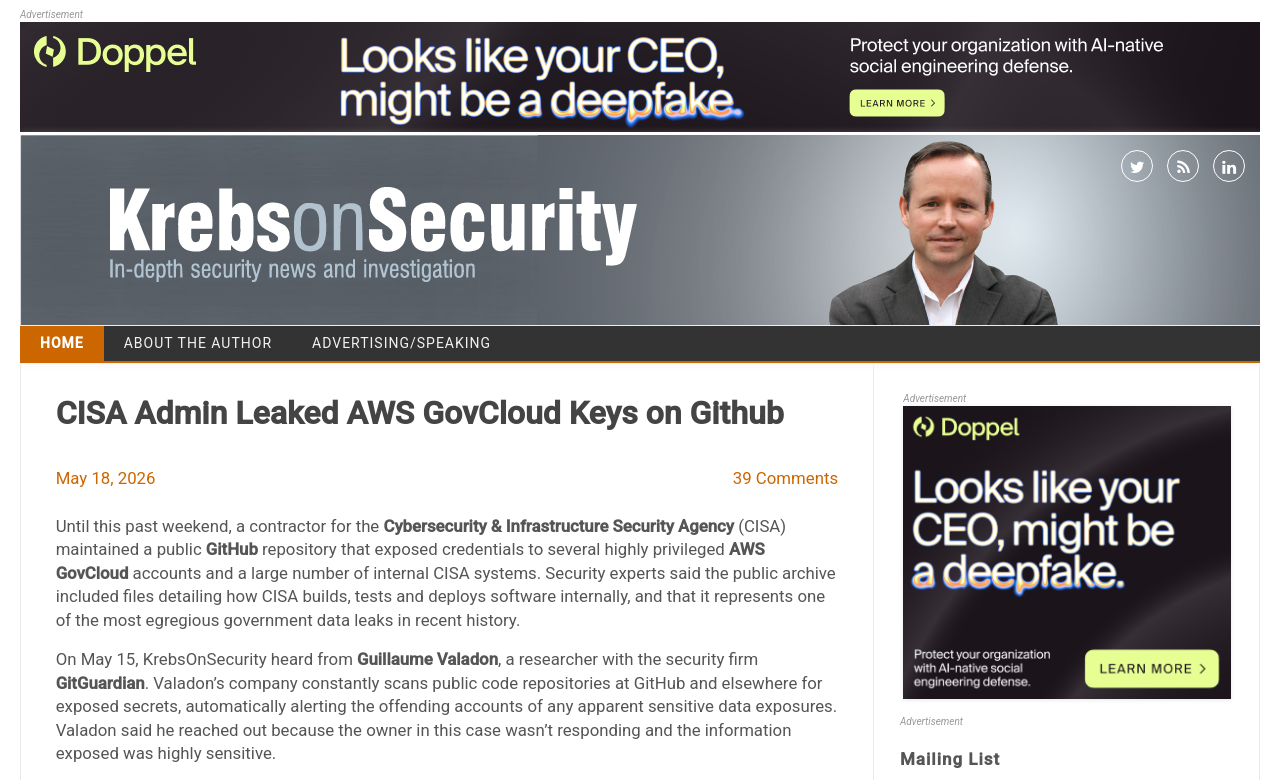
A CISA contractor operating a public GitHub repository named "Private-CISA" exposed highly privileged AWS GovCloud account credentials and extensive internal CISA system blueprints around May 2026. This incident bypassed traditional vulnerability exploitation, instead highlighting critical operational security failures within a trusted third party, leaving infrastructure exposed long after initial discovery.
What Happened
Security researchers at GitGuardian, specifically Guillaume Valadon, discovered the public GitHub repository containing sensitive CISA data. Brian Krebs of KrebsOnSecurity subsequently reported the findings. The repository, found to be live around May 2026, held AWS keys, tokens, plaintext passwords, and system logs. It detailed how CISA develops, tests, and deploys software internally. The contractor likely used the public repository to synchronize files between work and home systems, a dangerous practice. The repository was taken offline on May 15, 2026, shortly after CISA received notification. However, the exposed AWS keys remained valid and active for an additional 48 hours, creating a critical window for potential exploitation. This was a data leak caused by a misconfiguration, not a software vulnerability or a malware attack, hence no CVE ID was assigned.
Why It Matters
This leak exposed not just credentials but the methodology of how CISA, a critical cybersecurity agency, operates its internal systems. Exposing "several highly privileged AWS GovCloud accounts" and a "large number of internal CISA systems" means potential adversaries could gain insights into CISA's cloud architecture, development practices, and deployment pipelines. This effectively provides a playbook for future attacks. The 48-hour delay in revoking credentials after the repository was taken down is a severe incident response lapse, leaving the door open for continued access even after the primary indicator of compromise was addressed. Concerns about CISA's operational security are particularly acute given reports of reduced budget and staffing levels, making such fundamental errors even more impactful. Protecting sensitive credentials is a baseline requirement; use tools like 1Password or Bitwarden.
Technical Breakdown
The core issue here stems from a breakdown in configuration management and credential hygiene. A contractor pushed internal CISA development and deployment data, including live credentials, to a public GitHub repository. This effectively provided T1078 Valid Accounts to anyone with internet access, circumventing traditional perimeter defenses entirely. Once these credentials are out, an attacker could potentially establish persistent access to critical AWS GovCloud resources.
Imagine you build a highly secure vault. You design its locks, surveillance, and entry protocols. But then, one of your trusted builders leaves the master blueprint, along with a copy of all the master keys, on a public park bench. That is what happened here. The security around the "vault" (AWS GovCloud) itself is not necessarily compromised, but the access mechanisms were left completely exposed.
The presence of the Private-CISA repository on a public GitHub account represents a direct violation of CM-6 Configuration Settings and SA-10 Developer Configuration Management, both critical NIST SP 800-53 controls. Allowing highly sensitive information, including active credentials, to reside in an unauthenticated public repository fundamentally undermines any access enforcement mechanisms, directly violating AC-3 Access Enforcement. The 48-hour delay in revoking the exposed AWS keys after the repository was pulled also points to issues within IR-4 Incident Handling, specifically regarding the swiftness of containment and eradication steps post-discovery.
Historical Context
This incident is not isolated. A similar, though distinct, event occurred in December 2024 when Chinese hackers accessed a third-party contractor providing IT services to the U.S. Treasury. While the Treasury incident involved external hacking of a contractor's systems, the CISA leak was a contractor's misconfiguration. Both incidents underscore the persistent supply chain security risks faced by government operations. They demonstrate that whether through sophisticated targeting or simple human error, contractors remain a critical attack surface for sensitive government data and infrastructure.
Data at a Glance
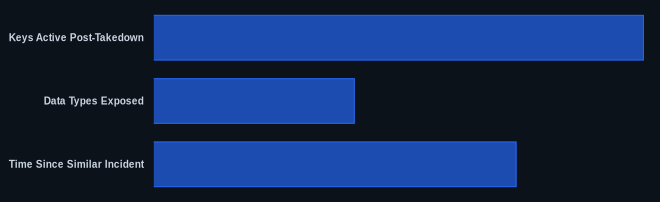
| Metric | Value | Source |
|---|---|---|
| Keys Active Post-Takedown | 48 hours | KrebsOnSecurity |
| Data Types Exposed | 4 | GitGuardian |
| Time Since Similar Incident | ~17 months | KrebsOnSecurity |
| Primary Discovery Organization | GitGuardian | GitGuardian |
| Attack Category | Misconfiguration | KrebsOnSecurity |
| Number of AWS GovCloud Accounts | Not precisely quantified; "several" | KrebsOnSecurity |
The CVEDaily Take
This CISA leak demands a harsh look at contractor vetting and ongoing oversight. The exposure of development and deployment methodologies, alongside live credentials, provides a blueprint for targeted attacks that could linger for years. We think CISA's incident response procedures warrant immediate review, given the 48-hour window during which exposed AWS keys remained active after the repository was taken down. This suggests a failure to prioritize immediate credential revocation, a critical step that should be automated for sensitive accounts. The continued prevalence of such basic operational security failures at an agency responsible for cybersecurity suggests a systemic issue with contractor management that likely extends beyond CISA itself. How thoroughly does your team audit third-party access to your development environments and public code repositories?
FAQ
Q: What specific data was exposed in the CISA contractor leak?
A: The exposed data included highly privileged AWS GovCloud account credentials, cloud keys, tokens, plaintext passwords, logs, and internal CISA system data detailing how the agency develops, tests, and deploys software. KrebsOnSecurity confirmed the exposure of credentials and internal system data.
Q: Was this incident a hack or a software vulnerability?
A: No, this was a data leak caused by a misconfiguration. A CISA contractor maintained a public GitHub repository, effectively exposing sensitive information and credentials due to poor operational security practices, not a software vulnerability or a malicious attack against CISA's systems. GitGuardian identified this as a misconfiguration issue.
Q: How long were the exposed AWS GovCloud credentials active after the repository was taken down?
A: Despite the public GitHub repository being taken offline on May 15, 2026, the exposed AWS GovCloud credentials remained valid and active for an additional 48 hours. KrebsOnSecurity reported this delay in credential invalidation.