
On May 15, 2026, attackers drained over $11 million in cryptocurrency from the THORChain decentralized finance (DeFi) platform, executing a sophisticated cross-chain exploit that simultaneously impacted at least nine blockchain networks.
What Happened
An attacker compromised functions across all nine supported chains on THORChain to perform a synchronized draining of funds, according to TRM Labs investigators. TRM Labs confirmed the affected networks included Bitcoin, Ethereum, Binance Smart Chain (BSC), Base, Avalanche, DOGE, Litecoin, Bitcoin Cash, and XRP. Funds, initially spread across Bitcoin, Ethereum, BSC, and Base, were rapidly consolidated into a two-address cluster by the attacker. While specific technical details of the exploit remain under investigation, TRM Labs confirmed tracing the fund flows across chains within hours, identifying initial attacker addresses.
THORChain's unique architecture facilitates native cross-chain swaps, allowing direct cryptocurrency exchanges without "wrapped" assets. This capability introduces significant complexity, making it a recurring target. The platform's operational stance of refusing to block illicit activity, citing "censorship," further cements its use as a laundering mechanism for stolen crypto, including proceeds from the $1.5 billion Bybit hack in February 2025 and the nearly $300 million KelpDAO hack in April 2026.
Why It Matters
This $11 million exploit adds to THORChain's history of security incidents. TRM Labs reports cumulative losses from THORChain thefts since 2021 now approach $25 million, highlighting a persistent pattern of vulnerability. THORChain founder JP Thorbjornsen was reportedly targeted by suspected North Korean hackers in 2025, demonstrating the high-value nature of its associated assets.
Securing complex, interoperable DeFi platforms is a critical challenge. When a single vulnerability can be used across multiple distinct blockchain networks simultaneously, the attack surface expands exponentially. This capability is attractive to sophisticated threat actors not only for direct theft but also for enabling rapid, multi-chain laundering of funds from other major compromises. This complicates traditional attribution efforts despite faster fund tracing. Securing access to critical backend infrastructure that orchestrates these cross-chain operations becomes paramount to limiting the blast radius of such vulnerabilities.
Technical Breakdown
While specific exploit primitives have not been fully disclosed by TRM Labs, the description of "compromised functions across all nine supported chains" points to a critical vulnerability in the core logic or an underlying component responsible for orchestrating cross-chain operations. Consider a universal currency exchange desk handling transactions for nine different countries. If a flaw exists in the central accounting system or the automated teller machine logic that interacts with all nine national currency reserves, a single exploit could allow an attacker to print money or withdraw from all reserves simultaneously. The native cross-chain swap functionality, by its very design, requires a highly trusted and robust mechanism to manage asset transfers and state changes across disparate blockchains. Any weakness here, whether in smart contract logic, API security, or oracle integrity, can be catastrophic.
Initial access and exploitation likely involved T1190 Exploit Public-Facing Application, targeting a flaw in the THORChain protocol's publicly accessible interfaces or smart contracts that manage cross-chain liquidity pools and swap logic. This would allow an attacker to manipulate transaction parameters or asset balances. Given the platform's history, the incident also implicitly highlights challenges in SI-2 Flaw Remediation, as previous exploits suggest ongoing issues with identifying and fully patching critical vulnerabilities in this complex environment.
Historical Context
This is not THORChain's first experience with exploits. In July 2021, the platform experienced two separate compromises. The first involved a reported $5 million theft due to an exploit in its Ethereum router, where an attacker manipulated gas fees to drain funds from liquidity pools. Days later, another vulnerability allowed an attacker to drain a further $8 million by manipulating transaction values in a smart contract flaw. While the 2021 attacks targeted specific vulnerabilities within individual chain integrations or router logic, the May 2026 exploit appears more coordinated and simultaneous across a broader array of chains. This suggests a potential deeper architectural flaw or a more sophisticated attack vector capable of using a single point of failure to impact the entire cross-chain ecosystem. The constant barrage of attacks indicates that THORChain remains a high-value, high-risk target, necessitating continuous security audits and rapid patch deployment.
Data at a Glance
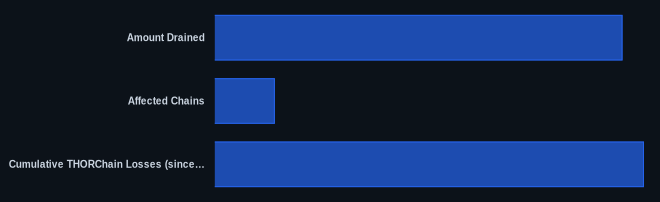
| Metric | Value | Source |
|---|---|---|
| Amount Drained | $11 million | TRM Labs |
| Date of Exploit | May 15, 2026 | TRM Labs |
| Affected Chains | 9 chains | TRM Labs |
| Cumulative THORChain Losses (since 2021) | ~$25 million | TRM Labs |
| TRM Tracing Time | Hours | TRM Labs |
Our Take
We've seen this pattern before: innovative, complex platforms that push boundaries also expand the attack surface. THORChain's commitment to native cross-chain swaps is technically impressive but comes at a steep security cost, repeatedly exploited. The "no censorship" policy, while a philosophical stance, directly enables crypto laundering on a massive scale. It's a trade-off that has tangible negative consequences for the broader crypto ecosystem.
The CVEDaily Take
THORChain's persistent vulnerabilities and its confirmed role as a money-laundering hub demand a more proactive stance from the security community and regulators. Its "no censorship" policy makes it a prime target for illicit activities, directly contradicting the goal of a secure and trustworthy decentralized financial system. We believe THORChain's repeated security incidents and its policy of allowing illicit fund flows show a fundamental conflict between philosophical decentralization and practical security accountability.
What specific measures are your development and security teams implementing to mitigate cross-chain risks in multi-blockchain environments, especially when a platform like THORChain refuses to block illicit activity?
FAQ
Q: What is a native cross-chain swap, and why is it more vulnerable?
A: A native cross-chain swap allows direct exchange of cryptocurrencies between different blockchains (e.g., Bitcoin to Ethereum) without needing "wrapped" tokens (like wBTC on Ethereum). This is innovative because it bypasses intermediaries, but it's more vulnerable because it requires the platform to directly control and manage assets across multiple disparate blockchain protocols, increasing the complexity of smart contract logic and the potential for flaws in how these protocols interact.
Q: How did the attacker consolidate funds across so many different chains?
A: The attacker likely used THORChain's own cross-chain capabilities to move the stolen assets. After draining funds from various liquidity pools on their native chains (Bitcoin, Ethereum, etc.), they would use THORChain's swap functionality to convert these diverse assets into a more manageable set of cryptocurrencies, then withdraw them to a concentrated set of attacker-controlled addresses. This process is ironically facilitated by the very functionality THORChain offers.
Q: Why does THORChain refuse to block illicit activity, and what are the implications?
A: THORChain maintains a policy of not blocking illicit activity, citing a stance against "censorship" in decentralized finance. This means that even if stolen funds are identified flowing through their platform, they will not actively intervene to freeze or block transactions. The implication is that THORChain becomes an attractive destination for threat actors seeking to launder proceeds from other hacks, further complicating attribution and recovery efforts for victims across the crypto space.