
On September 1, 2025, attackers accessed valid credentials belonging to a third-party partner of DocketWise, an immigration case management platform, leading to the exposure of highly sensitive client information for 116,666 individuals. The incident, which DocketWise detected in October 2025, highlights the persistent risks of managing privileged access in integrated supply chain environments, particularly when involving data such as Social Security numbers, financial details, and health information. This type of compromise, targeting external repositories, continues to be a primary vector for data exfiltration, demanding immediate attention to third-party access hygiene.
What Happened
The DocketWise immigration case management platform experienced a significant data breach stemming from unauthorized access to valid credentials belonging to a third-party partner. Attackers specifically targeted a repository maintained by this partner, a system integrated directly into DocketWise's data migration pipeline, as confirmed by official regulatory filings and independent law firm investigations, according to JD Supra. The initial compromise occurred on September 1, 2025.
DocketWise detected the incident in October 2025, but it took several months to fully understand the scope. Full discovery of the breach wasn't made until February 19, 2026. The compromise allowed an unauthorized party to clone repositories, facilitating the exfiltration of unstructured client data, as DocketWise has confirmed.
The official public disclosure of the breach came in April 2026, with news widely published by May 26, 2026, according to The National Law Review. Investigations found no evidence of malware deployment or ongoing unauthorized access after the initial credential compromise, DocketWise stated. This indicates a targeted exfiltration via existing, legitimate access pathways, emphasizing the criticality of managing third-party authentication.
Why It Matters
This incident directly illustrates supply chain risk in a sector handling deeply personal information. The DocketWise incident exposed data for 116,666 individuals, compromising data that includes names, Social Security numbers, government-issued identification, contact details, financial account data, and health-related information, as confirmed by DocketWise and reported by HIPAA Journal. For immigrants and legal clients, this data is often foundational to their legal status, financial stability, and personal safety.
The impact extends far beyond immediate financial fraud; identity theft in these contexts can disrupt immigration processes, jeopardize asylum claims, and expose individuals to various forms of exploitation. When Social Security numbers and government IDs are involved, the long-term risk of synthetic identity fraud and impersonation escalates significantly. This breach confirms that third-party credential compromise remains a potent and high-impact attack vector, capable of reaching the most sensitive data.
This type of breach erodes trust in systems designed to protect vulnerable populations. Organizations in legal, healthcare, and financial services, which routinely manage similar data, should view this as a clear warning about their own third-party access controls. The cost of remediation, including legal fees, regulatory fines, and reputational damage, will likely be substantial for DocketWise, though the exact figures are not yet public.
Affected Scope & Remediation
The immediate scope of impact centers on the 116,666 individuals whose highly sensitive data was exfiltrated from DocketWise's third-party partner system, as confirmed by DocketWise. Because this was a data breach and not a vulnerability in a specific product version, there are no patch versions or CVEs to list here. Instead, the focus shifts to individual remediation and organizational preventative measures.
For affected individuals, DocketWise is providing 24 months of complimentary credit monitoring and identity restoration services, according to DataBreaches.net. Anyone notified by DocketWise should immediately enroll in these services and remain vigilant for suspicious activity across financial accounts, credit reports, and any government correspondence. Freezing credit is a strong recommendation for those with exposed SSNs.
From an organizational standpoint, this incident highlights the urgency of validating security postures of every third-party vendor with access to sensitive data or critical systems. DocketWise reports having implemented additional security measures, though specific details are undisclosed. For peer organizations, the takeaway is clear:
- Audit third-party access: Regularly review and revoke unnecessary access. Use solutions like Bitwarden for secure credential sharing with external partners, ensuring secrets are rotated and tied to specific, temporary permissions.
- Enforce strong authentication: Mandate multi-factor authentication (MFA) for all third-party accounts, especially those with privileged access to data migration pipelines or repositories. Hardware keys like YubiKey can significantly bolster MFA against phishing attacks.
- Data minimization: Only grant third parties access to the absolute minimum data required for their function. If a migration pipeline only needs specific data types, restrict access to just those.
- Incident Response: The timeline from initial compromise (September 1, 2025) to full discovery (February 19, 2026) was 171 days, and disclosure followed in April 2026. This lengthy discovery period shows the challenge of detecting sophisticated credential misuse and the need for continuous monitoring.
Technical Breakdown
The DocketWise breach was a classic case of T1078 Valid Accounts leading to T1195.002 Compromise Software Supply Chain through a third-party partner. Attackers didn't exploit a zero-day or deploy malware; they simply gained access to legitimate credentials. Think of it like a valet service that uses a master key to access your car, but someone steals the master key from the valet. The car's locks are fine, but the credential protecting access to it is compromised.
Once inside the third-party system using these valid credentials, the attackers targeted a repository integrated with DocketWise's data migration pipeline. This allowed them to clone the repositories, which aligns with T1567 Exfiltration Over Web Service, as data was likely pulled over standard HTTP/S or similar protocols used for repository management. There wasn't a need for custom malware or exotic C2 channels; the legitimate service itself became the exfiltration pathway.
This scenario maps directly to several critical NIST SP 800-53 controls. The fundamental failure point lies with IA-5 Authenticator Management, specifically how credentials for the third-party system were managed, stored, and protected. Better controls around credential lifecycle management, rotation, and protection against theft (e.g., phishing resistance, privileged access management) could have prevented this. AC-2 Account Management is also highly relevant, as the permissions granted to the compromised third-party account were likely overly broad, enabling access to highly sensitive unstructured data. Finally, SC-8 Transmission Confidentiality and Integrity comes into play for the data exfiltration itself; while the transmission might have been encrypted, the authorization for that transmission was illegitimate.
The absence of malware suggests a focused, low-noise operation. It reinforces the idea that some of the most effective attacks exploit human and process vulnerabilities in credential management, rather than complex technical exploits.
Historical Context
This DocketWise incident is a recurring theme in cybersecurity, echoing the widespread impact of the SolarWinds supply chain attack in 2020. While the scale and sophistication differed significantly, both incidents highlight the catastrophic potential when trusted third-party access is compromised. SolarWinds involved the insertion of malicious code into legitimate software updates (Orion platform), turning a trusted software vendor into a conduit for attacking thousands of government agencies and private companies. Attackers used this access to move laterally and exfiltrate data, primarily through T1195.002 Compromise Software Supply Chain.
The similarity lies in the exploitation of trust relationships within a digital supply chain. In SolarWinds, it was trust in software updates; in DocketWise, it was trust in a partner's credential management for a data migration pipeline. Both incidents demonstrate that a single point of failure in a third party's security posture can lead to a cascading compromise of sensitive data for the primary organization. The difference is largely in the attack technique: SolarWinds was a deep, sophisticated software supply chain compromise for initial access, while DocketWise was a direct credential compromise of a third-party system. Both ultimately used existing trust and access to achieve data exfiltration.
Data at a Glance
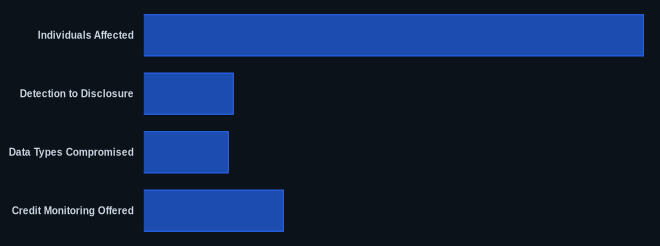
| Metric | Value | Source |
|---|---|---|
| Individuals Affected | 116,666 | JD Supra |
| Initial Compromise Date | September 1, 2025 | The National Law Review |
| Detection to Disclosure | 7 months | DataBreaches.net |
| Data Types Compromised | 6+ categories | HIPAA Journal |
| Credit Monitoring Offered | 24 months | JD Supra |
The CVEDaily Take
The 171-day gap between the initial compromise and full discovery at DocketWise is concerning, suggesting a potential blind spot in monitoring third-party access or a lack of granular logging. While DocketWise confirmed no ongoing unauthorized access after the initial incident, the extended discovery period allowed attackers ample time to exfiltrate a significant volume of highly sensitive data. We question whether DocketWise’s "additional security measures" include a more aggressive approach to credential rotation and real-time behavioral analytics on partner accounts, or if it's primarily reactive.
What specific technical controls could have shortened DocketWise's discovery timeline for this credential compromise?
FAQ
Q: What specific types of highly sensitive data were exposed in the DocketWise breach?
A: DocketWise confirmed the compromised data included names, Social Security numbers, government-issued identification numbers, contact details, financial account data, and health-related information, according to notifications reported by HIPAA Journal.
Q: Was malware involved in the DocketWise data breach?
A: No, investigations into the DocketWise breach found no evidence of malware deployment or ongoing unauthorized access after the initial incident. DocketWise stated the breach resulted from the compromise of valid third-party credentials, as reported by SecurityWeek.
Q: How long did it take DocketWise to detect and fully discover the breach after the initial compromise?
A: The initial compromise occurred on September 1, 2025. DocketWise detected the incident in October 2025, but full discovery wasn't made until February 19, 2026, marking a discovery period of 171 days, as reported by The National Law Review.