A widespread data breach impacting multiple Oracle product lines, including sensitive HR, payroll, and financial systems, was confirmed on May 16, 2026, after Oracle initially denied any compromise of its cloud infrastructure following public disclosure in March 2025. This incident has exposed critical organizational data across numerous customer bases, leading to significant risks for businesses relying on Oracle's ecosystem.
What Happened
The Oracle data breach initially surfaced in early March 2025, when CloudSEK researchers discovered Oracle Cloud credentials actively being sold on a prominent cybercriminal forum. The threat actor behind the sales claimed to have exfiltrated extensive data from Oracle's login infrastructure, specifically targeting SSO endpoints and LDAP data; Oracle has not confirmed these specific claims about exfiltrated data types. While Oracle, in response to these initial public findings, denied any breach of its cloud services, asserting the circulating credentials did not originate from its infrastructure and citing the age of some provided data samples, subsequent investigations proved otherwise. A detailed article published on May 16, 2026, finally confirmed the extensive impact. The breach affected a wide array of Oracle's offerings, encompassing Oracle Cloud Infrastructure (OCI), Oracle E-Business Suite (EBS), Oracle Health (formerly Cerner), Oracle Fusion, Oracle NetSuite, and the core Oracle SSO authentication layer. This confirmed event is distinct from a separate LexisNexis breach on March 3, 2026, which involved a React2Shell vulnerability. The Oracle breach, with its broader scope and later confirmation, is a critical event for IT professionals.
Why It Matters
This is a foundational compromise across Oracle's core business applications and infrastructure. The incident's widespread nature across multiple product lines means diverse customer bases are affected. Depending on the specific Oracle service, organizations face exposure of vendor and supplier records, payroll and HR data, financial records, and procurement intelligence, according to CloudSEK's analysis. Oracle has not confirmed the full scope of data types exposed. The practical risks are significant, ranging from sophisticated Business Email Compromise (BEC) attacks, often using detailed financial data, to widespread identity theft impacting employees and third parties. Competitors or adversarial actors could also exploit the exposed financial and procurement intelligence for strategic advantage. Direct financial losses and long-term reputational damage are possible.
Technical Breakdown
The initial compromise vector for this Oracle breach involved the availability of Oracle Cloud credentials on cybercriminal forums, as detailed by CloudSEK. This strongly suggests T1078 Valid Accounts as a primary initial access technique. Attackers likely used these stolen credentials to gain a foothold, then moved laterally within Oracle's extensive environment. The threat actor's claim of exfiltrating data from Oracle's login infrastructure, including SSO endpoints and LDAP data, points to a clear pathway for privilege escalation and data collection, though Oracle has not confirmed these specific details. Think of your organization's SSO system as the master key card for every office building and department. If that master key is copied, an attacker can walk into virtually any area they choose, accessing sensitive files without triggering typical alarm bells for individual applications.
Once inside, the focus shifted to data exfiltration, likely involving techniques such as T1041 Exfiltration Over C2 Channel. The access to SSO and LDAP implies a deep compromise, granting control over identity management, which is critical for persistence and expanding access to various product lines. Effective credential management is crucial here. Strong multifactor authentication, ideally using hardware tokens like YubiKey, is a vital defense against credential theft. Organizations should also consider advanced endpoint detection and response (EDR) solutions like CrowdStrike Falcon to identify and block suspicious lateral movement post-compromise, especially when legitimate credentials are used. For NIST SP 800-53 controls, this breach highlights critical failures in IA-2 Identification and Authentication (Organizational Users) and AC-2 Account Management, emphasizing the need for robust controls around user authentication and account lifecycle.
Historical Context
This Oracle breach, particularly its initial denials and eventual widespread confirmation, bears some resemblance to the 2017 Oracle MICROS Payment Systems breach, which impacted hospitality and retail customers. That incident, first disclosed in August 2016 by Brian Krebs and later confirmed by Oracle, involved malware on MICROS systems that facilitated credit card theft. Similarities include the initial reluctance to confirm the full scope and the impact on a broad customer base relying on critical Oracle-managed services. However, a key difference in the 2026 breach is the direct compromise of Oracle's internal SSO and LDAP infrastructure, as claimed by the threat actor and analyzed by CloudSEK, as opposed to malware on customer-facing POS systems. The current event suggests a more fundamental compromise of Oracle's own administrative domain, making the potential for deeper access and data exfiltration far greater.
Data at a Glance
| Metric | Value | Source |
|---|---|---|
| Publication Date | May 16, 2026 | CloudSEK |
| Initial Public Discovery | March 2025 | CloudSEK |
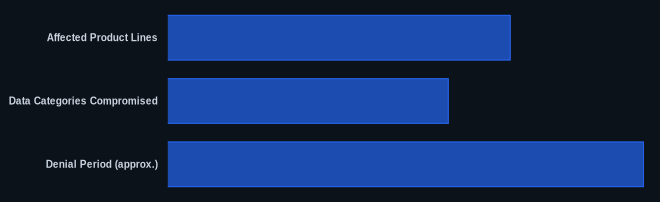
| Affected Product Lines | 6 | CloudSEK |
| Data Categories Compromised | 4 | CloudSEK |
| Denial Period (approx.) | 14 months | CloudSEK |
Our Take
We've seen this play out before: initial denials giving way to inevitable confirmations. Oracle's initial stance in March 2025, claiming no breach and dismissing credential origins, likely bought them time but ultimately damaged trust. The subsequent confirmation on May 16, 2026, details a far more pervasive issue across their product lines. This isn't just about a specific vulnerability; it's about the security posture of core identity and access management systems underpinning enterprise operations. Organizations running Oracle products need to assume compromised credentials were in play and act accordingly.
The CVEDaily Take
Oracle's prolonged denial, dating from March 2025 until the May 2026 confirmation, is particularly concerning. If the threat actor's claims of exfiltrating SSO and LDAP data are accurate—and given the subsequent confirmation of a widespread breach, they very well might be—then the scope of this incident could extend far beyond the initially confirmed product lines. We think Oracle may be downplaying the full extent of the compromise, especially regarding internal identity infrastructure, which affects the security of all their customers. This breach isn't just about a specific Oracle product being vulnerable; it fundamentally questions Oracle's ability to secure its core administrative domains.
Has your organization audited all privileged access to your Oracle environments, paying particular attention to SSO and LDAP logs dating back to early 2025, and rotated credentials since the May 2026 confirmation?
FAQ
Q: What specific Oracle products were confirmed to be affected by this breach?
A: The confirmed breach impacted Oracle Cloud Infrastructure (OCI), Oracle E-Business Suite (EBS), Oracle Health, Oracle Fusion, Oracle NetSuite, and Oracle's core SSO authentication layer.
Q: What type of data was exposed due to the Oracle breach?
A: According to CloudSEK, the breach led to the exposure of various sensitive data categories, including vendor and supplier records, payroll and HR data, financial records, and procurement data, with the specific types varying by the affected product line. Oracle has not confirmed these specific data types or their full exposure.
Q: What immediate actions should IT professionals take if their organization uses affected Oracle products?
A: Immediately initiate a comprehensive audit of all user and privileged access logs for Oracle environments, specifically focusing on SSO and LDAP systems. Force credential rotations for all administrative accounts, implement or reinforce multi-factor authentication (MFA) across all services, and conduct an an impact assessment on exposed data categories to identify potential follow-on risks like BEC or identity theft.