
Nissan's confirmed employee data breach, explicitly tied to active Oracle zero-day attacks, indicates sophisticated exploitation of previously unknown vulnerabilities in Oracle E-Business Suite (EBS) and underscores the severe challenges enterprises face defending against targeted, stealthy compromise.
What Happened
Nissan confirmed an employee data breach, explicitly linking the compromise to ongoing Oracle zero-day attacks, as reported by BleepingComputer. This points to advanced persistent threats targeting critical, widely deployed enterprise resource planning (ERP) software. Hackers are actively exploiting a critical Oracle E-Business Suite flaw, which aligns with the Nissan incident's characteristics.
While specific CVE IDs for the Nissan-related Oracle zero-days remain undisclosed, the context strongly suggests attackers used critical Oracle E-Business flaws. This incident follows a much broader, extensive Oracle data breach that began to unravel in May 2026, impacting numerous product lines. That earlier breach, characterized as a "months-long unraveling" across various systems, affected Oracle Cloud Infrastructure (OCI), EBS, Oracle Health, Oracle Fusion, Oracle NetSuite, and Oracle's SSO authentication layer, according to BleepingComputer.
Nissan stated the breach specifically exposed employee data. Exact figures for affected employees or the types of data exposed haven't been detailed in initial public reports. Given Nissan's scale, any breach tied to zero-day exploitation implies a substantial impact, likely involving sensitive personal and employment-related information.
Why It Matters
A major automotive company like Nissan falling victim to zero-day exploitation in core enterprise software like Oracle E-Business Suite means immediate, significant operational risk and potential long-term data exposure. Exploiting a zero-day bypasses conventional signature-based defenses, granting attackers initial access before vendors or security teams even know a vulnerability exists. This makes detection incredibly difficult.
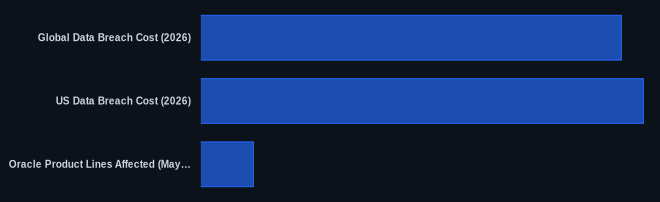
Prior data breaches in 2026 have already resulted in the exposure of personal, financial, and identity verification data for millions of global users, demonstrating the severe consequences. The average global cost of a data breach in 2026 was a staggering $4.44 million, with the average in the US hitting an all-time high of $10.22 million, as per reports cited by BleepingComputer.
These represent real financial losses, regulatory fines, and reputational damage. The fact that the attackers are using Oracle zero-days to hit Nissan indicates a highly skilled and well-resourced adversary. Organizations running similar Oracle EBS deployments need to take this seriously.
Affected Scope & Remediation
Organizations running Oracle E-Business Suite instances are currently exposed to these active zero-day attacks. Since specific CVEs and affected versions haven't been publicly disclosed for the Nissan-linked zero-days, a precise patch strategy is challenging. However, the confirmed active exploitation of a critical EBS flaw means that any unpatched EBS environment should be considered at risk.
Your immediate focus needs to be on detection and network segmentation. If you haven't recently audited your EBS environment for unusual activity or external connections, audit it now. Deploy advanced endpoint detection and response (EDR) solutions like CrowdStrike Falcon on any host interacting with your Oracle EBS databases or application servers. These tools can identify post-exploitation behaviors even if the initial zero-day bypasses traditional perimeter defenses.
Table: Known Oracle E-Business Suite Vulnerabilities (General Guidance)
| Product | Version Range | Fixed Version | Source |
|---|---|---|---|
| Oracle E-Business Suite | Specific versions unconfirmed (zero-day) | Apply all available critical patches | BleepingComputer |
| Oracle E-Business Suite | All actively supported versions | Apply latest Critical Patch Updates | Oracle Security Advisories |
| Oracle E-Business Suite | Legacy/End-of-Life versions | Upgrade or isolate immediately | Oracle Support Documentation |
Patch Links:
- Oracle Security Advisories: https://www.oracle.com/security-alerts/ (Monitor for new advisories related to EBS).
- NVD Entry: Specific CVE for Nissan-linked zero-day not yet public.
Workarounds/Mitigations (while awaiting specific patches):
- Network Segmentation: Immediately segment your Oracle EBS environment from the rest of your corporate network. Treat it as a highly sensitive, isolated zone. Cloudflare Zero Trust can help implement granular access policies to reduce the attack surface.
- Restrict External Access: Limit external access to EBS to an absolute minimum. Enforce multi-factor authentication (MFA) for all administrative and user access, even from internal networks.
- Intrusion Detection/Prevention: Ensure your IDS/IPS systems are running the latest signatures, even if zero-days often bypass them initially. Look for anomalies in traffic patterns.
- Threat Hunting: Actively hunt for indicators of compromise (IOCs) within your EBS logs and surrounding infrastructure. Look for unusual process execution, unauthorized data access, or unexpected network connections.
- Least Privilege: Enforce strict least privilege for all EBS accounts and services.
Timeline:
- Disclosure Date (Nissan breach): Recent (reported by BleepingComputer)
- Patch Release (for specific zero-day): Not yet public
- First Known Exploit: Active now (linked to Nissan)
Technical Breakdown
Attackers exploiting an Oracle E-Business Suite zero-day typically gain initial access through a public-facing component of the application. They identify an unknown flaw in the EBS application's web interface or a backend service, then craft an exploit to gain unauthorized access. This initial breach allows for execution within the application's context.
Once inside, the adversary will establish persistence and escalate privileges. This often involves techniques like T1190: Exploit Public-Facing Application to gain the initial foothold, followed by T1078: Valid Accounts if they can capture or create legitimate user credentials within the EBS environment. They might then attempt to pivot to underlying database servers or other networked systems. This could involve using the EBS application's trust relationships or directly exploiting further vulnerabilities.
Credential dumping is a common objective. Attackers will look for stored credentials, NTLM hashes, or service account details that could grant access to other systems, including domain controllers. This maps to T1003: OS Credential Dumping. Exfiltration of sensitive employee data, as seen with Nissan, would then be carried out via T1041: Exfiltration Over C2 Channel or similar methods, often disguised as legitimate traffic.
To defend against such sophisticated attacks, organizations need to adhere to security controls. SI-2: Flaw Remediation requires timely application of patches for known vulnerabilities, but also continuous monitoring and incident response for unknown threats. This means investing in proactive threat hunting and kernel-level telemetry, not just reactive patching.
Historical Context
The Nissan breach linked to Oracle zero-days echoes the challenges faced during the CVE-2026-21509 Excel zero-day vulnerability incident in January 2026. That flaw, a Microsoft Office Security Feature Bypass, was actively exploited before an emergency patch became available, forcing organizations into rapid response. Similar to the current Oracle situation, attackers found an unknown weak point in widely used business software, giving them an advantage.
A key difference lies in the target and potential impact. The Excel zero-day primarily affected endpoints and user interactions, often leading to client-side execution. The Oracle E-Business Suite zero-day directly targets core enterprise applications, offering a more direct path to sensitive corporate data and backend systems. While both highlight the persistent threat of unknown vulnerabilities, the Oracle EBS exploit is arguably more severe in terms of its potential for broad lateral movement and critical data compromise across an organization, impacting a much larger and more centralized data repository than individual Excel files. Both incidents underscore that zero-day exploitation remains a significant and recurring threat, constantly pushing the boundaries of defensive strategies.
Data at a Glance
| Metric | Value | Source |
|---|---|---|
| Global Data Breach Cost (2026) | $4.44 million | BleepingComputer |
| US Data Breach Cost (2026) | $10.22 million | BleepingComputer |
| Oracle Product Lines Affected (May 2026) | 6 major lines | BleepingComputer |
| Zero-Day Exploitation Status | Active | BleepingComputer |
| Affected Company | Nissan | BleepingComputer |
Our Take
We're seeing a clear trend: attackers are moving past easy targets and directly going after critical enterprise software with zero-days. It's no longer enough to just patch known vulnerabilities; we need to be actively hunting for anomalies, aggressively segmenting our most valuable assets, and assuming compromise. Oracle E-Business Suite is a prime target due to its pervasive role in large organizations and the sheer volume of sensitive data it holds. We expect to see more such attacks.
The CVEDaily Take
The Nissan breach highlights a fundamental shift towards more sophisticated, stealthy attacks leveraging unknown flaws in core business applications. Relying solely on perimeter defenses and signature-based detection against zero-day exploits is a losing game. We think Nissan's public statements understate the operational impact this type of breach typically has on an automotive giant, especially concerning potential intellectual property exfiltration beyond just employee data.
Is your Oracle E-Business Suite environment adequately isolated from the rest of your critical infrastructure, and are you actively monitoring its internal and external communications for anomalous behavior?
FAQ
Q1: What makes the Nissan employee data breach particularly significant?
A1: The Nissan breach is significant because it's explicitly linked to active exploitation of Oracle zero-day vulnerabilities, indicating attackers leveraged previously unknown flaws in critical enterprise software rather than just exploiting misconfigurations or known vulnerabilities.
Q2: Are specific CVE IDs available for the Oracle zero-days linked to the Nissan breach?
A2: No, specific CVE IDs for the Oracle zero-days exploited in the Nissan breach have not been publicly disclosed, making it challenging to identify exact affected versions or apply targeted patches immediately. Nissan has not confirmed the specific CVEs, and Oracle has not released related advisories as of publication.
Q3: What immediate actions should IT and security professionals take if they use Oracle E-Business Suite?
A3: Immediately review and strengthen network segmentation for your Oracle EBS environment, enforce multi-factor authentication for all access, deploy advanced EDR solutions on connected hosts, and proactively hunt for any unusual activity or indicators of compromise within your EBS logs and surrounding infrastructure.