A major data breach at Aflac Life Insurance Japan has compromised the personal information of approximately 4.38 million current and former policyholders, including bank account details for 230,000 individuals, following unauthorized access to its "Aflac Yorisou Net" policyholder portal and related systems. This incident marks another significant security lapse for Aflac, barely a year after a major compromise of its U.S. systems impacting 26.5 million individuals in 2025. The repeated breaches indicate systemic vulnerabilities or persistent targeting, raising serious questions about Aflac's overall cybersecurity posture and supply chain risk management, particularly for organizations relying on third-party portals for sensitive customer data.
What Happened
Aflac Japan discovered an anomaly on June 25, 2026, when an unusual spike in system load on their policyholder portal, "Aflac Yorisou Net," triggered an internal investigation. This surge ultimately led to the confirmation of unauthorized access to the portal and its underlying infrastructure, as reported by SecurityWeek and BleepingComputer. The company’s investigation revealed that initial unauthorized access occurred on June 15, 2026, with multiple intrusions detected over a ten-day period until the access was successfully blocked and systems were shut down on June 25.
The method of compromise was described as a "third party breached its policyholder website and related platforms" through "unauthorized access to its systems" according to TokyoReporter. The quick shutdown was critical to contain the damage and prevent further exfiltration or system compromise. Aflac Japan has promptly initiated notifications to affected customers and reported the incident to Japan's Financial Services Agency and the police, confirming that as of June 30, 2026, no fraudulent use of the leaked information has been confirmed.
Why It Matters
This breach exposes a substantial volume of personally identifiable information (PII) and sensitive financial data, directly affecting millions. The compromised data includes customer names, dates of birth, gender, home addresses, telephone numbers, policy numbers, and coverage details. More critically, for approximately 230,000 affected customers, bank account information used for premium payments was also exposed. This financial data encompasses institution names, branch names, account types, account numbers, and account holders' names, a goldmine for targeted phishing and financial fraud.
Beyond individual policyholders, the breach also leaked information for roughly 40,000 agencies, including representatives' names, addresses, and telephone numbers. While Aflac Japan states that highly sensitive "My Number" profiles (Japan's equivalent to a Social Security number) and credit card details were not compromised, the combination of PII and bank account details is sufficient for sophisticated identity theft and account takeovers. The incident underscores the severe consequences of inadequate web application security and access control, especially for systems handling vast amounts of financial consumer data.
Affected Scope & Remediation
The immediate impact scope is clear: 4.38 million Aflac Japan policyholders, including 230,000 with compromised bank account details and 40,000 agency representatives. Aflac Japan is currently notifying affected customers, and while some systems remain suspended, insurance claims and inquiries are being redirected through alternative, secure channels. This proactive communication, as reported by BleepingComputer, is a baseline expectation, but the deeper remediation involves significant architectural and procedural changes.
For security engineers facing similar incidents, immediate remediation priorities are clear:
- Isolate and Contain: Immediately shut down or segment any compromised systems or applications. Aflac Japan's swift action to block further access and suspend systems was critical.
- Forensic Investigation: Conduct a thorough forensic analysis to determine the root cause, extent of the breach, and specific vulnerabilities exploited. This involves analyzing logs, network traffic, and system images.
- Credential Reset: Force password resets for all potentially compromised accounts, especially those with access to the affected portal and related backend systems. Enforce multi-factor authentication (MFA) everywhere, even for internal systems. Solutions like YubiKey or an enterprise identity provider reduce credential theft risk.
- Patch and Harden: Identify and patch any exploited vulnerabilities in web applications, operating systems, and network infrastructure. This incident highlights the need for continuous web application security testing and hardening.
- Enhanced Monitoring: Deploy enhanced logging and monitoring across all public-facing applications and critical internal systems. Tools like CrowdStrike Falcon or SentinelOne offer endpoint detection and response (EDR) capabilities to detect post-exploitation activity.
- Review Access Controls: Implement a stringent least privilege model for all users and services. Regularly audit permissions, especially for sensitive data access and administrative roles. Consider implementing a Zero Trust architecture with solutions like Cloudflare Zero Trust for external access to internal resources.
- Third-Party Risk: If the breach originated via a third-party component or service, thoroughly re-evaluate that vendor's security posture and contractual obligations.
Technical Breakdown
The Aflac Japan breach, described as "unauthorized access to its policyholder website and related platforms," points toward initial access likely involving the T1190 Exploit Public-Facing Application MITRE ATT&CK technique. This could have been achieved through vulnerabilities in the "Aflac Yorisou Net" portal itself, such as SQL injection, cross-site scripting, or insecure direct object references. Attackers may have found a faulty lock on the front door of a bank. Once inside, they could use this initial foothold. Alternatively, if the portal was not inherently vulnerable, attackers might have used T1078 Valid Accounts via compromised credentials, perhaps obtained through phishing or credential stuffing attacks, to log in as legitimate users.
Once initial access was gained, the attackers likely explored the internal network and exfiltrated data. The exposure of sensitive customer and agency data, including bank account details, strongly suggests the use of T1567 Exfiltration Over Web Service. This technique involves using existing web service protocols or APIs to send stolen data out of the network. For example, an attacker could programmatically query internal databases through the compromised portal's backend, then transmit the results via HTTPS requests to a controlled server, blending in with legitimate web traffic. This type of data egress can be difficult to detect without advanced network monitoring and anomaly detection.
From a compliance and control perspective, this incident highlights critical failures in the AC-3 Access Enforcement and SI-4 System Monitoring NIST SP 800-53 controls. AC-3 requires organizations to enforce approved authorizations for controlling access to information system resources. A breach of this scale indicates that these enforcement mechanisms either failed or were bypassed. Similarly, SI-4 mandates the continuous monitoring of information systems for attacks and indicators of compromise. The ten-day window between initial access and discovery suggests that Aflac Japan's monitoring systems may have lacked the necessary capabilities or configurations to detect the unauthorized activity earlier.
Historical Context
This is not Aflac's first rodeo. In June 2025, Aflac disclosed a significant cyberattack that affected its U.S. systems, ultimately compromising data of 26.5 million individuals. That incident, widely reported by various outlets, involved the exposure of customer, employee, and policy beneficiary information, potentially including names, Social Security numbers, and protected health information. A social engineering attack campaign against the insurance industry by the Scattered Spider hacking group, known for its focus on data exfiltration rather than ransomware, was attributed as the cause of the 2025 U.S. breach.
While the 2025 U.S. breach used social engineering and targeted Aflac's broader corporate infrastructure, and the latest Japan incident appears to have targeted a web application, the common thread is clear: Aflac, as a global financial institution, remains a prime target for sophisticated threat actors seeking large volumes of sensitive customer data. Both incidents resulted in the exposure of millions of records and highlight the persistent challenge of securing complex, distributed systems and diverse attack surfaces. The key difference is the entry vector: social engineering for the U.S. breach versus suspected web application compromise for the Japan breach, but both ultimately led to massive data theft.
Data at a Glance
| Metric | Value | Source |
|---|---|---|
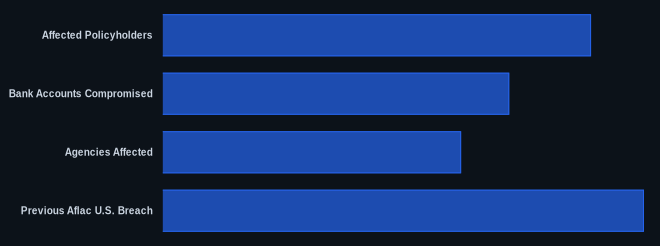
| Affected Policyholders | 4.38 million | SecurityWeek |
| Bank Accounts Compromised | 230,000 | TokyoReporter |
| Agencies Affected | 40,000 | TokyoReporter |
| Initial Access Date | June 15, 2026 | BleepingComputer |
| Discovery Date | June 25, 2026 | BleepingComputer |
| Previous Aflac U.S. Breach | 26.5 million | Research Brief |
The CVEDaily Take
Aflac's recurring incidents make it clear that reactive measures aren't cutting it. Two massive breaches in little over a year, hitting different systems (U.S. corporate vs. Japan policyholder portal), suggests either a continued failure in fundamental security hygiene across the enterprise, or a highly sophisticated, persistent targeting campaign by multiple threat groups. We think Aflac's response to the 2025 breach might have focused too narrowly on the social engineering vector, leaving other critical attack surfaces like web applications vulnerable. This latest incident, targeting a public-facing portal, confirms that security teams must adopt a holistic view of enterprise risk and not just address the last vulnerability exploited.
Has your organization performed a comprehensive, independent penetration test on all public-facing web applications in the last six months?
FAQ
Q: What specific information was exposed in the Aflac Japan data breach?
A: The breach exposed names, dates of birth, gender, addresses, telephone numbers, policy numbers, and coverage details for approximately 4.38 million policyholders. For 230,000 of these, bank account information (financial institution, branch, account type, account number, and account holder's name) was also compromised. Additionally, information for about 40,000 agencies was leaked, including representatives' names, addresses, and telephone numbers. Aflac Japan states that "My Number" profiles and credit card details were not compromised.
Q: Has Aflac confirmed any fraudulent use of the leaked data?
A: As of June 30, 2026, Aflac Japan has not confirmed any fraudulent use of the leaked information. However, the nature of the exposed data, particularly bank account details combined with PII, makes affected individuals highly susceptible to future targeted phishing attacks and identity theft.
Q: How does this Aflac Japan breach relate to the previous Aflac U.S. cyberattack in 2025?
A: This Aflac Japan incident is distinct and specifically confined to Aflac Japan's systems, unlike the June 2025 cyberattack that affected Aflac's U.S. systems and compromised data of 26.5 million individuals. While both are significant data breaches, the attack vectors and specific systems compromised appear different, suggesting separate incidents rather than a direct continuation of the 2025 breach.