The Grubhub data breach, publicly reported on January 16, 2026 by BleepingComputer, links to compromised credentials and access tokens stolen during prior attacks on third-party service providers used by Grubhub. This incident spotlights how interconnected business software platforms and sophisticated, potentially AI-weaponized flaws, are broadening the attack surface for organizations. We are seeing a convergence of traditional credential theft with advanced zero-day exploitation.
What Happened
The Grubhub incident, the most significant cybersecurity story of the past week, stems from compromised credentials and access tokens stolen during prior attacks on third-party service providers used by Grubhub, SecurityWeek reports. Attackers gained initial access to Grubhub's systems via earlier compromises of business software platforms; TheHackerNews states this is a common thread in a larger pattern of cybercrime affecting multiple organizations. Grubhub has not publicly disclosed specific technical details of how attackers accessed its systems.
This breach occurred amidst active exploitation of an "Excel zero-day vulnerability 2026," CVE-2026-21509, a Microsoft Office Security Feature Bypass flaw. This vulnerability allows attackers to execute malicious code through crafted documents by circumventing OLE/COM security controls, as NVD details. Microsoft released an emergency out-of-band patch for CVE-2026-21509 on January 26, 2026, confirming active exploitation before the patch.
Further complicating the situation, another flaw, CVE-2026-26144, an XSS vulnerability in Excel, has been weaponized to enable Copilot Agent for zero-click data exfiltration, requiring no user interaction or privilege escalation, according to NVD. Additionally, in April 2026, security researchers identified multiple malicious packages masquerading as "Claude Code" across PyPI and npm, designed to harvest developer credentials, SecurityWeek reports. These malicious packages had polished README files, plausible version histories, and naming conventions to deceive developers, indicating sophisticated software supply chain attacks.
Why It Matters
The Grubhub data breach sends ripples beyond just one food delivery company, according to BleepingComputer. It exposes vulnerabilities that likely affect competitors and businesses in adjacent industries, especially any organization using similar technology stacks or third-party service providers. This incident will likely prompt increased regulatory scrutiny of data protection practices within the food delivery sector.
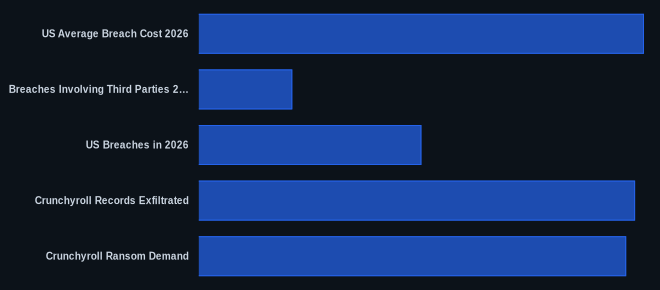
While the total number of breaches continues to rise, with the US alone seeing 3,322 breaches in 2026, TheHackerNews reports, the average cost tells a more nuanced story. General cybersecurity statistics from 2026 indicate the average cost of a data breach globally fell to $4.44 million, a 9% decline from 2024, attributed to widespread adoption of security AI and automation, SecurityWeek reports. However, the US average breach cost hit an all-time record of $10.22 million in 2026, 2.3 times the global average, according to SecurityWeek.
The Verizon 2026 Data Breach Investigations Report (DBIR) notes that the human element (e.g., social engineering, phishing, stolen credentials) accounts for 68% of breaches, and third-party involvement doubled year-over-year to 30%. The DBIR also highlights how generative AI is augmenting attacks, amplifying these human and supply chain weaknesses.
Affected Scope & Remediation
The Grubhub incident means any organization relying heavily on third-party business software platforms for critical operations is potentially exposed to similar attacks, especially if those platforms become initial breach points. The Excel zero-days, CVE-2026-21509 and CVE-2026-26144, cast a wider net, impacting any enterprise using Microsoft Office products.
For CVE-2026-21509, Microsoft released an emergency out-of-band patch on January 26, 2026. Patch it now. For organizations using Microsoft Copilot, CVE-2026-26144 represents a significant zero-click exfiltration risk through crafted Excel files; immediate review of Copilot security configurations and kernel-level telemetry for anomalous activity is critical. No new CVEs were added to CISA's Known Exploited Vulnerabilities catalog within the last 7 days, NVD confirms.
Here's the current status for the publicly detailed Excel vulnerabilities:
| Product | Version Range | Fixed Version |
|---|---|---|
| Microsoft Office (Excel) | All currently supported versions, specific to vendor advisories | Patch released January 26, 2026 |
| Microsoft Office (Excel/Copilot) | All currently supported versions, specific to vendor advisories | Not yet publicly available for CVE-2026-26144 |
Patch Links & Advisories:
- CVE-2026-21509 NVD Entry: https://nvd.nist.gov/vuln/detail/CVE-2026-21509
- CVE-2026-26144 NVD Entry: https://nvd.nist.gov/vuln/detail/CVE-2026-26144
Timeline for CVE-2026-21509:
- Disclosure Date: Not publicly disclosed
- Patch Release: January 26, 2026
- First Known Exploit: Confirmed prior to patch release
- Days from first known exploit to patch: Not publicly disclosed.
For CVE-2026-26144, without an immediate patch, mitigations include stringent user training on recognizing malicious documents, enhancing email filtering to block suspicious attachments, and deploying advanced endpoint detection and response (EDR) solutions like SentinelOne to detect post-exploitation activity. MFA enforcement and password rotation, including a password manager like 1Password, are critical to limit the impact of credential theft from supply chain compromises. Also, consider using solutions like Cloudflare Zero Trust for securing access to internal applications, minimizing the blast radius of compromised credentials.
Technical Breakdown
The Grubhub breach exemplifies a multi-stage attack that begins with compromising a peripheral entity to gain access to a primary target. Think of it like a thief not breaking into your house directly, but stealing the master key from your property manager, then using that key to enter your unit. The "third-party service providers" are the property manager, whose security posture directly impacts the security of Grubhub's "unit." This aligns with T1195.002 Compromise Software Supply Chain and T1078 Valid Accounts from MITRE ATT&CK.
Attackers initially exploited weaknesses in business software platforms used by Grubhub's vendors, likely through phishing or malware that targeted these third parties. This led to the theft of credentials and access tokens, which are essentially digital keys. Once these keys were obtained, attackers could then authenticate into Grubhub's systems, bypassing traditional perimeter defenses that might have been strong against direct attacks. NIST SP 800-53 control IA-5 Authenticator Management mandates strong controls over the issuance, use, and revocation of authenticators, including access tokens.
The Excel zero-day, CVE-2026-21509, is a Microsoft Office Security Feature Bypass. It allowed malicious code execution by cleverly manipulating OLE/COM objects within crafted documents. This bypasses security checks designed to prevent such actions, giving an attacker a foothold on a user's system simply by opening a weaponized Excel file. This is a classic client-side execution exploit, aligning with T1203 Exploitation for Client Execution. Meanwhile, CVE-2026-26144's ability to weaponize Copilot Agent for zero-click data exfiltration is a concerning evolution. An XSS vulnerability in Excel itself, it exploits the trust relationship between the application and its AI-driven features. This could allow for silent data theft without any visible interaction from the user, making it particularly insidious. Implementing strong flaw remediation procedures as per NIST SP 800-53 control SI-2 Flaw Remediation is critical for both these CVEs.
Historical Context
A similar incident is the Crunchyroll data breach in March 2026, TheHackerNews reports, which originated from a contractor's compromised laptop in India. The attack chain involved a phishing attack on a Telus International support agent, demonstrating the human element and third-party risk. The attacker gained Okta SSO access to Crunchyroll's internal systems, subsequently accessing Zendesk, Slack, Google Workspace, and Jira. Within 24 hours of the breach, the attacker claims 8 million support ticket records were downloaded, and 100GB of data exfiltrated, with a demand of $5 million, according to TheHackerNews. Crunchyroll has not confirmed these figures.
The Crunchyroll breach shares similarities with the Grubhub incident in its reliance on compromised third-party access and subsequent lateral movement within the target organization's internal systems. Both highlight the cascading effects of a single point of failure within the supply chain. What differs is the initial vector: Crunchyroll was a direct phishing attack against a support agent, whereas the Grubhub incident suggests a broader compromise of business software platforms, possibly incorporating more sophisticated zero-day exploits like those seen with Excel. Crunchyroll also saw specific figures for records exfiltrated and ransom demands, which haven't been publicly disclosed for Grubhub.
Data at a Glance
| Metric | Value | Source |
|---|---|---|
| Grubhub Breach Report Date | January 16, 2026 | BleepingComputer |
| CVE-2026-21509 Patch Date | January 26, 2026 | NVD |
| US Average Breach Cost 2026 | $10.22 million | SecurityWeek |
| Breaches Involving Third Parties 2026 | 30% | Verizon DBIR 2026 |
| US Breaches in 2026 | 3,322 | TheHackerNews |
| Crunchyroll Records Exfiltrated | 8 million (attacker claim) | TheHackerNews |
| Crunchyroll Ransom Demand | $5 million (attacker claim) | TheHackerNews |
Our Take
We're observing a dangerous evolution where the blast radius of a single third-party compromise is expanding dramatically. It's no longer just about direct attacks; it's about the security posture of every vendor in your ecosystem. The emergence of AI-weaponized flaws, like CVE-2026-26144 leveraging Copilot, signals a future where even strong security controls can be bypassed with zero-click precision, making traditional defenses against social engineering less effective. Incident response plans need to shift from reacting to a breach on your perimeter to containing a breach that started two vendors away.
The CVEDaily Take
The Grubhub incident shows that supply chain vulnerabilities, coupled with sophisticated zero-days and AI-augmented attacks, are the new battleground. We believe Grubhub’s current lack of public disclosure regarding the scale and specific data types affected suggests they are either still assessing the full impact or deliberately limiting information. This approach, while common, hinders public understanding of the broader risk. Organizations need to assume compromise, not just prevent it. Has your team conducted a comprehensive audit of third-party access and credential management for your critical business software platforms in the last six months?
FAQ
-
What specific data was exposed in the Grubhub data breach?
Specific types of data exposed beyond general "customer data," numbers of affected users or organizations, and ransom amounts related to the Grubhub breach have not been publicly disclosed by Grubhub as of January 16, 2026, BleepingComputer reports. -
How is CVE-2026-26144 an "AI-weaponized vulnerability?"
CVE-2026-26144 is an XSS vulnerability in Excel that weaponizes the Copilot Agent for zero-click data exfiltration, as NVD explains. This means it exploits the integration of AI capabilities (like Copilot) within applications to bypass user interaction requirements and silently exfiltrate data, representing a new frontier in exploit development. -
What's the main takeaway for organizations from the Grubhub incident regarding their third-party risk management?
The Grubhub incident shows organizations must rigorously vet the security posture of all their third-party service providers, especially those with access to critical business systems. It highlights the need for strong contractual clauses for security, continuous monitoring of third-party access, and implementing strong credential hygiene (e.g., MFA, privileged access management) across the entire supply chain, not just within their own direct infrastructure.