
On early August 2026, the INC Ransomware operation accelerated its campaign, exploiting recently patched zero-day vulnerabilities in SonicWall Secure Mobile Access (SMA) 1000 series VPN appliances, specifically CVE-2026-15409 and [CVE-2026-15410]. This campaign uses these critical flaws to achieve arbitrary command execution, steal high-value credentials, and access session databases across a global victim base. Resecurity observed the group's activity surge since early August 2026, affecting private sector and government organizations in countries like Australia, the U.S., and Switzerland. Patch all SonicWall SMA 1000 series appliances immediately.
What Happened
The INC Ransomware operation is a dominant threat actor, quickly weaponizing newly disclosed security flaws in SonicWall Secure Mobile Access (SMA) 1000 series VPN appliances. These flaws, CVE-2026-15409 and [CVE-2026-15410], are critical vulnerabilities allowing for arbitrary command execution and complete takeover of susceptible devices, according to NVD. Exploitation of these vulnerabilities directly leads to the theft of high-value credentials and active session databases, providing attackers a clear path to lateral movement and further compromise.
Attackers are deploying a custom Python script named KNUCKLEBALL and a bespoke Java web shell dubbed ORANGETAIL on compromised systems. SonicWall released fixes for these vulnerabilities in mid-July 2026. This timeline suggests the flaws were likely exploited as zero-days before patches could be widely applied, a claim supported by Resecurity's observation of a significant acceleration of INC Ransomware activity and new victim listings on their data leak site since early August 2026, as reported by The Hacker News.
Why It Matters
This is a critical ingress vector for a prominent ransomware group. Exploiting network edge devices like VPN appliances gives attackers direct access into an organization's perimeter, bypassing more complex endpoint protections. Rapid7's analysis confirms the extraction of high-value credentials and active session databases, which are critical for post-exploitation activities, including lateral movement and privilege escalation.
INC Ransomware claims 885 victims to date, per Resecurity data cited by The Hacker News, with activity accelerating rapidly. This means a substantial number of organizations, spanning private sector and government entities globally, are either compromised or at severe risk. The Hacker News reports that affected countries include Australia, the U.S., the U.A.E., Colombia, and Switzerland, showcasing the broad, indiscriminate nature of these attacks. Stolen VPN credentials bypass many layers of conventional security.
Affected Scope & Remediation
The vulnerabilities, CVE-2026-15409 and [CVE-2026-15410], affect SonicWall Secure Mobile Access (SMA) 1000 series firmware. Any firmware version prior to 12.4.2.0-15409 is susceptible to these arbitrary command execution flaws, according to the NVD. If you're running any older firmware on your SMA 1000 series appliance, you're exposed.
Patch all SonicWall SMA 1000 series appliances immediately.
| Product | Affected Version Range | Fixed Version |
|---|---|---|
| SonicWall SMA 1000 series | All versions prior to 12.4.2.0-15409 | 12.4.2.0-15409 and later |
Patch Links:
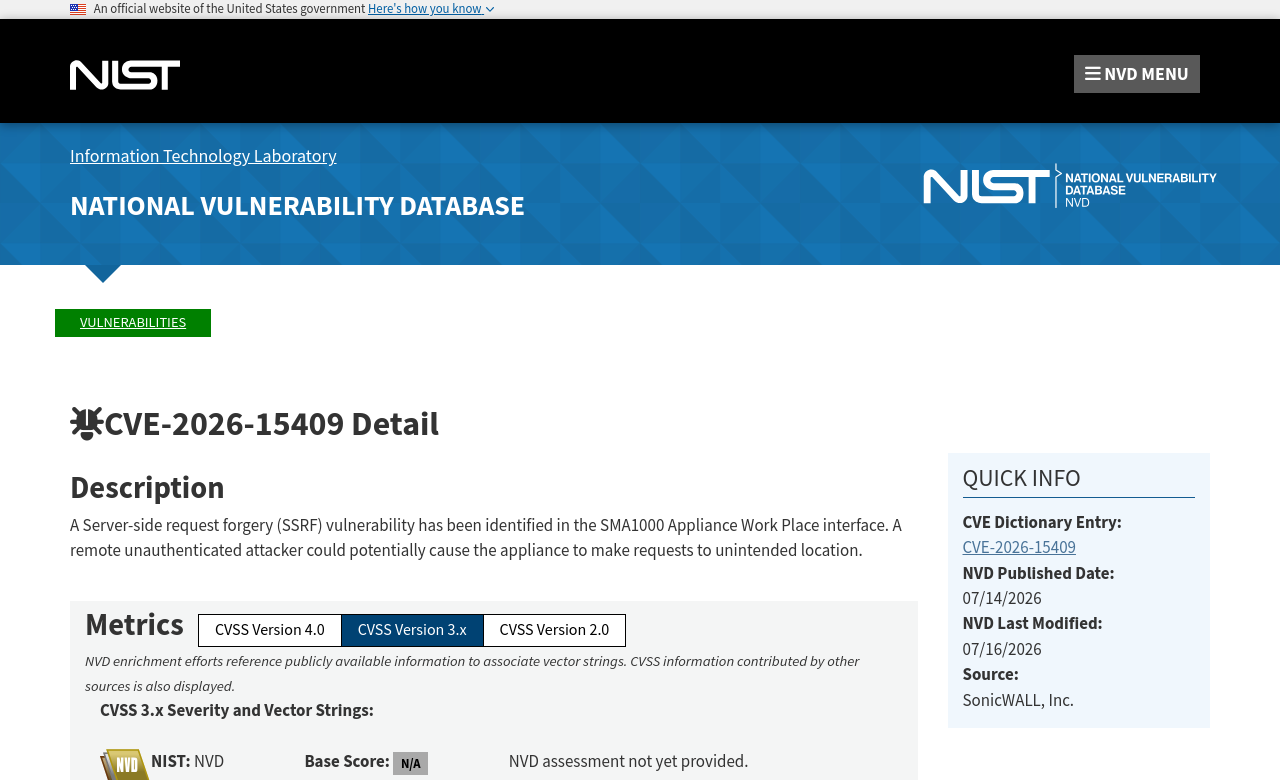
- CVE-2026-15409 NVD Entry: https://nvd.nist.gov/vuln/detail/CVE-2026-15409
- CVE-2026-15410 NVD Entry: https://nvd.nist.gov/vuln/detail/CVE-2026-15410
- SonicWall's official advisory should be consulted for specific download instructions.
Timeline:
- SonicWall released patches in mid-July 2026.
- INC Ransomware activity, specifically exploiting these flaws, accelerated in early August 2026, approximately 2-3 weeks after the patches became available. This gap suggests exploitation likely began prior to the mid-July 2026 patch release, operating as a zero-day.
There are no widely documented workarounds that fully mitigate the arbitrary command execution capabilities offered by these vulnerabilities without applying the official patch. Prioritize patching edge devices, and enforce strict network segmentation. Deploying an EDR solution like CrowdStrike Falcon can help detect anomalous activity and post-exploitation tool deployment on endpoints should an attacker breach the perimeter.
Technical Breakdown
Exploiting CVE-2026-15409 and [CVE-2026-15410] is conceptually straightforward for an attacker. These vulnerabilities represent a flaw in the primary locking mechanism of the SonicWall SMA 1000 appliance, allowing an attacker to gain control.
Once arbitrary command execution is achieved on the SonicWall SMA 1000 appliance, the INC Ransomware group proceeds with several critical attack steps. They transfer tools like the Python script KNUCKLEBALL and the Java web shell ORANGETAIL to the device. These tools facilitate the primary objective: stealing credentials and active session data. This aligns directly with MITRE ATT&CK T1190: Exploit Public-Facing Application for initial access, followed by T1105: Ingress Tool Transfer for bringing in KNUCKLEBALL and ORANGETAIL. The subsequent theft of credentials and session databases falls under T1003: OS Credential Dumping. This allows them to escalate privileges or move laterally using valid accounts, potentially bypassing MFA if session tokens are captured.
From a NIST SP 800-53 perspective, organizations failing to apply these patches are directly neglecting SI-2: Flaw Remediation. The ability to steal credentials and session tokens underscores a failure in IA-5: Authenticator Management, as compromised authenticators render strong authentication mechanisms less effective once the initial access is gained. Multi-factor authentication, ideally with hardware tokens like YubiKey, is a vital secondary defense to protect valid accounts even if hashes or session data are compromised, preventing immediate re-use by attackers.
Historical Context
The INC Ransomware group's exploitation of SonicWall SMA 1000 vulnerabilities echoes a persistent pattern where ransomware operators rapidly weaponize newly disclosed flaws in critical network edge devices. Qilin ransomware group was observed actively exploiting critical vulnerabilities in Palo Alto Networks GlobalProtect VPN appliances in late 2025. In that campaign, like the current INC operation, the goal was to gain initial access, establish persistence, and steal credentials to facilitate ransomware deployment.
While the specific vulnerabilities and affected vendors differ, the fundamental tactic remains consistent: target widely used, internet-facing network infrastructure, exploit flaws for initial access, and quickly move to credential theft and lateral movement. The Qilin campaign highlighted the critical importance of swift patching and monitoring VPN endpoints, a lesson that the INC Ransomware's current activities on SonicWall SMA 1000 series devices forcefully reinforces. CISA also added CVE-2026-50522, a critical Microsoft SharePoint flaw, to its KEV catalog in July 2026 due to active exploitation, further illustrating this broader trend of immediate weaponization.
Data at a Glance
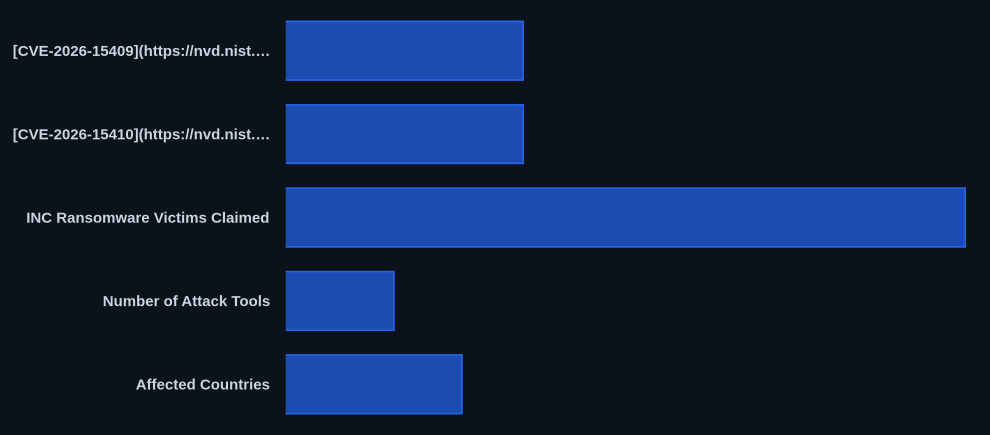
| Metric | Value | Source |
|---|---|---|
| CVE-2026-15409 CVSSv3.1 | 9.8 (CRITICAL) | NVD |
| CVE-2026-15410 CVSSv3.1 | 9.8 (CRITICAL) | NVD |
| INC Ransomware Victims Claimed | 885 organizations (claims by INC Ransomware group, unconfirmed by affected organizations as of publication) | The Hacker News |
| Patch Release Window | Mid-July 2026 | The Hacker News |
| Exploitation Acceleration | Early August 2026 | The Hacker News |
| Number of Attack Tools | 2 (KNUCKLEBALL, ORANGETAIL) | The Hacker News |
| Affected Countries | 5 (Australia, U.S., U.A.E., Colombia, Switzerland) | The Hacker News |
The CVEDaily Take
The immediate weaponization of these SonicWall flaws by INC Ransomware reinforces that network edge device security is paramount. The window between disclosure and active exploitation is effectively zero for critical assets. We believe the number of claimed victims, 885, may be an underestimate given the observed acceleration of attacks and the broad geographical spread. Organizations must shift beyond just patching promptly to proactive threat hunting on these critical devices and hardening identity and access management behind them, assuming they will eventually be compromised.
Has your team deployed MFA enforcement and password rotation, or FIDO2-based solutions, across all VPN access points beyond traditional passwords?
FAQ
Q1: What exactly are CVE-2026-15409 and CVE-2026-15410?
A1: These are two distinct but related critical vulnerabilities in SonicWall Secure Mobile Access (SMA) 1000 series firmware. Both flaws, per NVD, allow for arbitrary command execution, essentially giving an unauthenticated attacker full control over the affected VPN appliance.
Q2: How does INC Ransomware exploit these flaws?
A2: INC Ransomware exploits these flaws to execute commands on the vulnerable SonicWall SMA 1000 appliances. This allows them to deploy their custom tools, including the Python script KNUCKLEBALL and the Java web shell ORANGETAIL, to steal critical data such as high-value user credentials and active session databases, as reported by The Hacker News.
Q3: What immediate actions should organizations take?
A3: Apply the latest firmware update, 12.4.2.0-15409 or later, to all SonicWall Secure Mobile Access (SMA) 1000 series appliances. Beyond patching, review logs for any anomalous activity around the mid-July 2026 to early August 2026 timeframe, and enforce strong multi-factor authentication across all VPN user accounts to mitigate the risk of stolen credentials.