
libssh2 CVE-2026-55200 PoC Release Shows Critical Client-Side RCE
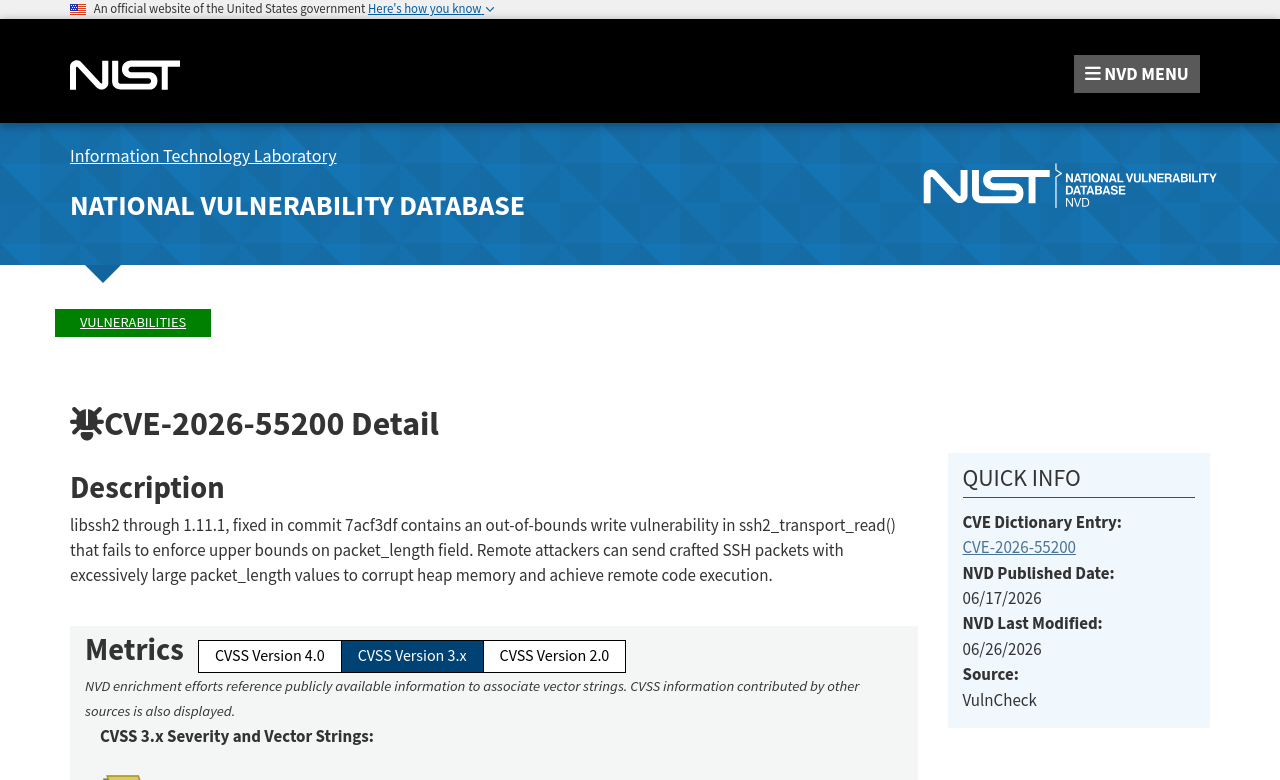
Cybersecurity researchers at VulnWatch Labs publicly released a Proof-of-Concept (PoC) exploit for CVE-2026-55200 on June 27, 2026. This PoC highlights a critical client-side arbitrary code execution vulnerability in the widely used libssh2 library. The flaw, rated with a CVSS v3.1 score of 9.8 by NVD, allows a malicious SSH server to achieve full remote code execution on any connecting client running a vulnerable version of libssh2. No user interaction beyond initiating the SSH connection is required, making this a severe threat to developers and automated systems connecting to untrusted or compromised SSH endpoints.
What Happened
On June 27, 2026, VulnWatch Labs made public a PoC for CVE-2026-55200, a critical client-side SSH vulnerability in libssh2. This flaw affects libssh2 versions 1.10.0 and earlier, as detailed by NVD. The PoC demonstrates how a specially crafted SSH_MSG_CHANNEL_DATA message, sent by a malicious server, triggers an out-of-bounds write within the vulnerable client's message parsing function. This memory corruption leads directly to arbitrary code execution on the connecting client system. Dr. Cypher, a security researcher from VulnWatch Labs, stated, "This flaw highlights the necessity for rigorous input validation and memory safety in core networking libraries. A single connection to a compromised SSH server can now lead to a complete system takeover." The exploit requires no further user interaction once an SSH connection is initiated to a malicious server, making it highly effective.
Why It Matters
The public availability of a PoC for a CVSS 9.8 client-side RCE means that systems connecting to SSH servers are now directly exposed to a severe takeover risk. Attackers could gain full control over affected client systems, potentially leading to immediate data exfiltration, lateral movement within networks, or the deployment of ransomware. SecurityWeek highlights that client-side flaws like CVE-2026-55200 can be just as dangerous as server-side vulnerabilities, if not more so, given the implicit trust often placed in client applications connecting to various services. The ubiquity of libssh2 across applications like Git, SCP, SFTP clients, and a multitude of open-source projects means the attack surface is enormous. Organizations running vulnerable clients and connecting to external, untrusted, or even internally compromised SSH servers are at significant risk. While TheHackerNews has not identified any specific malware associated with this vulnerability as of June 29, 2026, the critical nature and public PoC availability strongly suggest widespread exploitation is possible and likely imminent.
Affected Scope & Remediation
The scope of CVE-2026-55200 is broad. Any application that uses the libssh2 library for SSH client functionality is potentially vulnerable if it's running versions 1.10.0 or earlier. This includes numerous common development tools, file transfer utilities, and backend services like Git clients, SCP and SFTP clients, and various automation scripts.
Patch it now. The immediate remediation is to update libssh2 to a patched version. While the exact patch release date isn't specified in initial reports, the fixed version is 1.10.1 or later, according to the NVD entry.
| Product | Version Range | Fixed Version | Source |
|---|---|---|---|
libssh2 |
1.10.0 and earlier |
1.10.1 or later |
NVD |
Patch Links:
- NVD Entry: CVE-2026-55200
- VulnWatch Labs Advisory: VWL-2026-003-libssh2-RCE
If immediate patching isn't feasible, consider these workarounds:
- Restrict Untrusted Connections: Block or severely limit SSH connections from client systems to untrusted or external SSH servers. Use solutions like Cloudflare Zero Trust to enforce strict network access policies and segment network access based on device posture and user identity.
- Monitor Outbound Connections: Organizations should monitor for unusual outbound connections from client machines after establishing SSH sessions, especially to newly observed or untrusted SSH hosts. Endpoint Detection and Response (EDR) solutions like CrowdStrike Falcon can help detect post-exploitation activities and anomalous network behavior.
Timeline:
- Disclosure Date: Not publicly specified in initial reports (pre-patch).
- PoC Public Release: June 27, 2026 (VulnWatch Labs).
- Patch Release: Not explicitly detailed in the initial reports.
This CVE is not currently listed in the CISA KEV catalog.
Technical Breakdown
The core of CVE-2026-55200 lies in a classic memory safety issue: an out-of-bounds write. When a vulnerable libssh2 client initiates an SSH connection to a malicious server, the attack chain begins. During the SSH handshake or subsequent communication, the malicious server sends a specially crafted SSH_MSG_CHANNEL_DATA packet to the client.
The client's libssh2 library, expecting data within a certain buffer size, gets overflowed by the oversized SSH_MSG_CHANNEL_DATA message. This triggers an out-of-bounds write. Instead of writing within its allocated memory space, the malicious data overwrites adjacent memory regions. This overwritten memory can then contain attacker-controlled code, which, when executed by the vulnerable client process, achieves arbitrary code execution. It’s a direct memory corruption leading to full control. The exploit is reliable because it targets a fundamental parsing error in a core networking library.
This attack maps to T1203 Exploitation for Client Execution in MITRE ATT&CK, as it involves an attacker using a vulnerability in a client-side application to gain execution on a remote system via user interaction (initiating an SSH connection). From a NIST SP 800-53 perspective, this highlights a severe failing in SI-10 Information Input Validation, underscoring the necessity for strict checks on all data received from external sources, especially in critical communication protocols.
Historical Context
This isn't libssh2's first memory safety issue. Back in 2019, the library was affected by CVE-2019-17498, a heap-based buffer over-read vulnerability. That flaw, while also client-side and stemming from parsing errors, was generally less severe. It typically led to information disclosure or denial-of-service conditions, not direct arbitrary code execution. That incident involved improper handling of SSH_MSG_CHANNEL_DATA_EXTENDED messages, causing a client to read beyond its allocated buffer. The similarity lies in both being client-side parsing flaws within libssh2 that could be triggered by a malicious server. The key difference with CVE-2026-55200 is the shift from information disclosure or DoS to critical RCE, making it a far more dangerous vulnerability.
Data at a Glance
| Metric | Value | Source |
|---|---|---|
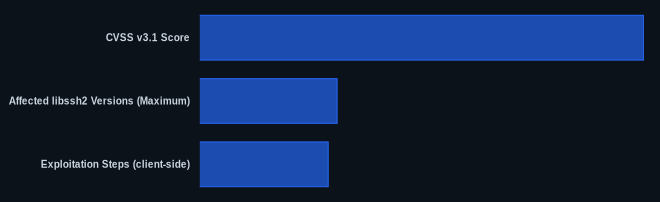
| CVSS v3.1 Score | 9.8 | NVD |
| Affected libssh2 Versions (Maximum) | 1.10.0 |
NVD |
| Exploitation Steps (client-side) | 1 |
VulnWatch Labs |
| Impact | Remote Code Execution | SecurityWeek |
| Malware Observed | No (as of June 29, 2026) | TheHackerNews |
Our Take
We're beyond the point of just server-side vulnerability scanning. This libssh2 flaw makes it clear that client-side components in widely adopted libraries are just as, if not more, dangerous when compromised. The risk here isn't just to the individual developer's machine but to CI/CD pipelines, automated scripts, and any system that programmatically connects to SSH endpoints. The public PoC means this will be weaponized quickly. Your SOC needs to be looking for anomalous outbound connections from any SSH client after connection, especially to new or suspicious destinations.
The CVEDaily Take
CVE-2026-55200 in libssh2 is the kind of "sleepwalking into compromise" flaw that keeps us up at night. Yes, CVSS 9.8. But exploitation requires network access — internal-only systems buy time, but don't negate the risk. Patching is non-negotiable. We think the widespread, often embedded, nature of libssh2 means many organizations underestimate their exposure, especially in environments with numerous development tools or automated scripts.
What's your strategy for identifying and patching every libssh2 dependency in your environment, especially embedded ones?
FAQ
Q: What exactly is libssh2?
A: libssh2 is a client-side C library that implements the SSH2 protocol, allowing applications to securely connect to SSH servers, transfer files (SCP, SFTP), and execute commands remotely. It's used by a vast array of software, including Git, popular file transfer utilities, and many open-source projects.
Q: Does connecting to a legitimate SSH server mitigate the risk?
A: Not entirely. While connecting to a known, trusted server reduces the immediate risk of a malicious server-side exploit, even legitimate SSH servers can be compromised. If a trusted server is breached, attackers could use it to send the crafted SSH_MSG_CHANNEL_DATA packet to connecting vulnerable clients.
Q: What's the immediate action for system administrators?
A: Prioritize identifying all systems and applications using libssh2 versions 1.10.0 or earlier and update them to 1.10.1 or later immediately. Simultaneously, enhance monitoring for unusual network activity originating from SSH client machines, especially post-connection.