CISA Adds Supply Chain Attack Vulnerabilities to KEV Catalog
On May 27, 2026, CISA added three new supply chain attack vulnerabilities to its Known Exploited Vulnerabilities (KEV) Catalog, signaling a critical shift in how attackers are targeting organizations. This move highlights a growing emphasis on compromising the integrity of software supply chains, moving beyond traditional network perimeters. These newly cataloged CVE-2026-8398, CVE-2026-45321, and CVE-2026-48027 affect trusted software installers, package registries, and developer tools, representing a direct threat to the very foundations of software development and deployment. The rapid exploitation window, potentially compressed further by agentic AI, demands immediate attention to these vulnerabilities.
What Happened
On May 27, 2026, CISA officially updated its KEV Catalog with three new entries specifically tied to supply chain attacks. This signals active exploitation in the wild, posing substantial risks to both federal and private sector organizations. The vulnerabilities added are: CVE-2026-8398, impacting DAEMON Tools Lite; CVE-2026-45321, related to compromised TanStack packages; and CVE-2026-48027, affecting the Nx Console developer extension.
These vulnerabilities target critical points in the software delivery pipeline. Rather than exploiting network-facing services, attackers are compromising systems that govern software installation itself, including trusted installers, public package registries like npm, and widely used developer tools. The overarching theme is the injection of malicious code into legitimate software or development components.
A significant example of this vector is the incident disclosed by Grafana Labs, which suffered a supply-chain attack leveraging compromised TanStack npm packages (covered by CVE-2026-45321) in a misconfigured GitHub Actions workflow. Attackers successfully stole a privileged GitHub App token and exfiltrated private source code, as reported by BleepingComputer. Grafana Labs confirmed this exfiltration and the theft of the token. This incident demonstrates the devastating potential when trust in developer tooling is shattered.
Why It Matters
Inclusion of these supply chain vulnerabilities in the KEV Catalog is a loud alarm for all organizations. CISA's Binding Operational Directive (BOD) 22-01 mandates federal agencies to remediate KEV-listed vulnerabilities by specified due dates, and CISA urges all organizations to prioritize timely remediation. This impacts every entity building or deploying software.
The impact can be far-reaching and disproportionate. Consider widely used components like LiteSpeed, often the default engine in cPanel shared hosting environments. A single compromised plugin or package could infect hundreds of tenants if it's part of their deployed stack, as seen in past incidents. The rapid exploitation of vulnerabilities—sometimes within hours of disclosure—is already a growing concern. Agentic AI could further compress the window between vulnerability disclosure and active exploitation, making proactive patching and supply chain integrity checks more critical than ever.
This CISA update follows a worrying trend of increasing supply chain attacks. The ease with which malicious code can propagate through trusted channels means that traditional perimeter defenses are becoming less effective against these sophisticated threats. Protecting the software supply chain now means scrutinizing every dependency, build tool, and developer extension.
Affected Scope & Remediation
The newly added CVEs impact popular software and developer tools, making their scope potentially broad across various industries.
| Product | Version Range | Fixed Version | Source |
|---|---|---|---|
| DAEMON Tools Lite | < 11.2.0.2036 |
11.2.0.2036 |
NVD CVE-2026-8398 |
| TanStack packages | Affected npm package distributions | Remediated distributions | NVD CVE-2026-45321 |
| Nx Console | < 19.3.0 |
19.3.0 |
NVD CVE-2026-48027 |
Remediation for these vulnerabilities is critical and urgent:
- CVE-2026-8398 (DAEMON Tools Lite): Organizations using DAEMON Tools Lite should immediately update to version 11.2.0.2036 or later. Details are available on the NVD CVE-2026-8398 entry.
- CVE-2026-45321 (TanStack packages): This CVE describes a supply-chain compromise of TanStack npm packages rather than a flaw in the package code itself. Organizations should ensure they are using untainted or remediated versions of
@tanstack/query,@tanstack/react-query, and other affected packages. Review yourpackage-lock.jsonor equivalent for suspicious hashes and verify package integrity. The Grafana Labs disclosure provides context, as noted by BleepingComputer. - CVE-2026-48027 (Nx Console): Users of the Nx Console VS Code extension should update to version 19.3.0 or newer. Refer to the NVD CVE-2026-48027 entry for more information.
While specific disclosure and patch dates for these newly added KEVs are not always public, their presence in the catalog confirms active exploitation. CISA's KEV Catalog entries can be found via the main KEV page. Federal agencies are mandated to patch these vulnerabilities by their assigned due dates per BOD 22-01.
If immediate patching is not feasible, implement compensating controls. Restrict network access to systems running affected software, enforce application whitelisting, and use endpoint detection and response (EDR) solutions like CrowdStrike Falcon or SentinelOne to monitor for anomalous activity. Regularly audit developer environments for unauthorized extensions or modified package registries.

Technical Breakdown
These supply chain attacks inject malicious code into trusted software components before they reach the end-user or developer. Instead of breaking into a production system directly, attackers poison the well. Think of it like a trusted food supplier sending you flour, but someone has already mixed in a small, undetectable amount of poison at the mill. By the time you bake with it, your entire product is compromised.
For CVE-2026-45321 affecting TanStack packages, the attack vector was the compromise of the npm package registry, allowing attackers to push malicious versions of legitimate packages. When developers pulled these packages into their projects, the malicious code executed. In the Grafana Labs incident, this led to the compromise of a GitHub Actions workflow, which then enabled the theft of a privileged GitHub App token. This token, typically used for automated tasks, granted attackers broad access to sensitive resources, including private source code. Exfiltration then likely occurred over a C2 channel.
Similarly, CVE-2026-48027 involving Nx Console, a Visual Studio Code extension, highlights how developer tools can be weaponized. A malicious extension, or a vulnerability within a legitimate one, can provide attackers with powerful hooks into a developer's environment. This can lead to remote code execution (RCE) via crafted project configurations, allowing attackers to access local files, credentials, or inject further malware. The DAEMON Tools Lite vulnerability (CVE-2026-8398) points to local privilege escalation, where an attacker who has already gained initial access can elevate their privileges to gain full control of the system, often exploiting flaws in how installers or system services handle file permissions or execute code.
These attack types fall under the MITRE ATT&CK technique T1195.002 Compromise Software Supply Chain, as they involve tampering with legitimate software, components, or updates. Once the supply chain is compromised, subsequent actions might involve T1041 Exfiltration Over C2 Channel for data theft or T1078 Valid Accounts if stolen credentials are used. From a compliance perspective, SA-10 Developer Configuration Management controls from NIST SP 800-53 are critical. This includes processes for secure coding, component validation, and integrity checks throughout the software development lifecycle. Without these, organizations remain vulnerable to pre-infection.
Historical Context
Supply chain attacks are not new, but their frequency and sophistication are rapidly increasing. A pertinent historical incident is the "Megalodon" campaign in March 2026. This campaign, extensively detailed by security researchers, impacted over 5,000 GitHub repositories by injecting malicious workflow files into GitHub Actions. Attackers leveraged compromised credentials or insecure configurations to modify .github/workflows YAML files, causing them to execute malicious commands during build processes. This allowed for credential theft and further infiltration, showcasing how deeply integrated development tools can become vectors for attack. The claim of 5,000 repositories impacted has not been independently verified, but was widely reported by security researchers at the time.
This "Megalodon" incident is strikingly similar to the Grafana Labs compromise linked to CVE-2026-45321. Both exploited weaknesses in automated build pipelines and relied on developers trusting the integrity of their code repositories and CI/CD tools. The key difference might lie in the initial compromise point: Megalodon focused on directly manipulating workflow files, while the TanStack incident involved poisoning upstream npm packages. However, the end goal — leveraging the supply chain to gain access and exfiltrate data — remains consistent. Earlier, in March 2026, a critical cPanel bug (CVE-2026-41940) was weaponized to distribute Mirai botnet malware and ransomware across approximately 44,000 cPanel servers (BleepingComputer), further illustrating the widespread impact of compromising widely used software infrastructure. The estimate of 44,000 servers was reported by security researchers, but not officially confirmed by cPanel.
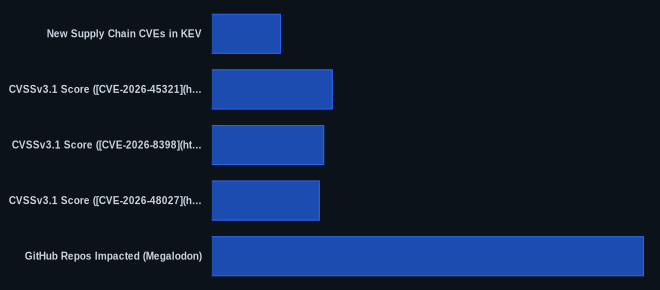
Data at a Glance
| Metric | Value | Source |
|---|---|---|
| New Supply Chain CVEs in KEV | 3 |
CISA KEV Catalog |
| KEV Addition Date | May 27, 2026 |
CISA KEV Catalog |
| CVSSv3.1 Score (CVE-2026-45321) | 9.8 |
NVD CVE-2026-45321 |
| CVSSv3.1 Score (CVE-2026-8398) | 7.8 |
NVD CVE-2026-8398 |
| CVSSv3.1 Score (CVE-2026-48027) | 7.3 |
NVD CVE-2026-48027 |
| GitHub Repos Impacted (Megalodon) | 5,000+ |
Security researcher reports, unconfirmed |
| Affected cPanel Servers (CVE-2026-41940) | 44,000 |
Security researcher reports, unconfirmed |
The CVEDaily Take
CISA's consistent push on supply chain vulnerabilities via the KEV catalog clearly signals the primary attack vector for the next few years. We think the widespread adoption of "agentic AI" could turn the supply chain into a minefield, accelerating exploitation from weeks to hours and forcing a re-evaluation of current patch management timelines. Ignoring compromised developer tools or tainted open-source components is a ticking time bomb.
Has your organization implemented automated integrity checks for all third-party dependencies in your CI/CD pipelines?
FAQ
Q: What is the significance of CISA adding supply chain vulnerabilities to its KEV Catalog?
A: It signifies that these specific supply chain attack methods are being actively exploited in the wild, posing immediate and severe risks. CISA's KEV Catalog entries carry a mandate for federal agencies to remediate and serve as an urgent warning for all other organizations.
Q: What immediate steps should organizations take to address these supply chain vulnerabilities?
A: Organizations should immediately identify if they use DAEMON Tools Lite, affected TanStack packages, or the Nx Console developer extension, and then apply the latest available patches or use untainted versions. Beyond specific CVEs, implement strong software supply chain security practices, including integrity checks on dependencies, secure development lifecycle processes, and continuous monitoring of build and deployment environments.
Q: How do agentic AI tools impact the exploitation window for supply chain vulnerabilities?
A: Agentic AI can significantly compress the time between a vulnerability's public disclosure and its active exploitation. These AI tools can rapidly analyze vulnerability details, generate exploit code, and identify potential targets at scale, potentially reducing the window for defenders to patch from days or weeks to mere hours.