Megalodon Campaign Targets Over 5,000 GitHub Repositories
An automated campaign, dubbed 'Megalodon', injected malicious workflow files into over 5,000 GitHub repositories via GitHub Actions on May 27, 2026, marking a significant escalation in supply chain attacks against open-source projects. The attackers executed 5,718 malicious commits across 5,561 repositories within a concentrated six-hour window, according to reports from BleepingComputer. This aggressive deployment demonstrates a clear intent to compromise CI/CD pipelines and exfiltrate sensitive data, primarily targeting JavaScript and Python projects. It’s a direct assault on the trust model underpinning modern software development.
What Happened
The 'Megalodon' campaign, first identified on May 27, 2026, launched a rapid-fire series of automated attacks designed to compromise the CI/CD pipelines of open-source projects. Over a mere six hours, the campaign successfully deployed 5,718 malicious commits across 5,561 GitHub repositories, as reported by The Hacker News. This was not a manual effort; the scale points to sophisticated automation.
The attack vector was GitHub Actions, GitHub's cloud-based CI/CD platform. Attackers injected malicious workflow files directly into target repositories. Once merged by a maintainer, these files would execute within the CI/CD environment, allowing the malware to run and potentially propagate. The primary goal was to steal sensitive information, including credentials and API keys, using the trusted execution context of the pipeline itself.
This incident reflects a broader, unsettling trend. IBM's X-Force Threat Intelligence Index 2026 notes a quadrupling of supply chain and third-party compromises over the past five years. Attackers increasingly focus on open-source ecosystems, with JavaScript and Python repositories being prime targets. Another incident, though unrelated to Megalodon, saw the TeamPCP hacking group steal roughly 3,800 internal GitHub repositories after a developer installed a poisoned Visual Studio Code extension, according to SecurityWeek. These are not isolated events; they are symptoms of a systemic vulnerability.
Why It Matters
This is about the integrity of the entire software supply chain. When malicious code is injected at the CI/CD level, it taints not only the immediate project but every downstream application that depends on it. A single compromised open-source library can introduce vulnerabilities into thousands of commercial products. This attack demonstrates how attackers are moving further upstream in the development process, targeting the very tools and platforms developers trust to build and deploy software.
The impact extends far beyond immediate data theft. Trust in the open-source community erodes. Developers become wary of pulling in dependencies. It also creates a massive remediation headache, as maintainers need to identify, revert, and verify the integrity of thousands of affected projects. Megalodon exploits the inherent trust in automated workflows, turning a convenience feature into a critical attack vector. We are seeing a direct parallel to incidents like SolarWinds, where a single compromise in a trusted software update mechanism led to widespread damage. This campaign signals a clear shift: securing the pipeline is now as critical as securing the endpoint.
Affected Scope & Remediation
The immediate scope of the 'Megalodon' campaign directly affected over 5,500 GitHub repositories, primarily targeting open-source JavaScript and Python projects, as reported by The Hacker News. Project maintainers whose repositories show unexpected commits or modifications to .github/workflows/ directories should consider their projects compromised. The remediation for Megalodon is multi-faceted: it requires enhanced security postures rather than a simple patch. Implement stronger code review processes, especially for pull requests touching CI/CD configurations. Verify third-party dependencies rigorously, using tools that check for known vulnerabilities and suspicious behavior.
Continuous monitoring of development pipelines for suspicious activity is now mandatory. Tools like CrowdStrike Falcon can help detect anomalous execution within CI/CD environments, flagging unusual build behaviors or outbound connections. Implement strict access controls for GitHub Actions, ensuring least privilege for workflow tokens. Limit the permissions granted to GitHub Actions workflows, only allowing what is absolutely necessary. Implement a secrets management solution, such as Bitwarden, for all credentials used within workflows, ensuring secrets are not hardcoded.
In a separate but equally urgent matter, CISA added CVE-2026-48172 to its Known Exploited Vulnerabilities (KEV) catalog on May 26, 2026. This critical-severity vulnerability impacts the LiteSpeed user-end plugin for cPanel and is being actively exploited in the wild. Federal agencies have a hard deadline to patch or remove the vulnerable plugin versions by May 29, 2026. While unrelated to Megalodon, it underscores the need for immediate action against known exploited flaws.
| Product | Version Range | Fixed Version | Source |
|---|---|---|---|
| LiteSpeed user-end plugin for cPanel | Consult NVD and Vendor Advisories | Consult NVD and Vendor Advisories | NVD, CISA |
| GitHub Repositories (Megalodon) | Any project utilizing GitHub Actions | N/A (requires process change, not patch) | BleepingComputer, The Hacker News |
For CVE-2026-48172, the CISA KEV entry details the urgency, but specific disclosure, patch release, and first known exploit dates were not immediately available at the time of its addition to the KEV catalog. The mandatory patch deadline for federal agencies is May 29, 2026, just 3 days after its KEV listing. Organizations not bound by CISA directives should still prioritize this CVE, given its active exploitation.
- NVD Entry (CVE-2026-48172): https://nvd.nist.gov/vuln/detail/CVE-2026-48172
- CISA KEV Entry (CVE-2026-48172): https://www.cisa.gov/known-exploited-vulnerabilities-catalog
- Vendor Advisory (CVE-2026-48172): Consult LiteSpeed/cPanel directly as specific URL was not detailed in initial reports.
Technical Breakdown
The 'Megalodon' campaign operates by abusing the automated nature of GitHub Actions, turning the very fabric of continuous integration into a weapon. Attackers initiate pull requests (PRs) or directly commit to target repositories, often appearing innocuous. The payload is not a traditional virus file; it is a malicious workflow definition, typically written in YAML, placed in the .github/workflows/ directory. Once a project maintainer unwittingly merges this commit, the malicious workflow is triggered according to its defined schedule or event, such as a push, pull request, or even a cron job.
Consider this scenario: your team is building a house, and you use a detailed blueprint (the repository) with automated robots (GitHub Actions) to perform repetitive tasks like pouring concrete or framing walls. The attacker sneaks a modified page into your blueprint that tells the robots to secretly build a hidden room and leave a key for them. You approve the blueprint, and the robots, blindly following instructions, build the backdoor.
The malicious workflow, now executing with the repository's inherent permissions and access to its secrets, can perform a range of actions. This often includes credential dumping, exfiltrating environment variables, GitHub tokens, or cloud service API keys to an attacker-controlled server. It can also download and execute additional payloads, leading to further compromise of the build environment or even connected systems. The attack uses T1195.002 Compromise Software Supply Chain by directly injecting malicious components into trusted development infrastructure. It also aligns with T1078 Valid Accounts if the initial compromise involved a developer account.
From a defensive standpoint, this highlights critical control gaps. The NIST SP 800-53 control SA-10 Developer Configuration Management is directly applicable here. It calls for managing and controlling configuration items developed internally and acquired externally. For CI/CD pipelines, this means rigorously controlling who can modify workflows, what those workflows can do, and continuously monitoring their execution for deviations from baseline behavior. Ignoring this control gives attackers an open invitation to your build environment.
Historical Context
The 'Megalodon' campaign echoes the larger threat of supply chain attacks, notably mirroring the infamous SolarWinds compromise identified in late 2020. In the SolarWinds incident, attackers, suspected to be the Russian-backed APT29 (Cozy Bear), injected malicious code into the legitimate software updates of SolarWinds' Orion platform. This compromised software was then distributed to thousands of government agencies and private companies, leading to widespread network infiltration.
The similarity lies in the exploitation of trust within critical software infrastructure. SolarWinds abused trust in a vendor's update mechanism, while Megalodon targets the trust in open-source collaboration and automated CI/CD pipelines. Both bypass traditional perimeter defenses by inserting malicious elements into what appear to be legitimate, trusted processes.
However, key differences exist. SolarWinds was a highly targeted, sophisticated operation aimed at specific high-value targets, delivering a trojanized product update. Megalodon, conversely, is an automated, high-volume assault on a broad swathe of open-source GitHub repositories, injecting malicious workflow definitions directly. It is less about a bespoke trojan and more about widespread, automated abuse of a platform feature. While the end goal (data exfiltration, access) is similar, the scale and attack vector—from product binaries to workflow files—illustrate the evolving nature of supply chain threats.
Data at a Glance
| Metric | Value | Source |
|---|---|---|
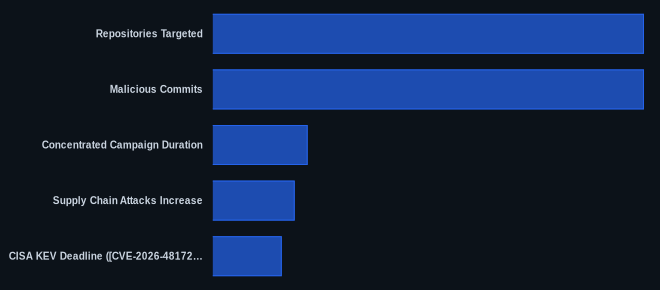
| Repositories Targeted | 5,561 (reported) | BleepingComputer |
| Malicious Commits | 5,718 (reported) | The Hacker News |
| Concentrated Campaign Duration | 6 hours (reported) | SecurityWeek |
| Supply Chain Attacks Increase | 4x (over 5 years, reported by IBM X-Force Threat Intelligence Index 2026) | The Hacker News |
| CISA KEV Deadline (CVE-2026-48172) | 3 days | CISA |
| Attack Type | Supply Chain Attack | CVEDaily.com |
The CVEDaily Take
Megalodon highlights a glaring blind spot in many organizations' security postures: the CI/CD pipeline. These attacks exploit inherent trust and automation, turning them into vulnerabilities. We believe organizations are underestimating the risk of malicious workflow injections and are not applying the same scrutiny to CI/CD changes as they do to production code. This attack proves that a robust perimeter defense is useless if the build environment itself is compromised.
Is your team implementing continuous monitoring and stringent code reviews for all CI/CD changes, especially those touching critical secrets?
FAQ
Q: What is the primary attack vector exploited by the Megalodon campaign?
A: The Megalodon campaign primarily exploits GitHub Actions, GitHub's cloud-based CI/CD platform, by injecting malicious workflow files into repository .github/workflows/ directories. These files execute within the CI/CD environment, allowing for sensitive data theft and potential propagation.
Q: How does the Megalodon campaign steal sensitive information from compromised repositories?
A: Once a malicious workflow file is merged and executed in the CI/CD pipeline, it can use the repository's granted permissions to access and exfiltrate environment variables, GitHub tokens, API keys, and other secrets directly to an attacker-controlled server.
Q: What immediate steps should open-source project maintainers take to mitigate the risk from campaigns like Megalodon?
A: Maintainers should implement rigorous code review processes for all pull requests, especially those affecting CI/CD workflow files. They should also verify third-party dependencies, restrict GitHub Actions permissions to least privilege, and use a secrets management solution for all credentials. Continuous monitoring of CI/CD pipeline logs for anomalous activity is also critical.