Kee Wah Bakery, a prominent local bakery chain, confirmed last week it was hit by a malicious ransomware attack. The company states the incident potentially exposed the personal data of its employees, business partners, online customers, and loyalty program members. On June 13, 2026, Kee Wah Bakery discovered its internal network system failing to operate normally, leading to the receipt of a ransom note. While this attack is currently a regional story, it emphasizes the impact on sensitive data for organizations of all sizes.
What Happened
Kee Wah Bakery discovered its internal network system was failing to operate normally on Friday, June 13, 2026. Following this initial disruption, the company received a ransom note, which confirmed a targeted ransomware attack. Immediate action included engaging cybersecurity experts who implemented emergency measures to block further intrusion and secure the compromised systems. The company swiftly reported the incident to the Office of the Privacy Commissioner for Personal Data and filed a formal police report regarding the attack. As of June 16, 2026, when the story broke, Kee Wah Bakery has not publicly disclosed technical details about the specific ransomware variant used, the exploit mechanism that granted initial access, or any specific indicators of compromise (IOCs) related to the attack, according to initial reports. This lack of public technical detail makes it challenging for other organizations to proactively defend against this specific threat vector, relying instead on general ransomware hygiene.
Why It Matters
The ransomware incident at Kee Wah Bakery is serious. It potentially put the personal data of a significant number of individuals at risk: employees, business partners, online customers, and loyalty program members. While Kee Wah Bakery has not publicly disclosed the exact number of affected individuals or specific types of data compromised beyond 'personal data,' the nature of a bakery chain's operations implies a high likelihood of Personally Identifiable Information (PII) being involved, such as names, addresses, contact details, and potentially payment information for online customers. Such data compromises can lead to identity theft, fraud, and significant reputational damage for the company. We've seen the catastrophic operational disruptions and data fallout from large-scale incidents like the Change Healthcare attack earlier this year, which severely impacted healthcare services and exposed millions of records. For a retail business like Kee Wah, losing customer trust due to a data breach can have long-lasting financial consequences.
Affected Scope & Remediation
Kee Wah Bakery has largely not disclosed the specific scope of affected systems and data types, which makes recommending targeted patches or specific product versions impossible. Since no particular CVEs or exploit mechanisms have been publicly identified for this incident, the remediation strategy focuses on general best practices for ransomware recovery and prevention. Kee Wah Bakery's immediate response to engage cybersecurity experts, block further intrusion, and secure systems aligns with initial incident handling protocols.
For organizations facing similar threats, the priority is always containment and eradication. This involves isolating affected systems, performing forensic analysis to understand the breach's root cause, and thoroughly cleaning and restoring systems from secure, tested backups. Proactive measures are critical. Implementing strong network segmentation can limit lateral movement, while multi-factor authentication (MFA) across all internal and external services can prevent credential-based attacks. Regular, immutable backups, often managed by solutions like Veeam, are non-negotiable for rapid recovery without paying the ransom. Additionally, endpoint detection and response (EDR) solutions such as CrowdStrike Falcon can provide real-time visibility and automated response capabilities to detect and block suspicious activity before encryption occurs. Because the exploit mechanism isn't known, vulnerability management, including regular scanning (RA-5 Vulnerability Monitoring and Scanning) and patching, is essential to minimize attack surfaces. This incident doesn't have an associated timeline for disclosure-to-exploit given the lack of technical details, nor are there any CISA KEV deadlines tied to it.
Technical Breakdown
While Kee Wah Bakery has not made public the specific technical details of its ransomware attack—including the variant and initial access vector—we can infer common ransomware tactics. Attackers often gain initial access through T1190 Exploit Public-Facing Application by compromising internet-facing services or via T1566.001 Spearphishing Attachment or T1566.002 Spearphishing Link targeting employees. Once inside, they typically use T1078 Valid Accounts for lateral movement, often exploiting misconfigurations or weak credentials.
Imagine a ransomware attack as a digital home invasion. The initial access is like an unlocked window (an unpatched public-facing server) or a scammer tricking someone into opening the front door (a phishing email). Once inside, the attacker doesn't immediately trash the place; they first try to find the master bedroom (domain controller) or valuable safes (critical data shares) by quietly moving from room to room (lateral movement). They might use T1003 OS Credential Dumping to harvest NTLM hashes or other credentials from memory, then T1021.001 Remote Desktop Protocol or other remote services to spread. Before encrypting, they often perform T1105 Ingress Tool Transfer to bring in their ransomware payload and T1041 Exfiltration Over C2 Channel to steal sensitive data for double extortion. Finally, they execute the T1486 Data Encrypted for Impact phase, locking down systems, often coupled with T1490 Inhibit System Recovery by deleting shadow copies or backups. From a NIST SP 800-53 perspective, IR-4 Incident Handling and IR-6 Incident Reporting are crucial post-compromise, but proactive controls like SI-3 Malicious Code Protection and AC-3 Access Enforcement are necessary to prevent such attacks in the first place.
Historical Context
The Kee Wah Bakery incident echoes recent ransomware attacks against businesses, including those in the food and agriculture sector. A very recent example is the attack on Mackay Sugar, Australia's second-largest raw sugar producer, where The Gentlemen ransomware group claimed responsibility on June 15, 2026, forcing some mills to shut down. This happened just days before Kee Wah Bakery's public disclosure, according to BleepingComputer.
Both incidents highlight the broad-brush targeting of ransomware groups, who often prioritize targets based on vulnerability rather than specific sector. While Mackay Sugar saw operational technology (OT) impact leading to physical shutdowns, Kee Wah's impact appears to be on IT systems and data confidentiality. The similarity lies in the immediate operational disruption and the potential for significant data compromise, showcasing how ransomware is a pervasive threat regardless of an organization's size or industry. For Mackay Sugar, the claim of responsibility and immediate operational impact provided clearer details, whereas Kee Wah's public statement remains light on specifics.
Data at a Glance
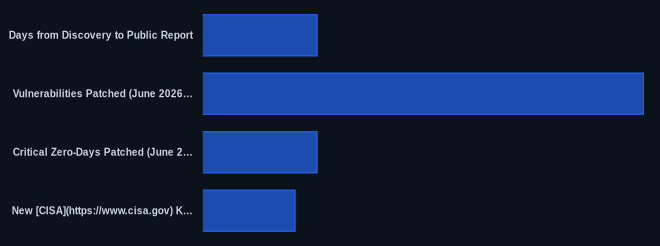
| Metric | Value | Source |
|---|---|---|
| Incident Discovery Date | June 13, 2026 | Kee Wah Bakery Statement, as reported by BleepingComputer |
| Public Report Date | June 16, 2026 | BleepingComputer |
| Days from Discovery to Public Report | 3 days |
CVEDaily analysis based on Kee Wah Bakery statement |
| Vulnerabilities Patched (June 2026 Patch Tuesday) | 206 |
Microsoft Security Update Guide |
| Critical Zero-Days Patched (June 2026 Patch Tuesday) | 3 |
Microsoft Security Update Guide |
| New CISA KEVs (recent additions) | 2 |
CISA KEV Catalog |
| Affected Data Types | Personal Data |
Kee Wah Bakery Statement, as reported by BleepingComputer |
| Ransomware Attack Status | Confirmed |
Kee Wah Bakery Statement, as reported by BleepingComputer |
The CVEDaily Take
The Kee Wah Bakery incident shows that even seemingly low-profile targets are fair game for profit-driven ransomware gangs. While engaging experts and reporting to authorities are standard steps, we think the lack of public technical details around the specific ransomware variant and initial access vector is a missed opportunity for collective defense. This isn't just a regional news item; it's a template for what's happening globally, highlighting that organizations often understate initial access vectors. Businesses need to get serious about basic cyber hygiene, strong backups, and security awareness training through platforms like KnowBe4.
Has your organization simulated a full-scale ransomware recovery, including offline backups, in the last six months?
FAQ
Q: What types of data were potentially exposed in the Kee Wah Bakery ransomware attack?
A: Kee Wah Bakery has stated that the incident potentially exposed the personal data of its employees, business partners, online customers, and loyalty program members. Specific categories of personal data (e.g., names, addresses, payment info) have not been publicly disclosed by the company.
Q: Has Kee Wah Bakery identified the specific ransomware group or variant responsible for the attack?
A: As of the public reports on June 16, 2026, Kee Wah Bakery has not publicly disclosed the specific ransomware variant used or attributed the attack to a particular threat actor group. Technical details like exploit mechanisms or IOCs are also currently unavailable.
Q: What actions has Kee Wah Bakery taken in response to the ransomware attack?
A: Kee Wah Bakery immediately engaged cybersecurity experts to implement emergency measures, including blocking further intrusion and securing their systems. They also reported the incident to the Office of the Privacy Commissioner for Personal Data and filed a formal police report regarding the attack.