
Detecting subtle database anomalies and delayed responses is critical, as blind and time-based SQL injection attempts often bypass signature-based tools. In 2023, these attacks contributed to an average data breach cost of $4.45 million IBM X-Force Threat Intelligence Index 2023. This guide details specific detection signals, a rapid response playbook, and preventive controls that work. We’ll outline how to continuously monitor database activity for behavioral deviations and provide actionable steps to stop attackers cold.
How SQL injection Works: The Attack Chain
SQL injection isn't a single event; it's an attack chain designed to trick an application into running malicious SQL queries. Attackers exploit flawed input validation in web applications, inserting hostile SQL commands into fields like usernames, passwords, or search queries. This allows them to bypass authentication, extract sensitive data, or even take control of the underlying operating system.
It’s like a disgruntled librarian subtly altering catalog entries to misdirect patrons, making them retrieve the wrong books or reveal private information about other library users, without anyone noticing the initial "query" change. The librarian doesn't directly steal books; they manipulate the system to expose them.
1. Initial Access
Attackers identify public-facing web applications with input validation flaws. They use automated scanners like SQLMap or manually probe parameters for vulnerability, often targeting common web application frameworks. This phase aligns with MITRE ATT&CK technique T1190 (Exploit Public-Facing Application). A successful probe might return an unexpected error or a different page response.
2. Execution and Control
Once a vulnerability is confirmed, attackers inject commands to gather information about the database schema, user tables, and database version. They might use xp_cmdshell (on SQL Server) or sys_eval (on MySQL) to execute operating system commands directly through the database. This uses the application's database connection to establish a foothold, often under the web server’s privileges, aligning with T1059 (Command and Scripting Interpreter).
3. Persistence and Privilege Escalation
With OS command execution, attackers can upload web shells or establish remote access tools. They’ll often use tools like Havij to facilitate this. A web shell, placed in the web server's accessible directory, grants persistent access, even if the initial SQLi vector is patched. This relates to T1505.003 (Server Software Component: Web Shell) as they maintain control through the compromised application.
4. Credential Access and Data Exfiltration
From the compromised server or database, attackers search for credentials. They might dump password hashes from the database (e.g., from sys.sql_logins in SQL Server) or use OS commands to access system files like SAM or LSASS (T1003 – OS Credential Dumping). These stolen credentials facilitate lateral movement. Finally, sensitive data, like customer records or intellectual property, gets exfiltrated to an attacker-controlled server.
SQL injection Variants and Types
SQL injection isn't a monolithic threat; several variants exploit different database behaviors and application responses. Knowing the distinctions helps tailor detection and prevention strategies.
Error-based SQL injection
This variant relies on the application displaying verbose database error messages. Attackers craft queries that intentionally produce errors, using the error messages themselves to extract information such as table names, column names, or even sensitive data. For example, a banking app in 2022 might have revealed schema details in an error message during a misconfigured transaction.
Union-based SQL injection
Attackers use the UNION SELECT statement to combine the results of a malicious query with the legitimate query results, embedding unauthorized data directly into the web page. Threat actors like Fancy Bear have historically used this method for data exfiltration, making it appear as part of normal application output.
Blind SQL injection (Boolean-based, Time-based)
Blind SQLi doesn't return data directly to the web page or through error messages. Instead, attackers infer information based on the application's behavior. Boolean-based attacks return a true/false condition (e.g., page loads or doesn't load) to test conditions. Time-based attacks, the most difficult to detect, rely on database delays (e.g., SLEEP(5)) to determine if a condition is true or false. A healthcare provider in 2023 suffered a blind SQLi where the attacking group claims patient records were slowly exfiltrated without direct error feedback; no affected organization has confirmed this claim.
Out-of-band SQL injection
This advanced technique forces the database server to send data to an external, attacker-controlled system, often through DNS lookups or HTTP requests. The DLAPiper incident of 2024, involving data security, highlighted how exfiltration might occur via such covert channels, bypassing direct web application responses.
How to Detect SQL injection: Warning Signs and IOCs
Detecting SQL injection requires continuous vigilance across endpoints, networks, and SIEMs, focusing on behavioral anomalies often missed by simple signatures.
Endpoint Indicators
Monitor web and database servers for unexpected process activity. Look for Windows Event ID 4688 (Process Creation) where cmd.exe, powershell.exe, or sqlcmd.exe are spawned by web server processes like w3wp.exe, httpd.exe, or nginx.exe. Pay close attention to command-line arguments containing xp_cmdshell, bcp, sp_oacreate, or other database-specific shell commands. Endpoint Detection and Response (EDR) solutions like CrowdStrike Falcon can alert on "Suspicious Child Process of Web Server" or "Web Shell Activity Detected," indicating post-exploitation actions (MITRE ATT&CK T1505.003). Also, watch for unusual file modifications in web root directories, specifically .asp, .aspx, .php, or .jsp files, which often signal web shell uploads.
Network Indicators
Inspect network traffic for anomalies originating from web or database servers. Look for outbound connections from these servers to unusual ports (80, 443, 53, 21, 22, 25, 3389) or external IPs that aren't whitelisted, especially to known C2 infrastructure or non-corporate ranges. High volumes of small, repeated HTTP requests to specific web application parameters, often with unusual URL encoding or non-standard characters, can indicate automated scanning or blind SQLi attempts. DNS queries from database servers to external domains, particularly non-existent ones, are strong indicators of out-of-band data exfiltration.
SIEM Detection
Centralize and analyze logs from web servers, databases, and WAFs to correlate events. A Splunk query like index=windows sourcetype=WinEventLog:Security EventCode=4688 ParentProcessName IN ("w3wp.exe", "httpd.exe", "nginx.exe") NewProcessName IN ("cmd.exe", "powershell.exe", "sqlcmd.exe") | stats count by NewProcessName, CommandLine can quickly flag suspicious process creations. For Elastic users, search for web shell uploads with winlog.event_id:"4663" AND file.path:(*.asp OR *.aspx OR *.php OR *.jsp) AND process.name:(w3wp.exe OR httpd.exe OR nginx.exe) to detect write activity in web directories. Monitor for a spike in database login failures (e.g., SQL Server Event ID 18456) or multiple failed authentication attempts (MITRE ATT&CK T1110) from the web application's service account, which might signal brute-force or credential stuffing attempts targeting the database.
Response Playbook: What to Do When SQL injection Hits
When SQL injection strikes, rapid, precise actions are crucial to minimize damage and prevent further compromise. This playbook outlines immediate containment, forensic preservation, and recovery steps.
Phase 1: Immediate Containment (first 15 minutes)
- Isolate affected systems: Immediately disconnect the compromised web server and database server from the network. Do not power them down; a network disconnect preserves volatile memory for forensics.
- Block attacker IPs: Block the attacker's source IP addresses at the perimeter firewall or Web Application Firewall (WAF). Review logs to identify if the attacker has established other active connections or used different source IPs.
- Rotate credentials: Force rotate credentials for the web application's database user account and any other administrative or service accounts that may have been compromised. For SQL Server, use
ALTER USER [username] WITH PASSWORD = '[new_password]'.
Phase 2: Forensic Preservation
- Image volatile memory: Acquire a forensic image of the volatile memory (RAM) from both the compromised web server and the database server. Tools like FTK Imager Lite or Magnet RAM Capture can be invaluable here, capturing critical in-memory artifacts.
- Collect all relevant logs: Gather web server access logs, database logs (transaction logs, error logs, audit logs), application logs, and system event logs (e.g., Windows Event 4624/4625 for logon/logoff events). These logs are essential for understanding the attacker's actions and timeline.
- Document system state: Record the current state of the compromised systems. This includes a list of running processes, open network connections (
netstat -ano), file system timestamps, and any suspicious files found in web roots or system directories.
Phase 3: Recovery and Hardening
- Restore from backup: Restore the web application and database from a known good backup taken before the compromise. Verify the integrity and functionality of the restored systems before bringing them back online.
- Patch and validate: Apply all necessary patches to address the identified SQL injection vulnerability (MITRE ATT&CK T1190) and any other discovered weaknesses. Implement strong input validation and parameterization in the application code.
- Post-incident review and WAF deployment: Conduct a thorough post-incident review to identify gaps in detection, response, and prevention. Deploy or enhance a Web Application Firewall (WAF) to block known SQL injection patterns and provide virtual patching for web applications.
How to Prevent SQL injection: Controls That Work
Preventing SQL injection requires a multi-layered approach, integrating secure coding practices with strong infrastructure controls. These controls map directly to NIST SP 800-53 and MITRE ATT&CK mitigations.
Input Validation and Secure Coding
Implement input validation (NIST SI-10 Information Input Validation) for all user-supplied data, ensuring only expected data types and formats are processed. Always use parameterized queries or prepared statements, avoiding string concatenation for SQL queries to directly mitigate MITRE ATT&CK T1190. Enforce least functionality (NIST CM-7 Least Functionality) by disabling unused database features and stored procedures, like xp_cmdshell, that could be abused. Integrate secure coding practices and security testing into your CI/CD pipelines (NIST SA-10 Developer Configuration Management) to catch vulnerabilities early.
Access Control and Credential Management
Apply the principle of least privilege (NIST AC-6 Least Privilege) to all database users; web application database accounts should never have administrative or excessive permissions. This limits the impact of a successful credential compromise (MITRE ATT&CK T1003). Implement strong account management (NIST AC-2 Account Management) and authenticator management (NIST IA-5 Authenticator Management), requiring strong, unique passwords and multi-factor authentication (MFA). Tools like 1Password can streamline the secure management and rotation of these critical credentials. Restrict remote access (NIST AC-17 Remote Access) to database servers, limiting access to only necessary management interfaces and ideally routing through secure jump boxes.
Monitoring and Hardening
Enable comprehensive event logging (NIST AU-2 Event Logging) for all database activities, including queries, schema changes, and administrative actions. Regularly perform audit record review, analysis, and reporting (NIST AU-6 Audit Record Review Analysis and Reporting) to quickly detect anomalies indicating compromise or unauthorized activity (MITRE ATT&CK T1059). Conduct continuous vulnerability monitoring and scanning (NIST RA-5 Vulnerability Monitoring and Scanning) of both web applications and databases to identify and remediate flaws proactively (NIST SI-2 Flaw Remediation). Finally, deploy a Web Application Firewall (WAF) as part of your boundary protection (NIST SC-7 Boundary Protection) to inspect and filter web traffic, blocking known SQL injection patterns before they reach the application.
Real-World Incidents
SQL injection remains a potent threat, consistently exploited in major breaches over the years, highlighting persistent control failures.
TalkTalk (2015)
In October 2015, British telecommunications company TalkTalk suffered a significant data breach attributed to SQL injection, orchestrated by a 15-year-old. The attack exposed personal and financial data for up to 157,000 customers, including names, addresses, dates of birth, email addresses, phone numbers, and partial bank details. The incident cost TalkTalk approximately £77 million in recovery efforts, customer compensation, and fines from the Information Commissioner's Office (ICO). The vulnerability was exploited using readily available tools like SQLMap.
Lesson: Basic input validation and parameterization were missing. The failure to detect and patch a known vulnerability at the application layer allowed a simple SQLi to compromise sensitive customer data.
RockYou (2009)
The RockYou incident in December 2009, though older, highlights SQL injection's impact on credential security. A SQL injection vulnerability in the popular social media application led to the compromise of a database containing 32 million plaintext passwords. The attacker exploited the vulnerability to access and dump the entire user table. The exposed data quickly made its way to public forums, enabling widespread credential stuffing attacks against users who reused passwords across multiple services.
Lesson: The critical failure here was storing passwords in plaintext and the lack of strong input validation. Even with the raw data, proper hashing and salting would have significantly mitigated the impact of MITRE ATT&CK T1003 (OS Credential Dumping).
MOVEit Transfer (2023)
While not a classic SQL injection in its initial phase, the MOVEit Transfer vulnerability (CVE-2023-34362) exploited in 2023 by the Clop ransomware group involved an SQL injection variant that permitted unauthorized access to MOVEit's database. The vulnerability allowed an attacker to inject specially crafted payloads into specific parameters, leading to privilege escalation and arbitrary code execution within the database context. This flaw, with a CVSS v3.1 Base Score of 9.8 (Critical) NVD, resulted in a supply chain attack affecting over 2,700 organizations and impacting more than 90 million individuals, according to Claroty. The total estimated damages are projected to exceed $10 billion.
Lesson: Even sophisticated applications can harbor SQL injection-like flaws. The critical failure was inadequate input validation at the application layer, which allowed a "zero-day" vulnerability to persist. Regular, thorough vulnerability monitoring (NIST RA-5) and aggressive patching are essential, especially for public-facing software.
Data at a Glance
| Metric | Value | Source |
|---|---|---|
| Average Cost of a Data Breach (2023) | $4.45 million | IBM X-Force Threat Intelligence Index 2023 |
| Average Time to Identify a Breach (2023) | 204 days | IBM X-Force Threat Intelligence Index 2023 |
| Injection Vulnerability Ranking (OWASP) | #3 (2021) | OWASP Top Ten 2021 |
| Percentage of Web Attacks as Injection | 49% | Akamai State of the Internet 2023 |
| CVE-2023-34362 (MOVEit) CVSS Score | 9.8 (Critical) | NVD |
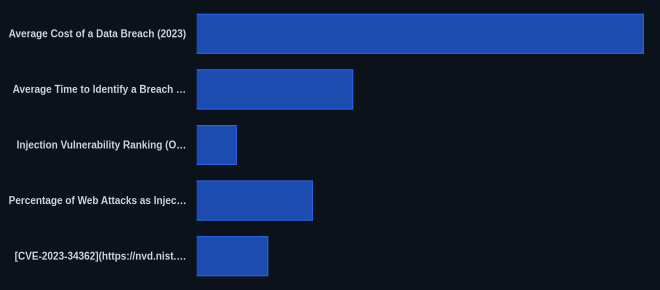
The CVEDaily Take
Standard Web Application Firewalls and signature-based tools often miss the nuanced behaviors of blind and time-based SQL injection, especially in targeted attacks. We see a significant gap in continuously monitoring database activity for subtle, delayed behavioral anomalies that indicate covert exfiltration or command execution. Your database activity logs must feed into a real-time analytics engine, or you risk waiting for an alert that might never fire from a WAF.
How do you differentiate between legitimate database delays and time-based SQL injection attempts in your SIEM?
Tools & Resources
Using the right tools can drastically improve your team's ability to detect, prevent, and respond to SQL injection attacks.
Detection (EDR/SIEM)
- CrowdStrike Falcon (Endpoint Security): Detects unusual process execution chains and web shell uploads originating from web server processes, crucial for post-exploitation SQLi detection. CrowdStrike Falcon Documentation
- Splunk Enterprise Security (SIEM): Aggregates logs from web servers, databases, and WAFs to correlate suspicious activity like multiple failed login attempts followed by unusual queries or outbound connections. Splunk Enterprise Security
- Acunetix (Web Vulnerability Scanner): Identifies SQL injection vulnerabilities in web applications before attackers can exploit them, providing actionable remediation guidance. Acunetix
Prevention (Controls/Hardening)
- ModSecurity (Web Application Firewall): An open-source WAF that can block known SQL injection patterns and provide virtual patching for web applications. ModSecurity Documentation
- OWASP ESAPI (Security Library): Provides a set of security controls, including input validation and output encoding functions, for developers to build more secure applications. OWASP ESAPI
Incident Response (Forensics/Containment)
- Autopsy (Digital Forensics): Helps analyze disk images and other digital evidence to reconstruct attack chains and identify compromised data post-incident. Autopsy
FAQ
Q: How to detect SQL injection?
A: Monitor for web server processes spawning unusual child processes (like cmd.exe or powershell.exe) with database-related command-line arguments, look for high volumes of small, repeated requests to web application parameters, and track outbound connections from database servers to non-whitelisted external IPs or domains.
Q: How to respond to a SQL injection attack?
A: Immediately isolate affected web and database servers from the network, block the attacker's source IP addresses at the firewall/WAF, and force rotate credentials for the compromised web application database user and any other affected administrative accounts.
Q: How to prevent SQL injection?
A: Implement rigorous input validation and parameterized queries in all web application code to prevent malicious data from altering SQL statements, and enforce least privilege by ensuring database user accounts have only the absolute minimum permissions required for their function.