The Cl0p ransomware group exploited a zero-day SQL injection vulnerability (CVE-2023-34362) in Progress Software's MOVEit Transfer product in May 2023, allowing data exfiltration from hundreds of organizations globally. This guide provides IT teams and security engineers with specific detection signals, a rapid response playbook, and proven prevention controls to fortify their infrastructure against previously unknown threats, like those seen with MOVEit Transfer in 2023 and Ivanti Connect Secure VPN in 2024.
How Zero-day Vulnerabilities Work: The Attack Chain
A zero-day exploit allows an attacker to discover a previously unknown weak spot in an organization's defenses, enabling them to bypass security controls before vendors can issue patches. The chain typically unfolds in these steps:
1. Initial Access
Attackers gain entry by exploiting an unknown vulnerability, often via T1566: Phishing (malicious links, attachments) or T1190: Exploit Public-Facing Application (unpatched web servers, VPN appliances like Ivanti Connect Secure or FortiGate). This first step establishes a foothold.
2. Execution
Once inside, the adversary executes arbitrary code, often shellcode, to deploy a second-stage payload. This uses techniques like T1059: Command and Scripting Interpreter (PowerShell, Bash) or T1203: Exploitation for Client Execution (browser-based exploits). This could involve an Office document dropping a malicious executable.
3. Persistence
To maintain access, attackers establish footholds. This might involve creating new services, modifying registry keys, or scheduling tasks using T1547: Boot or Logon Autostart Execution or T1053: Scheduled Task/Job. Think web shells on compromised Microsoft Exchange servers.
4. Privilege Escalation
With persistence, the next step is gaining higher privileges, moving from a standard user to SYSTEM or root. This often involves T1068: Exploitation for Privilege Escalation against kernel flaws, or T1078: Valid Accounts if credentials are stolen early.
5. Defense Evasion
Adversaries work to avoid detection. They use T1027: Obfuscated Files or Information (packing, encryption) to hide payloads, or T1070: Indicator Removal (clearing logs, deleting artifacts) to cover their tracks. Process hollowing is a common technique here.
6. Credential Access
Stealing credentials is key for lateral movement. Techniques include T1003: OS Credential Dumping (like using Mimikatz to extract from LSASS memory) or T1552: Unsecured Credentials (hunting for plaintext credentials in configuration files).
7. Discovery
Attackers map the compromised network, identifying critical assets and data. This involves T1083: File and Directory Discovery and T1046: Network Share Discovery to understand the environment.
8. Lateral Movement
Using stolen credentials or new exploits, attackers move between systems. This can involve T1021: Remote Services (RDP, SSH) or T1563: Remote Service Session Hijacking to spread their influence deeper into the network.
9. Collection
The objective is usually data exfiltration. Attackers gather target data, intellectual property, or financial records using T1005: Data from Local System or T1537: Transfer Data to Cloud Account.
10. Exfiltration
Finally, collected data is moved out of the network via T1041: Exfiltration Over C2 Channel (encrypted tunnels) or T1048: Exfiltration Over Alternative Protocol (DNS tunneling, HTTP/S to cloud storage). The MOVEit Transfer attacks used this stage extensively.
11. Impact
The ultimate goal, whether it's T1486: Data Encrypted for Impact (ransomware), T1490: Inhibit System Recovery (wiping backups), data destruction, or long-term espionage.
Zero-day Vulnerability Variants and Types
Zero-day vulnerabilities manifest in several critical ways, each posing unique threats to different parts of an organization's digital footprint. Google Project Zero observed 97 disclosed zero-days in 2023, highlighting their diverse nature.
Remote Code Execution (RCE)
RCE vulnerabilities allow an attacker to run arbitrary code on a remote system, often without authentication. This is incredibly dangerous as it grants immediate control. The Microsoft Exchange ProxyLogon vulnerabilities (CVE-2021-26855 et al.) are prime examples, enabling mass server compromise.
Local Privilege Escalation (LPE)
An LPE flaw grants higher privileges on a system a threat actor has already partially compromised, moving from a standard user to an administrator or SYSTEM account. Many sandbox escapes eventually lead to an LPE to fully control the underlying OS.
Information Disclosure
These vulnerabilities allow attackers to read sensitive data that should be protected. While not directly allowing code execution, they can expose credentials, internal network layouts, or proprietary data, paving the way for further exploitation or espionage, as seen with some MOVEit Transfer flaws like CVE-2023-34362.
Sandbox Escape
Sandbox escapes enable an attacker to break out of a confined environment, such as a web browser or virtual machine, to access the underlying operating system. These are crucial for exploiting user-facing applications and are frequently chained with LPE vulnerabilities.
How to Detect Zero-day Vulnerabilities: Warning Signs and IOCs
Detecting zero-day exploitation requires correlating subtle, often low-severity, anomalies that don't trigger signature-based alerts.
Endpoint Indicators
Monitor for unusual process behaviors. Look for Word launching PowerShell or cmd.exe (Windows Event ID 4688 with suspicious parent-child relationships). Watch for Sysmon Event ID 1 for enriched process creation data, specifically new processes running from non-standard locations (e.g., %TEMP%, %APPDATA%) or with unusual command-line parameters. EDR tools like CrowdStrike Falcon will flag memory injection attempts, unsigned DLL loads, or attempts to modify sensitive registry keys (e.g., HKLM\SOFTWARE\Microsoft\Windows\CurrentVersion\Run). Also, monitor for Event ID 4624 (Successful Logon) from unusual source IPs or logon types, and Event ID 4720/4722/4725 (User/Group Modification) for new administrative accounts.
Network Indicators
Scrutinize network traffic for deviations from baselines. Look for DNS anomalies: queries to newly observed or rarely seen domains, especially those with high TLD entropy (e.g., *.xyz, *.top). Exfiltration via DNS tunneling (unusually large DNS query sizes) is a critical signal. Watch for unusual traffic patterns: spikes in outbound data on non-standard ports (e.g., 53, 80, 443 for non-HTTP/S traffic) or connections to known malicious IP addresses from threat intelligence feeds. Malformed User-Agent strings or non-standard protocols over common ports (like HTTP traffic on port 22) also point to C2 activity.
SIEM Detection
Integrate EDR and network logs into your SIEM (e.g., Splunk, Elastic Security). Establish correlation rules that aggregate low-severity alerts. For instance, a rule could trigger on: (EDR.alert_level < 3 AND process.name LIKE "%powershell%" AND process.parent.name NOT IN ("explorer.exe", "cmd.exe")) OR (network.outbound_bytes > 1GB AND destination.port IN (53, 80) AND destination.domain NOT IN (allowlist)). Baseline deviation alerts for unusual logon times for critical users (Event ID 4624) or sudden increases in outbound traffic to previously unknown geographic regions are also vital. Integrate CISA KEV catalog and other threat intelligence feeds to immediately flag IOCs associated with newly disclosed vulnerabilities.
Response Playbook: What to Do When a Zero-day Vulnerability Hits
Responding to a zero-day is a race against time. Swift, decisive action is crucial to minimize damage. The Ivanti Connect Secure VPN zero-days in 2024 showed how quickly persistent access can be established if initial compromise isn't contained.
Phase 1: Immediate Containment (first 15 minutes)
Isolate affected systems by disconnecting them from the network or moving them to a quarantine VLAN. Block known IOCs (malicious IPs, domain names, hashes) at your network edge (firewalls, IPS/IDS). Immediately disable compromised user or service accounts. Stop any identified malicious processes (e.g., taskkill /F /PID <PID>). Remove detected persistence mechanisms (e.g., delete suspicious scheduled tasks, clear malicious registry run keys). Apply emergency patches or vendor-provided mitigations if available, even if they're temporary workarounds.
Phase 2: Forensic Preservation
Before any cleanup, preserve the evidence. Create full disk images of compromised systems for deep analysis. Collect memory dumps to capture volatile data, including running processes, open network connections, and loaded modules. Gather all relevant logs: Windows Event Logs (Security, System, Application), Sysmon logs, EDR logs (like from CrowdStrike Falcon), network device logs (firewall, DNS, proxy), and application-specific logs (web server, VPN). Perform network packet capture on affected segments to analyze command and control traffic. Ensure all collected data is forensically sound and has a clear chain of custody.
Phase 3: Recovery and Hardening
Begin recovery by eradicating the threat. This means thoroughly cleaning compromised systems, removing all malicious files, and reversing configuration changes. Harden the recovered systems by applying all available patches, implementing stronger authentication (MFA), and tightening access controls. Rebuild or restore critical systems from known clean backups, ideally from before the compromise. Enhance monitoring for new IOCs and suspicious activities. Conduct a post-incident review to identify root causes, improve detection capabilities, and update your incident response plan. Report to relevant authorities like CISA within 72 hours for critical infrastructure.
How to Prevent Zero-day Vulnerabilities: Controls That Work
Preventing zero-day vulnerabilities is inherently challenging, but strong foundational controls significantly raise the bar for attackers. The goal isn't perfect immunity but reducing the attack surface and increasing the cost of an exploit.
Vulnerability Management
Implement NIST RA-5 (Vulnerability Monitoring and Scanning) and NIST SI-2 (Flaw Remediation) with continuous vulnerability scanning and automated patch management. Integrate threat intelligence feeds to prioritize patching based on exploitability and active use of vulnerabilities, as seen with CISA's KEV Catalog. This ensures you're proactively addressing known issues that might become part of a zero-day chain.
Application Security
Adhere to NIST SA-10 (Developer Configuration Management) by embedding security throughout your Software Development Lifecycle (SSDLC). Use Web Application Firewalls (WAFs) to provide a layer of defense against web-based exploits like SQL injection, a technique used in the MOVEit Transfer attacks. Implement NIST SI-10 (Information Input Validation) to guard against common exploitation vectors.
Endpoint Security
Deploy advanced EDR/EPP solutions capable of behavioral analysis, not just signatures. Enforce NIST AC-6 (Least Privilege) and NIST CM-7 (Least Functionality) by running applications with minimal necessary permissions and disabling unnecessary services. Implement NIST AC-3 (Access Enforcement) through application whitelisting and host-based firewalls to control what executables can run and what network connections are allowed. SentinelOne offers strong behavioral detection against fileless and memory-based threats often employed in zero-days.
Network Security
Segment your network using NIST SC-7 (Boundary Protection) to limit lateral movement. Employ Intrusion Prevention Systems (IPS) to detect and block exploit attempts. Adopt a Zero Trust Architecture guided by NIST AC-17 (Remote Access) and IA-2 (Identification and Authentication) principles, where no user or device is trusted by default, regardless of network location. Solutions like Cloudflare Zero Trust enforce granular access controls and continuously verify identity and device posture for every connection, effectively limiting the blast radius of a compromised endpoint.
User Awareness and Training
Conduct regular phishing awareness training following NIST AT-2. Many zero-day chains begin with a user clicking a malicious link or opening an attachment, making human resilience a critical defense layer against T1566: Phishing.
Secure Configuration
Harden systems using NIST CM-6 (Configuration Settings) and CIS Benchmarks. This reduces the attack surface by eliminating default configurations and unnecessary features that attackers often target.
Real-World Incidents
Zero-day exploits aren't theoretical; they're the cutting edge of cyber warfare and sophisticated criminal operations, causing billions in damages and impacting millions of lives.
MOVEit Transfer Zero-Day (Cl0p Ransomware) – 2023
In May 2023, the Cl0p ransomware gang claims to have exploited a zero-day SQL injection vulnerability (CVE-2023-34362) in Progress Software's MOVEit Transfer managed file transfer product. This allowed them to exfiltrate data from hundreds of organizations globally, including Shell, the BBC, and multiple US federal agencies. BleepingComputer reports the breach affected over 90 million individuals, with Maximus confirming 11 million individuals impacted and the Louisiana DMV nearly 6 million. Financial losses are estimated in the billions by industry analysts, considering direct remediation costs, legal fees, and reputational damage. The average cost of a data breach is typically around $4.75 million (IBM, 2025), but for zero-day incidents like MOVEit, this figure can easily double or triple, reaching $10-15 million.
- Lesson: Sole reliance on perimeter defenses and lack of deep application security analysis of third-party software allowed a seemingly minor SQL injection flaw to become a catastrophic data exfiltration event.
Ivanti Connect Secure VPN Zero-Days (Chinese APT Groups) – 2024
Starting in late 2023 and continuing into early 2024, a chain of zero-day vulnerabilities in Ivanti Connect Secure VPN appliances were actively exploited by state-sponsored Chinese APT groups (e.g., UNC5325, UNC5221), as reported by Mandiant. These included an authentication bypass (CVE-2023-46805 with a CVSS score of 8.2) and a command injection (CVE-2024-21887 with a CVSS score of 9.1). Mandiant states the exploitation compromised hundreds of critical infrastructure organizations, government entities, and defense contractors globally, leading to persistent access and espionage. CISA issued multiple advisories and emergency directives, highlighting the severity and widespread impact.
- Lesson: Network edge devices, often treated as impenetrable, are prime targets. Lack of continuous monitoring for suspicious activity on these appliances, beyond simple health checks, allowed attackers to establish deep persistence for weeks or months.
Microsoft Exchange Server Zero-Days (Hafnium / ProxyLogon) – 2021
In March 2021, a Chinese state-sponsored group known as Hafnium exploited a chain of four zero-day vulnerabilities in Microsoft Exchange Server (dubbed ProxyLogon), Microsoft confirmed: CVE-2021-26855 (SSRF), CVE-2021-26857 (unauthenticated RCE), CVE-2021-26858 (post-auth RCE), and CVE-2021-27065 (post-auth RCE). This led to the mass compromise of tens of thousands of organizations worldwide, including over 30,000 US organizations according to KrebsOnSecurity, resulting in widespread email exfiltration and the deployment of web shells for persistent access. The financial impacts were in the hundreds of millions, covering incident response, system rebuilding, and data breach notifications.
- Lesson: Complex applications with broad functionality (like email servers) present a large attack surface. Delayed patching and insufficient monitoring of internal network traffic for web shell activity allowed attackers to maintain control long after initial exploitation.
Data at a Glance
| Metric | Value | Source |
|---|---|---|
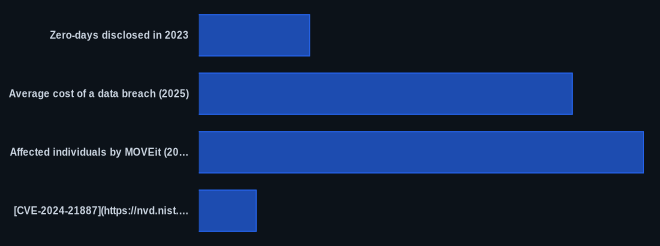
| Zero-days disclosed in 2023 | 97 | Google Project Zero |
| Expected average zero-days annually (2024-2026) | 80-100 | Google Project Zero |
| Average cost of a data breach (2025) | ~$4.75 million | IBM Cost of a Data Breach Report (2025 estimates) |
| Estimated cost of zero-day incident | $10-15 million | CVEDaily.com analysis of zero-day remediation costs |
| Affected individuals by MOVEit (2023) | Over 90 million | BleepingComputer |
| CVE-2024-21887 (Ivanti) CVSS score | 9.1 | NIST NVD |
| YoY trend in zero-day volume | Consistent upward trend | Google Project Zero |
The CVEDaily Take
We often see security teams over-relying on vendor-provided alerts from their EDR or SIEM, hoping for a high-fidelity "zero-day detected" signal. This approach misses the subtle, early-stage behavioral shifts. The real non-obvious truth is that many successful zero-day compromises aren't a single, loud bang, but a series of quiet, seemingly innocuous events that, when correlated (like an unusually high number of whoami commands from a service account paired with outbound DNS queries to a new domain), form a clear picture of compromise.
What specific behavioral rule or correlation are you missing in your SIEM right now that could connect low-severity endpoint process activity with network traffic anomalies?
Tools & Resources
Using the right tools can significantly enhance your ability to detect and respond to zero-day vulnerabilities. These solutions offer capabilities essential for modern defense.
Detection (EDR/SIEM)
CrowdStrike Falcon
Provides advanced EDR capabilities including behavioral analytics, AI-driven threat prevention, and real-time visibility into endpoint activity, which is critical for spotting the early, subtle signs of zero-day exploitation that bypass traditional signatures.
Official Documentation
Splunk Enterprise Security (ES)
A powerful SIEM that enables correlation of diverse log sources (EDR, network, OS) to build complex detection rules and identify patterns indicative of zero-day attack chains. Its search and reporting capabilities are vital for forensic analysis.
Official Documentation
Prevention (Controls/Hardening)
Cloudflare Zero Trust
Offers a modern approach to network security by enforcing granular access controls, continuous identity verification, and device posture checks for every user and device accessing internal resources, significantly reducing the attack surface.
Official Documentation
Tenable Nessus
A leading vulnerability scanner that helps identify known security weaknesses in systems and applications, supporting proactive patching and configuration hardening to reduce the likelihood of zero-day exploitation against a weakened target.
Official Documentation
Incident Response (Forensics/Containment)
Velociraptor
An open-source digital forensic and incident response tool that collects deep endpoint visibility and evidence from hundreds of thousands of endpoints, essential for rapid containment and thorough forensic analysis during a zero-day incident.
Official Documentation
FAQ
-
Q: How to detect zero-day vulnerability?
A: Detect zero-days by correlating EDR alerts for unusual process creation (e.g., Word launching PowerShell) with network anomalies like outbound traffic to newly observed domains or non-standard ports, and using SIEM rules to spot multiple low-severity events forming a chain. -
Q: How to respond to a zero-day vulnerability attack?
A: Immediately isolate affected systems, block known IOCs at the network perimeter, disable compromised accounts, and stop malicious processes. Then, preserve forensic evidence like disk images and memory dumps before proceeding to recovery. -
Q: How to prevent zero-day vulnerability?
A: Prevent zero-days by implementing application whitelisting (NIST AC-3) and strictly enforcing the principle of least privilege (NIST AC-6), significantly limiting what executables can run and what access accounts have, even if an exploit is successful.