A 16-year-old flaw in the Linux Kernel-based Virtual Machine (KVM), dubbed "Januscape," allows guest virtual machines to escape to the host system on both Intel and AMD x86 processors. Reports on this VM escape vulnerability emerged around July 6, 2026, marking a long-undetected window of exposure for systems globally. This critical vulnerability bypasses the fundamental isolation mechanism of virtualization, posing a severe risk to cloud environments, data centers, and enterprise infrastructure reliant on Linux KVM.
What Happened
The Januscape vulnerability has been publicly disclosed, revealing a severe VM escape flaw within the Linux KVM infrastructure. This defect, reportedly embedded in the Linux kernel for 16 years, permits an attacker who has compromised a guest VM to escalate privileges and execute arbitrary code on the underlying host machine. The flaw's reported age suggests a considerable period during which systems could have been vulnerable without detection or confirmed exploitation.
Initial reports from BleepingComputer, The Hacker News, and SecurityWeek surfaced around July 6, 2026, bringing widespread attention to the issue. The Januscape flaw specifically targets the KVM, which is deeply integrated into the Linux kernel and is a cornerstone of virtualization on x86 architectures. Its presence in systems running on both Intel and AMD processors ensures a broad impact across the industry.
The severity of Januscape is critical; VM escape vulnerabilities are among the most dangerous as they directly undermine the core security principle of virtualization: isolation. This effectively turns a compromised guest into a compromised host, obliterating the security perimeter that hypervisors are designed to enforce.
Why It Matters
A VM escape capability fundamentally breaks the trust model of virtualization, turning a seemingly isolated guest into a launchpad for host compromise. For organizations using Linux KVM in their cloud infrastructure, data centers, or internal development environments, Januscape represents an immediate, critical threat. The widespread deployment of KVM means millions of virtualized instances could be at risk.
Compromising the host machine grants attackers complete control over all other guest VMs running on that host, along with access to the host's resources and potentially the broader network. This can lead to massive data breaches, complete system takeover, and extensive service disruption. An attacker gaining access to an entire cluster from a single compromised web server VM would be able to expand their attack significantly.
The reported 16-year lifespan of this flaw before discovery highlights a significant blind spot in hypervisor security research. It raises serious concerns about potential past exploitation that went unnoticed. Organizations should assume a lengthy window of vulnerability.
Every incident response plan that assumes VM isolation now needs re-evaluation for KVM environments. Proactive threat hunting using EDR solutions like SentinelOne becomes even more crucial to detect post-exploitation activity on KVM hosts.
Affected Scope & Remediation
The Januscape flaw reportedly affects virtually all Linux-based virtualized environments using KVM on Intel and AMD x86 processors, spanning 16 years of kernel development. This includes major cloud providers, enterprise data centers, and any organization running Linux hosts with KVM. Given the pervasive use of KVM, the attack surface is enormous.
Specific kernel versions affected and their corresponding fixed versions are still being detailed as vendor advisories are developed, but a broad range is expected. While a specific CVE ID hasn't been assigned or publicly linked to Januscape as of this report, one is anticipated.
Immediate remediation will involve patching the Linux kernel. Stay vigilant for official updates from your Linux distribution vendor (e.g., Red Hat, Canonical, SUSE, Debian) and apply them as soon as they become available. Given the criticality, expect these patches to be prioritized.
| Product | Version Range | Fixed Version | Source |
|---|---|---|---|
| Linux Kernel (KVM) | All versions for ~16 years | Pending kernel update | The Hacker News |
| Intel Processors | All x86 architectures since 2010 | Host kernel patch | BleepingComputer |
| AMD Processors | All x86 architectures since 2010 | Host kernel patch | SecurityWeek |
Note: Specific CVE ID, NVD entry, and vendor advisory URLs are pending as of the initial disclosure of Januscape. Patches are expected to follow swiftly from Linux distribution maintainers.
CISA KEV Catalog Status: As of July 6, 2026, Januscape is not yet listed in CISA's Known Exploited Vulnerabilities catalog, per BleepingComputer. This suggests active exploitation might not be publicly confirmed, but it doesn't negate the potential.
Timeline:
- Initial Flaw Inception: Approximately 16 years ago (around 2010).
- Public Disclosure Date: Around July 6, 2026.
- Patch Release: Expected soon after disclosure.
- First Known Exploit: Unconfirmed as of disclosure.
While waiting for specific patches, implement stricter VM-level security configurations. Ensure guest VMs run with the principle of least privilege. Consider deploying host-based intrusion detection systems (HIDS) or advanced EDR solutions on KVM hosts to monitor for unusual process activity or unauthorized kernel modifications. Implement strong change management for KVM hosts, per NIST SP 800-53's SI-2 (Flaw Remediation) control.
Technical Breakdown
Januscape fundamentally exploits a flaw within the Linux KVM hypervisor that enables a guest VM to "escape" its isolation. Think of a VM as a securely locked room within a larger building (the host). The hypervisor acts as the security guard, ensuring nothing from inside the room can reach the building's infrastructure without explicit permission. Januscape is like finding a hidden, unprotected service tunnel from inside that room directly to the building's basement, completely bypassing the guard.
Specifically, the vulnerability allows an attacker to transition from user mode within the guest VM to kernel mode on the host system. This is a severe privilege escalation. Once on the host, the attacker can execute arbitrary code with kernel privileges, effectively taking full control of the machine. This would map directly to T1068: Exploitation for Privilege Escalation in the MITRE ATT&CK framework. An attacker could then deploy further implants, exfiltrate data, or disrupt services across the entire host and its other guests.
The exact technical root cause of Januscape (e.g., a specific memory corruption bug, an unchecked input, or a faulty privilege boundary enforcement) is still under detailed analysis. However, given its 16-year tenure, it likely stems from a subtle logic error or a long-standing oversight in how KVM handles a specific low-level instruction or hardware interaction on x86 processors. This type of flaw is extremely difficult to detect through routine code reviews or even fuzzing, requiring deep expertise in kernel internals and virtualization.
Implement strong vulnerability management practices, including continuous monitoring and rapid patch deployment (SI-2 Flaw Remediation). Even with a powerful EDR like CrowdStrike Falcon, detecting the initial exploit might be challenging, but subsequent post-exploitation activities on the host would be critical to flag.
Historical Context
VM escape vulnerabilities, while rare, are historically among the most impactful flaws in cybersecurity. A prominent parallel to Januscape is the VENOM vulnerability, officially CVE-2015-3456, disclosed in 2015. VENOM (Virtualized Environment Neglected Operations Manipulation) was a critical buffer overflow bug in the QEMU Floppy Disk Controller emulation code.
Like Januscape, VENOM allowed an attacker within a guest VM to escape and execute code on the host system. The similarity lies in the core impact: breaching the hypervisor's isolation. However, the differences are in scope and technical detail. VENOM affected multiple virtualization platforms that used QEMU (such as Xen, KVM, and VirtualBox) and was tied to an emulated hardware component. Januscape, as currently understood, is specific to the Linux KVM itself and appears to be a more fundamental kernel-level issue impacting specific processor architectures. Both underscore the severe implications when the foundational layer of virtualization is compromised, making them critical reminders of the need for rigorous security at the hypervisor level.
Data at a Glance
| Metric | Value | Source |
|---|---|---|
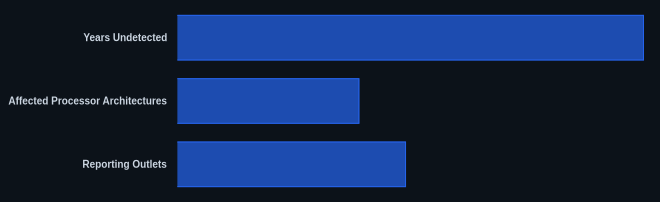
| Years Undetected | 16 years | The Hacker News |
| Affected Processor Architectures | 2 (Intel, AMD x86) | BleepingComputer |
| Disclosure Date | July 6, 2026 | SecurityWeek |
| Impact Severity | Critical (VM Escape) | BleepingComputer |
| CISA KEV Catalog Status | Not listed (as of July 2026) | BleepingComputer |
| Primary Attack Vector | Guest VM Compromise | The Hacker News |
| Reporting Outlets | 3+ major cybersecurity news | BleepingComputer, The Hacker News, SecurityWeek |
Our Take
This 16-year-old KVM escape is genuinely unsettling. It speaks to the extreme difficulty of finding such deep-seated flaws in widely used, complex software like the Linux kernel and its virtualization components. For years, every Linux KVM host has been unknowingly vulnerable to complete compromise from a single guest, a thought that should send shivers down the spine of any security engineer managing virtualized environments. We can't afford to be complacent about foundational layers. This incident reminds us that even the most battle-tested code can harbor critical vulnerabilities for extended periods.
The CVEDaily Take
The fact that the Januscape VM escape vulnerability remained undetected for 16 years challenges the assumption that widely used, open-source codebases are inherently more secure due to public scrutiny. We believe this suggests a deeper issue in how hypervisor-level security research is prioritized and funded, particularly for foundational components like KVM. Organizations must invest in continuous, deep-dive security research into core infrastructure components, and not rely solely on community efforts.
Has your team developed a comprehensive KVM host patching and kernel-level telemetry monitoring strategy in light of this critical disclosure, or are you still relying on previous assumptions of VM isolation?
FAQ
Q: What is Januscape and why is it critical?
A: Januscape is a newly disclosed 16-year-old vulnerability in the Linux KVM hypervisor that allows an attacker to break out of a compromised guest virtual machine and gain full control over the underlying host system. It's critical because it bypasses the fundamental isolation that virtualization is designed to provide, impacting data centers and cloud infrastructure.
Q: Which systems are affected by Januscape?
A: All Linux-based systems running KVM on Intel and AMD x86 processors are affected. This covers a vast array of servers and virtualized environments globally, dating back 16 years to approximately 2010.
Q: What is the immediate recommendation for affected organizations?
A: Monitor official announcements from your Linux distribution vendors for specific kernel patches addressing Januscape. Apply these updates immediately upon release. In the interim, implement stricter host-level monitoring, enforce least privilege on guest VMs, and consider deploying EDR solutions on KVM hosts to detect any post-exploitation activity.