
Cisco Unified CM CVE-2026-20230 Exploited After PoC Release
Threat intelligence firm Defused confirmed active exploitation of the Cisco Unified Communications Manager (Unified CM) flaw, CVE-2026-20230, just 18 days after patches became available. Attackers are already using automated sweeps, dropping webshells via Tor, putting vulnerable Unified CM deployments at severe risk of full system compromise. This critical server-side request forgery (SSRF) allows unauthenticated, remote attackers to write arbitrary files to the underlying operating system and escalate privileges to root. Patch it now.
What Happened
Cisco released security advisories and patches for CVE-2026-20230 on June 3, 2026, addressing a critical SSRF vulnerability in Unified CM and Unified CM Session Management Edition (SME). At that time, Cisco acknowledged the existence of a public PoC exploit but stated they were unaware of any active exploitation in the wild as of that date. This critical vulnerability, rated 8.6 CVSS, stems from improper input validation within the WebDialer service. If WebDialer is enabled (it's disabled by default), and an attacker knows the target system's hostname, they can craft malicious HTTP requests to bypass input validation.
This flaw enables arbitrary file writes and privilege escalation to root. Defused observed initial exploitation attempts over the weekend of June 21-22, 2026, beginning just 18 days after patches were released. These attacks, observed by Defused, involved automated sweeps, often originating from Tor exit nodes, designed to drop webshells onto vulnerable systems. The attack chain, as detailed by Defused, leverages the WebDialer SSRF to deploy a rogue Apache Axis service. This service then writes a first-stage JSP file-writer, followed by a second-stage command-execution shell under /platform-services/axis2-web/. This rapid transition from PoC availability to active exploitation means security teams must move faster.
Why It Matters
A critical SSRF leading to root access on a widely deployed communication platform like Cisco Unified CM means attackers can quickly gain full control of an organization's telephony infrastructure. A successful exploit allows for initial access (T1190 Exploit Public-Facing Application) and privilege escalation (T1068 Exploitation for Privilege Escalation), paving the way for lateral movement, data exfiltration, and persistent access to critical internal systems. Losing control of a VoIP network, call recordings, and user directories would significantly impact operations and data security.
Compromised Unified CM systems become ideal pivot points into the rest of the network. Defused noted "genuinely-formatted file:// file-write payloads landing on our decoys," confirming the efficacy of the file write primitive. Attackers using automated sweeps and Tor imply a broad, untargeted campaign. While CVE-2026-20230 isn't yet in the CISA Known Exploited Vulnerabilities (KEV) catalog, its current active exploitation observed by Defused makes it a high-priority threat for any organization running Cisco Unified CM.
Affected Scope & Remediation
CVE-2026-20230 impacts Cisco Unified Communications Manager (Unified CM) and Unified CM Session Management Edition (SME). The vulnerability specifically affects deployments where the WebDialer service is enabled. This service is disabled by default, which offers a narrow window of protection for some organizations. However, many enterprise deployments enable WebDialer for functionality like click-to-dial features. Exploitation requires knowledge of the target system's hostname, which can often be gleaned through OSINT or prior network reconnaissance.
Cisco released patches for affected versions on June 3, 2026. For Unified CM 15, the fixed version is 15SU5, which is scheduled for release in September 2026. Organizations running Unified CM 15 should deploy the available COP1 hotfix as an immediate measure. For others, apply the respective Security Update (SU) immediately. Endpoint Detection and Response (EDR) solutions can help detect anomalous process execution or webshell drops, but patching remains the primary defense. Furthermore, employing a Zero Trust Network Access (ZTNA) model can limit external exposure of services like WebDialer.
The timeline from patch to exploit was swift:
- June 3, 2026: Cisco releases patches and acknowledges public PoC.
- June 21-22, 2026: Threat intelligence firm Defused confirms active exploitation.
- 18 days: Approximate interval between patch release and observed in-the-wild exploitation.
This rapid turnaround demonstrates that security teams must prioritize flaw remediation as defined by NIST SP 800-53 (SI-2 Flaw Remediation).
Here's the breakdown of affected versions and their respective fixes:
| Product | Version Range | Fixed Version |
|---|---|---|
| Unified CM | 14.x (prior to 14SU6) | 14SU6 |
| Unified CM | 12.5.x (prior to 12.5SU9) | 12.5SU9 |
| Unified CM | 15.x (prior to 15SU5) | 15SU5 |
| Unified CM (Interim 15.x fix) | 15.x (prior to 15SU5) | COP1 hotfix |
Patch Links:
- Cisco Security Advisory
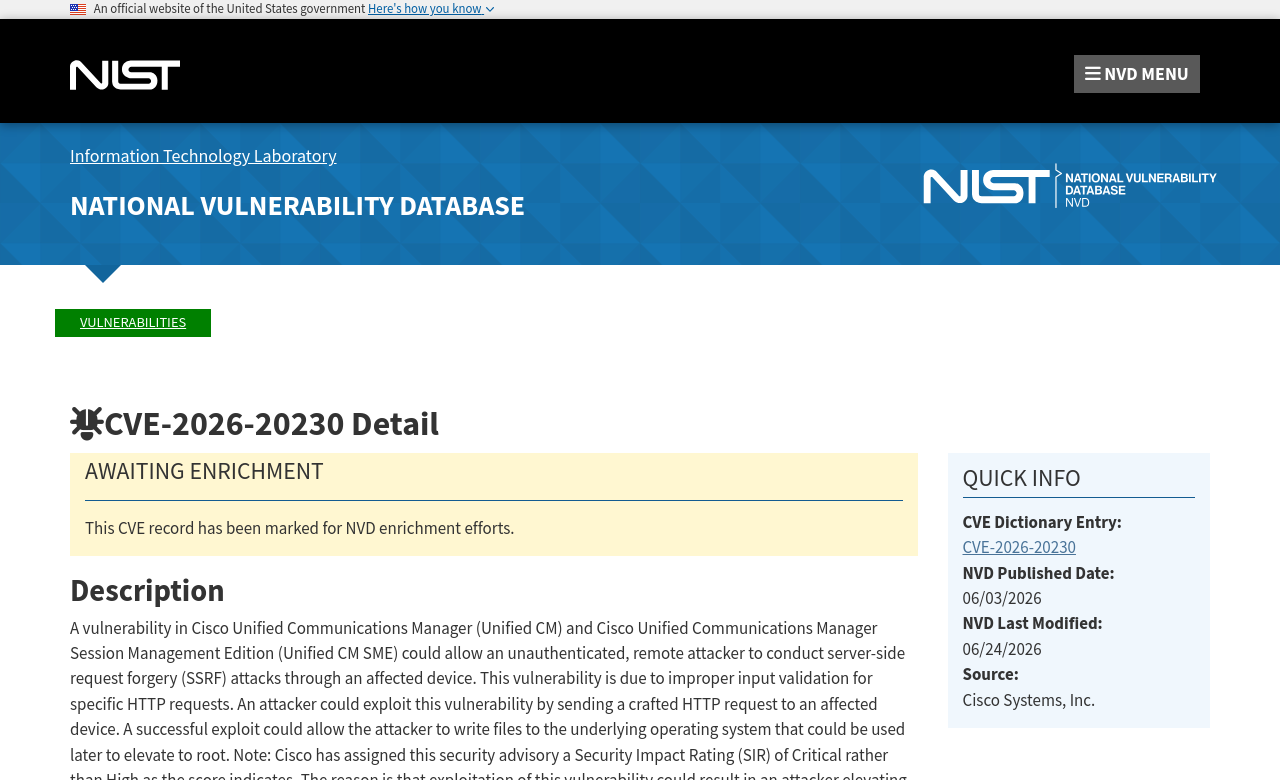
- NVD Entry: CVE-2026-20230
- CISA KEV Catalog: Not currently listed
If immediate patching isn't feasible, disable the WebDialer service. However, this may impact legitimate user functionality that relies on it.
Technical Breakdown
CVE-2026-20230 is a server-side request forgery (SSRF) flaw in the WebDialer service of Cisco Unified CM. At its core, the vulnerability, as described by Cisco's advisory and SSD Secure Disclosure's analysis, is due to improper input validation (SI-10 Information Input Validation) for specific HTTP requests. When an application fails to properly scrutinize user-supplied data, especially in parameters that dictate internal resource access, an SSRF can occur.
The server is tricked into making requests or performing actions on behalf of the attacker to internal or local resources it should not access.
In the observed attack chain, attackers (T1190 Exploit Public-Facing Application) exploit this SSRF to write arbitrary files to the underlying operating system. Defused detailed this process:
- The SSRF is abused to deploy a rogue Apache Axis service. Apache Axis is a framework for creating SOAP web services, and in a compromised state, it can be manipulated to execute arbitrary code.
- Once the rogue Axis service is running, it's used to write a first-stage JSP file-writer. JSP (JavaServer Pages) files are server-side scripting language pages that, when executed, can perform various functions, including writing other files. This acts as an
T1105 Ingress Tool Transfer. - Following the file-writer, a second-stage command-execution shell is deployed under
/platform-services/axis2-web/. This provides the attacker with remote code execution capabilities, allowing them to escalate privileges (T1068 Exploitation for Privilege Escalation) to root and gain full control over the Unified CM server. The ability to write arbitrary files and execute commands remotely makes this a high-impact vulnerability.
Historical Context
Cisco Unified CM has faced critical, actively exploited vulnerabilities before. Earlier in 2026, CVE-2026-20045, a code injection flaw in Cisco Unified CM, was also targeted in the wild. That vulnerability similarly allowed attackers to execute arbitrary code, leading to significant compromise potential. The similarities between CVE-2026-20230 and CVE-2026-20045 lie in their impact: both provide remote attackers with high-level access to critical telephony infrastructure.
However, the technical mechanisms differ. CVE-2026-20045 was a direct code injection, whereas CVE-2026-20230 is an SSRF used as a primitive for arbitrary file write and subsequent privilege escalation. Both demonstrate the high value attackers place on compromising widely deployed, internet-facing communication systems. The rapid exploitation of CVE-2026-20230 after a PoC was released echoes the urgency seen with CVE-2026-20045, reinforcing the need for immediate patching cycles.
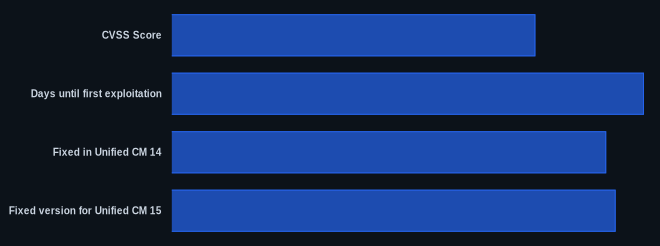
Data at a Glance
| Metric | Value | Source |
|---|---|---|
| CVSS Score | 8.6 | NVD |
| Days until first exploitation | 18 days | SecurityWeek |
| Fixed in Unified CM 14 | 14SU6 | Cisco |
| Exploitation observed by | Defused | The Hacker News |
| Fixed version for Unified CM 15 | 15SU5 (Sept 2026) | CSOOnline |
The CVEDaily Take
This Cisco Unified CM flaw perfectly illustrates the compressed attack surface and response windows security teams face today. If you have WebDialer enabled on Unified CM, you're a high-value target for automated sweeps. The 18-day window between Cisco releasing patches and Defused confirming active exploitation of CVE-2026-20230 highlights that any critical vulnerability with a public PoC, especially one allowing unauthenticated root access, is a ticking time bomb that teams must treat with zero-day urgency. We think many organizations are underestimating the risk by relying on default configurations or a lack of CISA KEV listing as sufficient indicators for prioritization.
Have you integrated your vulnerability management program with your threat intelligence feeds to prioritize patching based on observed exploitation, rather than just CVSS scores or KEV listings?
FAQ
Q: What is WebDialer, and how do I check if it's enabled?
A: WebDialer is a Cisco Unified CM service that allows users to initiate calls from web applications, often used for click-to-dial functionality. You can check its status through the Cisco Unified CM Administration interface, under "Serviceability" > "Tools" > "Service Activation."
Q: My Unified CM 15 deployment won't get a full patch until September 2026. What should I do now?
A: Cisco has provided a COP1 hotfix for Unified CM 15 deployments that should be applied immediately. If you absolutely cannot apply the hotfix, consider disabling the WebDialer service entirely, understanding that this will impact features that rely on it.
Q: Does this vulnerability affect other Cisco Unified Communications products besides Unified CM?
A: The advisory specifically mentions Cisco Unified Communications Manager (Unified CM) and Unified CM Session Management Edition (SME). Always refer to Cisco's official advisory for the most accurate and up-to-date information on affected products and versions.