
Cisco Unified CM CVE-2026-20230: Unauthenticated Root on KEV Catalog
On June 25, 2026, CISA added CVE-2026-20230, a critical Server-Side Request Forgery (SSRF) vulnerability in Cisco Unified Communications Manager (Unified CM), to its Known Exploited Vulnerabilities (KEV) Catalog, confirming active exploitation in the wild. This flaw allows an unauthenticated, remote attacker to write arbitrary files to the underlying operating system, which is a direct path to root privilege escalation. Federal Civilian Executive Branch (FCEB) agencies have a hard deadline of June 28, 2026, to patch these systems, underscoring the severe risk this vulnerability poses to federal networks and all organizations running affected Cisco infrastructure.
What Happened
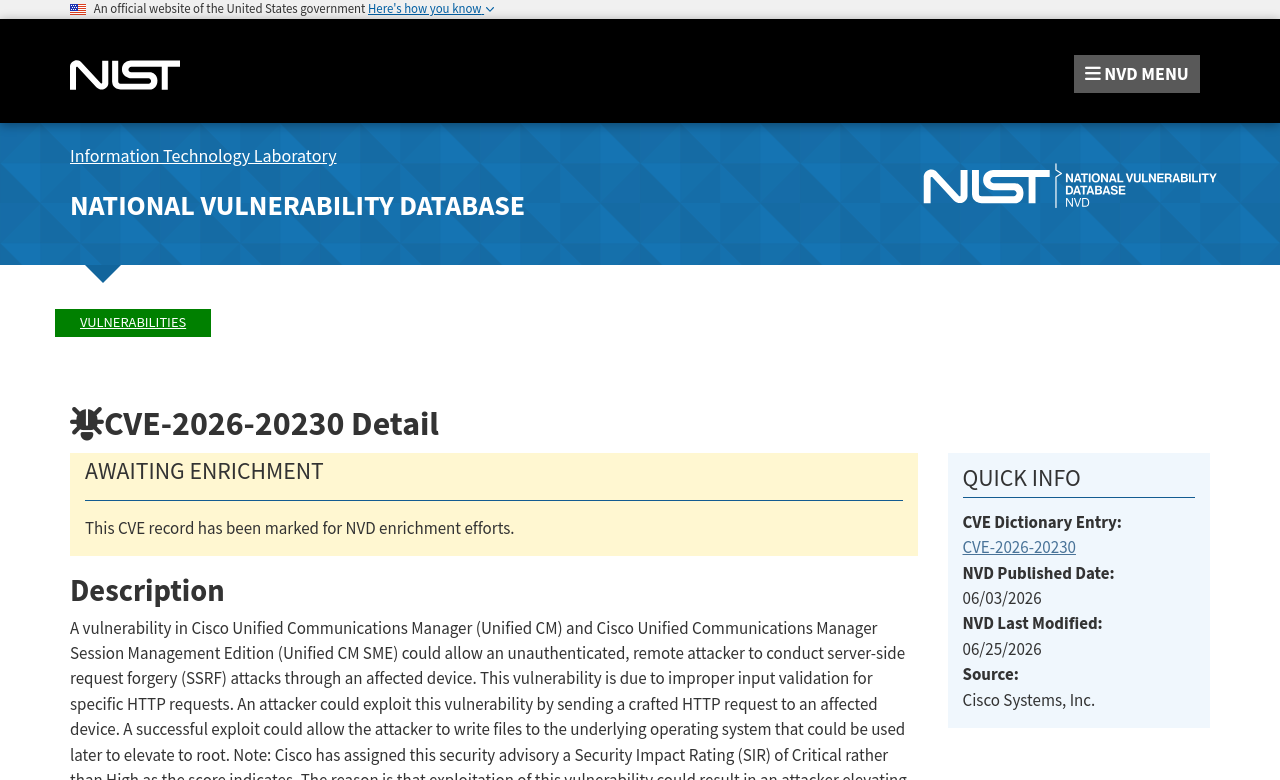
On June 25, 2026, the Cybersecurity and Infrastructure Security Agency (CISA) included CVE-2026-20230 in its Known Exploited Vulnerabilities (KEV) Catalog. This addition signifies that attackers are actively exploiting the vulnerability, elevating it beyond a theoretical risk to an immediate threat. The vulnerability is categorized as a Server-Side Request Forgery (SSRF) – specifically CWE-918 – affecting Cisco Unified Communications Manager (Unified CM) and Cisco Unified Communications Manager Session Management Edition (Unified CM SME) NVD.
Exploitation of CVE-2026-20230 allows an unauthenticated, remote attacker to achieve arbitrary file write capabilities on the underlying operating system. This capability, in turn, can lead to full root privilege escalation. No authentication is needed, which makes this particularly dangerous. Cisco has released security advisories with mitigation instructions for impacted versions NVD.
Within the last week, CISA also added CVE-2026-12569 (PTC Windchill and FlexPLM Improper Input Validation) to the KEV catalog on June 25, 2026, sharing the same federal patch deadline. Earlier, on June 23, 2026, other critical vulnerabilities, including multiple Ubiquiti UniFi OS flaws (e.g., CVE-2026-34908), were also added CISA.
Why It Matters
When CISA flags a vulnerability for its KEV catalog, it means attackers are already weaponizing it. For CVE-2026-20230, the potential for unauthenticated, remote root privilege escalation on Cisco Unified CM systems is about as bad as it gets. These are often core communication systems, sometimes exposed to the internet, making them attractive targets for initial access and persistence.
An unauthenticated SSRF that allows arbitrary file writes effectively lets attackers rewrite parts of your system without even needing a username or password. This is a proven attack vector in active use. CISA's Binding Operational Directive (BOD) 26-04 mandates rapid remediation for KEV Catalog vulnerabilities for FCEB agencies, in this case, a mere 3-day window to patch CISA. That's a short fuse.
CISA strongly encourages all organizations, public or private, to prioritize remediation of KEV entries. Ignoring these means leaving a known-open door for attackers. Attackers specifically target widely deployed communications infrastructure like Cisco Unified CM, recognizing its potential as a pivot point for broader network compromise. Before applying patches, check for prior compromise, as CISA advises.
Affected Scope & Remediation
The primary affected products are Cisco Unified Communications Manager (Unified CM) and Cisco Unified Communications Manager Session Management Edition (Unified CM SME). Given the lack of specific version ranges in the public NVD entry, organizations must consult Cisco's official security advisories for precise affected and fixed versions.
| Product | Version Range Affected | Fixed Version(s) |
|---|---|---|
| Cisco Unified Communications Manager (Unified CM) | Consult Cisco Advisory | Consult Cisco Advisory |
| Cisco Unified Communications Manager Session Management Edition (Unified CM SME) | Consult Cisco Advisory | Consult Cisco Advisory |
Patch it now. For FCEB agencies, the deadline to apply patches or mitigating controls is June 28, 2026. All other organizations should treat this with the same urgency. Cisco typically provides detailed instructions for applying patches. Ensure your patch management systems are up-to-date and apply the relevant security updates immediately.
Before you patch, however, hunt for anomalies. Active exploitation means some systems may already be compromised. Use tools like CrowdStrike Falcon or SentinelOne to scan for unusual processes, network connections originating from your Unified CM instances, or unauthorized file modifications. Look for signs of arbitrary file writes, new user accounts, or unexpected outbound traffic. If compromise is detected, follow your incident response plan before applying patches.
References:
- NVD Entry for CVE-2026-20230
- CISA KEV Catalog
- CISA Advisory on KEV Additions
- Cisco Security Advisory (URL placeholder – consult Cisco's official website)
Technical Breakdown
CVE-2026-20230 is an instance of Server-Side Request Forgery (SSRF), designated as CWE-918. In an SSRF attack, the attacker doesn't directly access an internal resource. Instead, they trick the vulnerable server into making requests on their behalf. Think of it like this: your Unified CM server has a built-in "concierge service" that can make requests to other services or files on the network or even locally on the machine itself. An SSRF vulnerability is like an attacker tricking this concierge into calling an internal, unlisted service number and then relaying sensitive information or performing actions, rather than just calling an external number as intended.
The critical impact here is that this specific SSRF allows an unauthenticated, remote attacker to write arbitrary files to the underlying operating system. This is a severe capability. An attacker could, for example, write a malicious web shell, modify configuration files to enable remote code execution, or drop a root-privileged cron job. Once an attacker can write arbitrary files, the jump to full root access (privilege escalation) is often a straightforward, if not trivial, next step. This could involve overwriting system binaries, adding SSH keys, or manipulating service configurations to gain persistent, high-level control.
From a MITRE ATT&CK perspective, the initial exploitation of this public-facing application falls under T1190 Exploit Public-Facing Application. The subsequent steps to achieve root access would then map to T1068 Exploitation for Privilege Escalation, where the arbitrary file write capability is used to gain higher privileges.
To prevent such flaws, SI-10 Information Input Validation is paramount. Input validation mechanisms prevent attackers from crafting malicious URLs or requests that manipulate the server's internal request-making functions. For remediation, SI-2 Flaw Remediation emphasizes timely patching and vulnerability management, exactly what CISA's KEV directive enforces.
Historical Context
Cisco products, particularly those acting as edge devices or core infrastructure, are consistently high-value targets for advanced persistent threats and opportunistic attackers alike. This isn't the first time attackers have actively exploited a zero-day or critical vulnerability in Cisco systems, sending security teams scrambling.
Earlier in 2026, Mandiant reported the active exploitation of CVE-2026-20245, a zero-day vulnerability in Cisco Catalyst SD-WAN Manager Google Cloud. Attackers leveraged this flaw to gain root-level access to vulnerable appliances, at least two months before the vulnerability was publicly disclosed. Similarly, February 2026 saw reports of another critical zero-day affecting Cisco ASA firewalls.
The common thread here is the targeting of crucial network infrastructure and the goal of achieving root or high-level administrative access. While the specific technical mechanism for CVE-2026-20230 is an SSRF, distinct from the specifics of CVE-2026-20245 or the ASA zero-day, the ultimate impact – unauthenticated remote access leading to full system compromise – remains a constant. Adversaries know these devices are often internet-facing and provide a direct path into an organization's internal network.
Data at a Glance
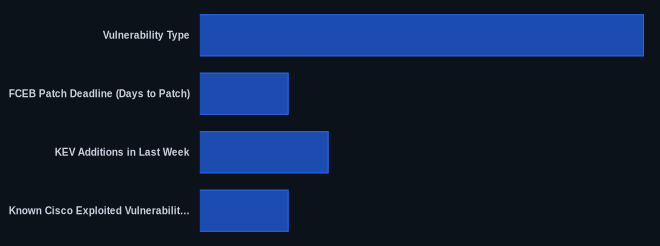
| Metric | Value | Source |
|---|---|---|
| CVE ID | CVE-2026-20230 | NVD |
| Vulnerability Type | SSRF (CWE-918) | NVD |
| CISA KEV Addition Date | June 25, 2026 | CISA |
| FCEB Patch Deadline (Days to Patch) | 3 days | CISA |
| KEV Additions in Last Week | 6 KEVs | CISA |
| Known Cisco Exploited Vulnerabilities in 2026 | 3 | Cloud.google.com, The Hacker News |
| Exploitation Status | Actively Exploited | CISA |
The CVEDaily Take
CVE-2026-20230 isn't just another vulnerability; it's a clear signal that adversaries are highly effective at weaponizing critical flaws in widely deployed communication platforms. The unauthenticated nature and root potential make this an urgent, high-stakes remediation. We think that many organizations, despite CISA's warnings, still treat these critical infrastructure devices as secure by default, rather than isolating them or segmenting them from external networks. Are your Cisco Unified CM instances fully isolated from external networks, or are you betting on a perimeter that's already been proven permeable?
FAQ
Q: What is a Server-Side Request Forgery (SSRF) in the context of CVE-2026-20230?
A: SSRF, or CWE-918, means an attacker tricks the Cisco Unified CM server into making an arbitrary HTTP request to a location the attacker specifies. For CVE-2026-20230, this request can be manipulated to write files directly to the server's operating system, which is a critical step towards gaining full control.
Q: Is there an unauthenticated exploit available for CVE-2026-20230?
A: Yes. The vulnerability allows an unauthenticated, remote attacker to perform the arbitrary file write, which can lead to root privilege escalation. This means no valid credentials are required for the initial stages of exploitation.
Q: How quickly do we need to patch Cisco Unified CM for CVE-2026-20230?
A: Federal Civilian Executive Branch agencies must patch by June 28, 2026, which is just 3 days from the CISA KEV listing. All other organizations should treat this with the same extreme urgency, as active exploitation means your systems are immediate targets.