
PTC Windchill & FlexPLM CVE-2026-12569: Active Exploitation Leads to JSP Web Shells
On June 26, 2026, the U.S. Cybersecurity and Infrastructure Security Agency (CISA) added CVE-2026-12569 to its Known Exploited Vulnerabilities (KEV) Catalog, confirming active exploitation of a critical remote code execution (RCE) flaw in PTC Windchill PDMlink and FlexPLM. This marks the first time a PTC product vulnerability has appeared in the KEV list. Attackers are using this improper input validation flaw (CVSS 9.3) to achieve unauthenticated RCE via deserialization of untrusted data, deploying JSP web shells against vulnerable systems. Organizations running these critical enterprise management platforms need to patch CVE-2026-12569 immediately and hunt for indicators of compromise, as PTC confirmed heightened threat activity even after patches were released last week.
What Happened
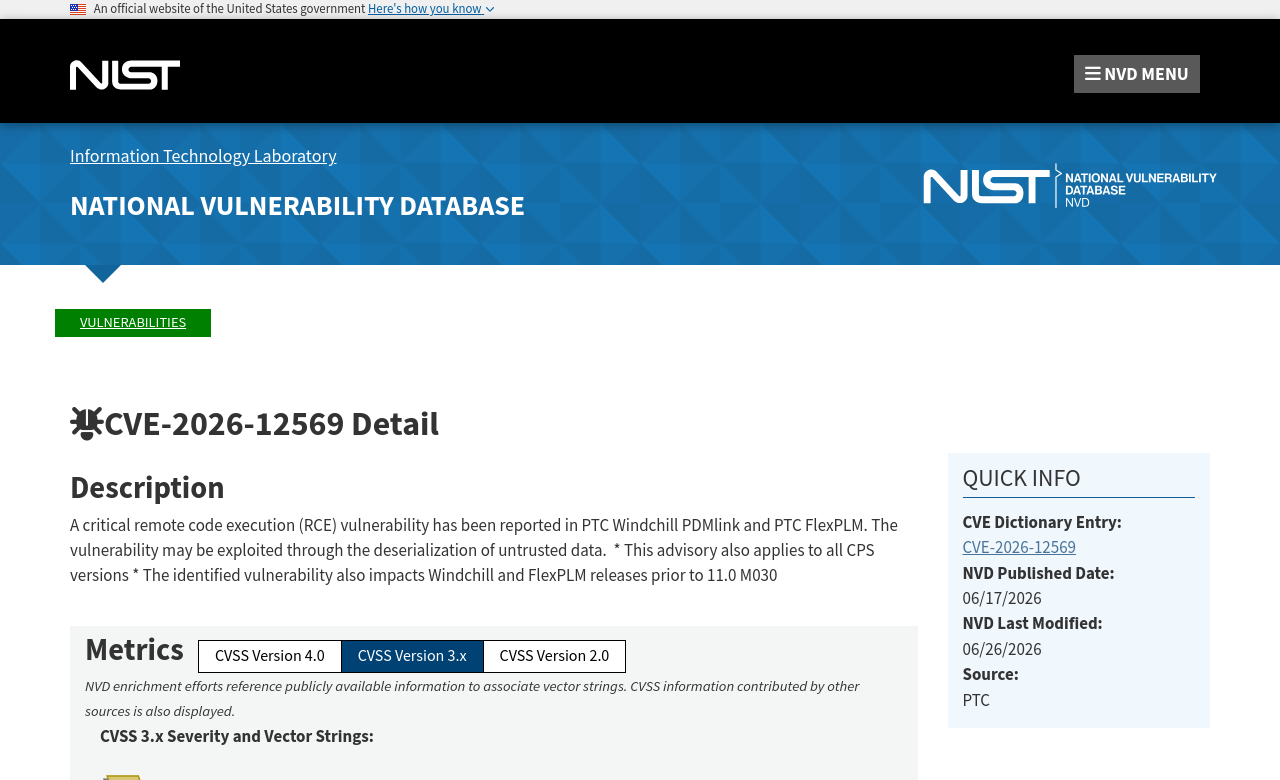
On June 26, 2026, CISA listed CVE-2026-12569 in its KEV Catalog, signaling confirmed in-the-wild exploitation. This critical RCE impacts PTC Windchill PDMlink and PTC FlexPLM software, allowing an unauthenticated, remote attacker to execute arbitrary code with a CVSS score of 9.3. The vulnerability stems from improper input validation, specifically using deserialization of untrusted data when a malicious request is sent to the network.
PTC released patches for CVE-2026-12569 last week. However, as of June 25, PTC confirmed "continued reports of heightened threat activity," indicating rapid weaponization by attackers even after patches were available. Attackers are deploying JSP web shells once they successfully exploit the vulnerability. Patching is urgent.
Several Indicators of Compromise (IoCs) have emerged from PTC's advisories. One identified attacker command-and-control (C2) IP address is 5.180.41.35. Web shell files planted after exploitation follow a distinct naming pattern, such as /Windchill/login/[0-9a-f]{16}.jsp. The presence of flst.txt in /tmp or the Windchill working directory serves as another critical indicator of compromise.
Why It Matters
This is a critical flaw in enterprise-grade Product Data Management (PDM) and Product Lifecycle Management (PLM) systems. Successful exploitation of CVE-2026-12569 can lead to full system compromise, data theft, and deeper network intrusion. The widespread use of PTC Windchill PDMlink and FlexPLM across various industries suggests a broad potential impact.
CISA's inclusion of CVE-2026-12569 in its KEV Catalog is a loud alarm bell for every organization. It means attackers are actively exploiting this vulnerability, and federal agencies are mandated by CISA to remediate it rapidly due to the high risk. This same urgency should extend to all enterprises, regardless of federal mandates.
This incident highlights a dangerous trend: attackers are laser-focused on internet-exposed management infrastructure. They weaponize newly disclosed vulnerabilities almost immediately. The confirmation of active exploitation after patches were released underscores the minimal window defenders have. It’s a race, and we’re often starting behind the attackers.
Affected Scope & Remediation
All organizations running unpatched versions of PTC Windchill PDMlink and PTC FlexPLM are exposed to CVE-2026-12569. Patch it now. Given the active exploitation, simply waiting for your normal patch cycle isn't an option.
PTC released patches last week to address this vulnerability. Your first step is to apply these updates across all affected deployments. You should also deploy endpoint detection and response (EDR) tools like CrowdStrike Falcon or SentinelOne to monitor for suspicious activity, even after patching.
| Product | Version Range | Fixed Version | Source |
|---|---|---|---|
| PTC Windchill PDMlink | All versions prior to the latest security updates addressing CVE-2026-12569 | Latest patched releases (contact PTC) | PTC |
| PTC FlexPLM | All versions prior to the latest security updates addressing CVE-2026-12569 | Latest patched releases (contact PTC) | PTC |
Patch Links:
- NVD Entry: CVE-2026-12569
- PTC Security Advisories: https://www.ptc.com/support/go-to/security-updates
- CISA KEV Catalog: https://www.cisa.gov/known-exploited-vulnerabilities-catalog
Beyond patching, immediate mitigations include blocking the identified C2 IP address 5.180.41.35 at your perimeter firewall. Additionally, proactively hunt for signs of compromise. Search HTTP access logs for POST requests to suspicious JSP files that match the /Windchill/login/[0-9a-f]{16}.jsp naming pattern. Scan your filesystem for these JSP files and look for the presence of flst.txt in /tmp or your Windchill working directory. The timeline here is tight: patches were released approximately June 19, 2026, and active exploitation was confirmed by June 25, 2026. This means exploitation was confirmed within about 6 days of patch availability.
Technical Breakdown
CVE-2026-12569 is an improper input validation vulnerability that uses deserialization of untrusted data to achieve unauthenticated remote code execution. The Windchill or FlexPLM application processes input without adequately scrutinizing its integrity or safety. When an attacker sends a specially crafted malicious request to the network, the application attempts to deserialize this untrusted data. This process then triggers arbitrary code execution on the underlying system.
Think of it like this: your application expects a specific type of serialized object, like a meticulously packed and labeled box for inventory management. This vulnerability is akin to the application accepting any box, even one that's been tampered with to contain a miniature bomb, and dutifully unpacking its contents without inspection. Once "unpacked" (deserialized), the malicious payload executes, giving the attacker control over the system.
This type of vulnerability is often a low-effort way for an unauthenticated attacker to gain initial access. The successful deployment of JSP web shells directly following exploitation points to the attacker's immediate goal: establishing persistent access and control over the compromised server. This aligns with MITRE ATT&CK technique T1190 Exploit Public-Facing Application for initial access, followed by T1105 Ingress Tool Transfer to deploy the web shells. From there, attackers can move laterally, exfiltrate data, or further compromise the environment. From a compliance perspective, the fundamental failure lies in adhering to NIST SP 800-53 SI-10 Information Input Validation, which emphasizes the necessity of validating all inputs to prevent injection attacks and other forms of malicious data processing.
Historical Context
This rapid exploitation of a critical RCE in enterprise management software is a recurring pattern. In January 2026, Ivanti Endpoint Manager Mobile (EPMM) products were hit by a string of critical RCE flaws, including CVE-2026-1281 and CVE-2026-1340. These vulnerabilities were also quickly added to CISA's KEV Catalog after active exploitation was confirmed, as reported by BleepingComputer.
The similarities are striking: critical RCEs in widely used, often internet-exposed management platforms, targeted by attackers with extreme speed. The difference with PTC Windchill is the specific deserialization vector, compared to various command injection or authentication bypasses seen in other products. However, the overarching theme remains: management infrastructure, be it PDM, PLM, MDM, or VPNs, represents a high-value target for initial access. Attackers prioritize these systems because they offer broad control and often privileged access to corporate data and networks, making quick weaponization of associated flaws a consistent operational tactic.
Data at a Glance
| Metric | Value | Source |
|---|---|---|
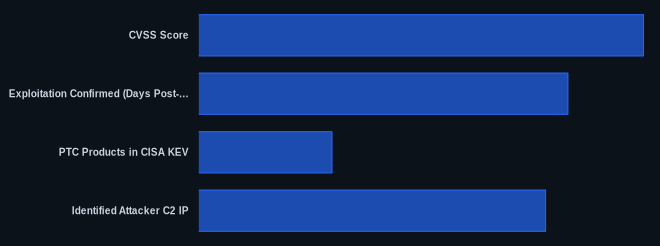
| CVSS Score | 9.3 |
NVD |
| Exploitation Confirmed (Days Post-Patch) | ~6 days |
BleepingComputer, PTC |
| PTC Products in CISA KEV | 1 |
CISA |
| Identified Attacker C2 IP | 5.180.41.35 |
PTC |
| Vulnerability Type | Improper Input Validation |
NVD |
| Active Exploitation Confirmed Date | June 26, 2026 |
CISA |
Our Take
We're seeing an increasingly short fuse between vulnerability disclosure, patch release, and active exploitation. This isn't just about applying patches anymore; it's about anticipating these attacks and having strong detection capabilities in place for post-exploitation activities. Relying solely on perimeter defenses is a losing game when adversaries are so adept at exploiting these internet-facing applications. Our teams need to shift focus to internal monitoring and threat hunting, looking for tell-tale signs like web shells and suspicious outbound connections, even in systems we thought were patched.
The CVEDaily Take
The rapid weaponization of CVE-2026-12569 validates the grim reality that enterprise management systems are under constant, automated attack. Proactive threat intelligence and rapid deployment of compensating controls are just as critical as patching. We believe PTC's statement of "heightened threat activity" after patches were released understates the immediate and widespread impact, suggesting automated scanning and exploitation began almost instantly.
Beyond patching, what automated systems are you deploying to detect post-exploitation activity like web shells on critical PDM/PLM infrastructure?
FAQ
Q1: What is CVE-2026-12569?
A1: CVE-2026-12569 is a critical remote code execution (RCE) vulnerability (CVSS 9.3) in PTC Windchill PDMlink and FlexPLM. It's caused by improper input validation, allowing an unauthenticated, remote attacker to execute arbitrary code by sending a malicious request that exploits deserialization of untrusted data.
Q2: Why is CISA adding this to its KEV catalog significant?
A2: CISA's inclusion of CVE-2026-12569 in its KEV Catalog confirms active exploitation in the wild. This mandates that all U.S. federal agencies prioritize and rapidly remediate this vulnerability, underscoring its high risk and immediate threat to all organizations.
Q3: What immediate actions should IT/security teams take?
A3: Immediately apply the latest PTC patches for Windchill PDMlink and FlexPLM. Block the identified attacker C2 IP 5.180.41.35 at your firewall. Proactively hunt for indicators of compromise: search HTTP access logs for POST requests to /Windchill/login/[0-9a-f]{16}.jsp and scan your filesystem for matching JSP files, as well as the presence of flst.txt in /tmp or the Windchill working directory.