Linux CVE-2026-31431: Tiny Payload Grants Root Privilege Escalation
A critical Linux kernel zero-day, identified as CVE-2026-31431, was publicly disclosed in May 2026, allowing root privilege escalation on unpatched systems running kernels 5.15 through 6.8. The exploit leverages a missing boundary validation within the copy_from_user() kernel function, enabling a 732-byte payload to trigger a buffer overflow and inject ring-0 shellcode. This disclosure follows the CVE-2026-21509 Excel zero-day and other simultaneous unpatched vulnerabilities across both Windows and Linux, indicating a particularly dangerous period for system administrators. As of May 2026, no official patch has been assigned or released, leaving hundreds of millions of production Linux deployments directly exposed.
What Happened
The Linux zero-day exploit, CVE-2026-31431, surfaced in May 2026 via the oss-security@openwall.com mailing list. It targets a fundamental flaw in the Linux kernel’s memory copy subsystem, specifically a missing boundary check during copy_from_user() operations. This function is crucial for safely transferring data from user-space applications to the kernel. Without proper validation, a malicious user-space process can supply an oversized buffer.
That oversized buffer then overflows its intended memory region. The exploit uses a meticulously crafted 732-byte payload to achieve this. This small payload overwrites adjacent kernel memory, directly injecting arbitrary shellcode. Once injected, this shellcode executes with ring-0 privileges, providing immediate and complete root access to the compromised system. The vulnerability affects a broad range of Linux kernel versions, specifically those from 5.15 up to 6.8. The NIST NVD has a pending record confirming the vulnerability, but there is no patch information attached as of the disclosure.
Why It Matters
The immediate concern with CVE-2026-31431 is its simplicity and severity: local privilege escalation (LPE) to root with a tiny payload. Linux underpins countless systems globally, from web servers and cloud infrastructure to embedded devices and enterprise workstations. Hundreds of millions of production Linux deployments are estimated to run vulnerable kernel versions; no specific count of affected users or organizations is available as of publication due to the recent disclosure and unpatched status. The ability for a local attacker, or even malware with initial user-level access, to instantly gain root undermines virtually all standard security layers.
The financial and operational impact of a widespread exploit could be immense. The average global cost of a data breach in 2026 is projected at $4.44 million. For organizations operating in the United States, that figure is even higher, with the average data breach cost reaching an all-time high of $10.22 million in 2026. The healthcare sector continues to face the highest average data breach costs, hitting $7.42 million per breach in 2025 for the 15th consecutive year. This Linux zero-day is particularly dangerous because it lands during a May 2026 period already marked by critical, unpatched zero-days across both Windows and Linux stacks. The CVE-2026-21509 Excel zero-day, which required an emergency out-of-band patch from Microsoft in January 2026, showed that critical, unpatched zero-days can appear simultaneously across major platforms.
Affected Scope & Remediation
CVE-2026-31431 directly impacts Linux kernel versions 5.15 through 6.8. This covers a substantial portion of current enterprise and consumer Linux distributions, including popular releases of Ubuntu, Red Hat, Debian, and various cloud images. The vulnerability grants an attacker root privileges, bypassing typical user segregation and access controls.
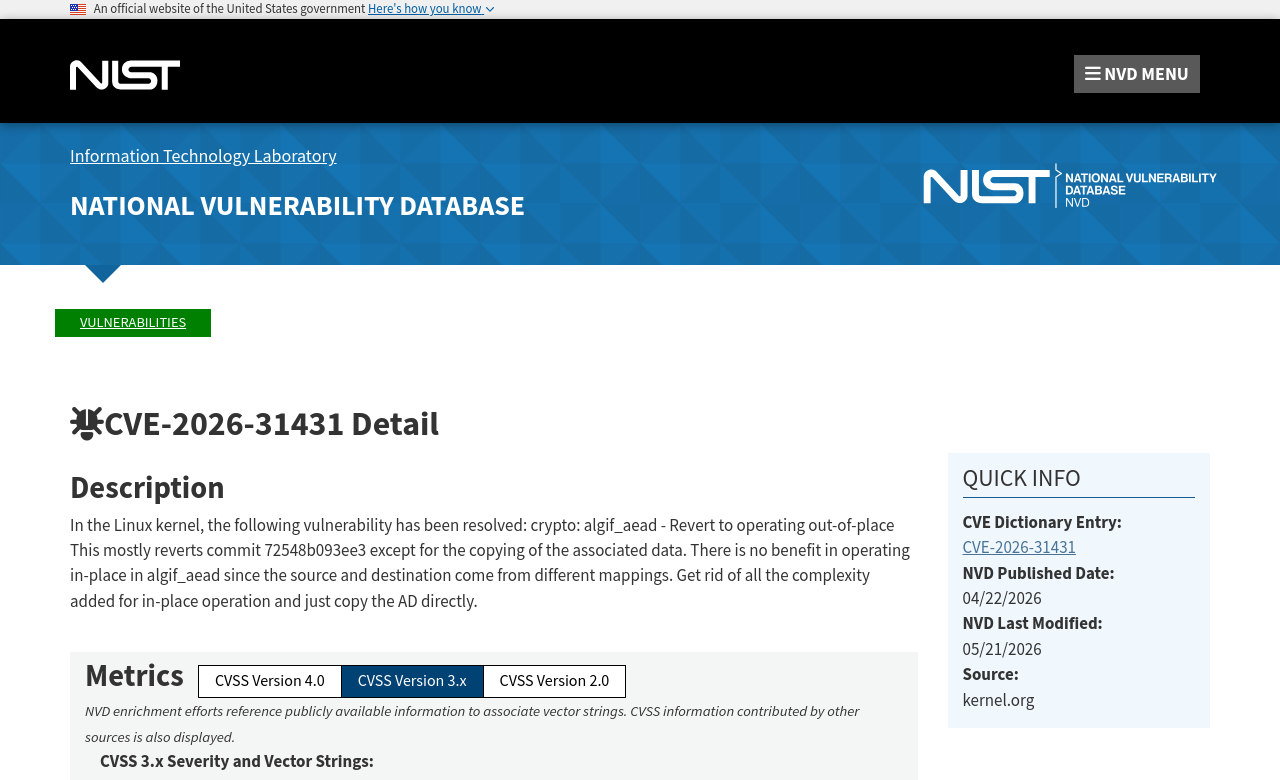
As of May 2026, no official patch has been released. The NIST NVD entry for CVE-2026-31431 remains pending, with no vendor advisories or patch links. This means direct remediation is not yet possible through kernel updates.
| Product | Version Range | Fixed Version | Source |
|---|---|---|---|
| Linux Kernel | 5.15 – 6.8 | None (Pending) | oss-security |

Given the lack of an immediate patch, mitigation strategies are paramount. Reduce the attack surface. Enforce strict least privilege principles (NIST SP 800-53 AC-6 Least Privilege) to prevent low-privileged users or compromised applications from executing arbitrary code locally. Monitor for suspicious process activity, especially attempts to load unexpected kernel modules or access /dev/mem. Tools like CrowdStrike Falcon or SentinelOne can help detect anomalous behavior indicative of LPE attempts. Applying AppArmor or SELinux policies to restrict system call access for critical services can also limit exploit efficacy. Until a patch from kernel.org stable release announcements or distribution-specific security advisories (Ubuntu USN, Red Hat RHSA, Debian DSA) becomes available, assume any system in the 5.15–6.8 range is vulnerable to a local root compromise.
Technical Breakdown
The core of CVE-2026-31431 lies in a classic memory safety bug: a missing boundary validation within the copy_from_user() function. When a user-space application requests to copy data into kernel memory using this function, the kernel needs to ensure the provided buffer size does not exceed the allocated kernel buffer. This vulnerability specifically fails to perform that check. Imagine trying to pour a gallon of water into a pint glass; without a boundary check, the kernel just keeps pouring, overflowing the pint glass and spilling into adjacent memory regions.
An attacker crafts a user-space buffer slightly larger than what the copy_from_user() function expects or allocates. This malformed instruction expands outside its designated memory segment, overwriting critical kernel data structures. The 732-byte payload is specifically engineered to not just trigger the overflow but to inject malicious shellcode at a predictable location in kernel memory. Once the shellcode is placed, the kernel's execution flow is diverted to it, running with the highest possible privileges (ring-0). This bypasses all user-space security mechanisms and grants the attacker unfettered control over the system. This directly maps to MITRE ATT&CK technique T1068 Exploitation for Privilege Escalation. Organizations should focus on NIST SP 800-53 controls like SI-2 Flaw Remediation for rapid patching, and SI-10 Information Input Validation to prevent such vulnerabilities from being introduced in the first place.
Historical Context
This type of Linux kernel privilege escalation is not unprecedented. A notable parallel can be drawn to Dirty Pipe (CVE-2022-0847), disclosed in 2022. Both vulnerabilities exploited flaws in how the Linux kernel handles data copying, specifically enabling an attacker to overwrite data in read-only files. While Dirty Pipe specifically affected the splice() system call and pipe_buffer structure, the underlying principle of a memory corruption vulnerability leading to privilege escalation is similar.
The difference with Dirty Pipe was the relatively swift availability of patches; patches for affected kernel versions landed within days of public disclosure. For CVE-2026-31431, the absence of an immediate patch amplifies its danger. The Dirty Pipe exploit also allowed an unprivileged process to inject arbitrary data into any file on the system, including /etc/passwd, leading to root access. CVE-2026-31431 directly overwrites kernel memory for code execution. Both highlight the critical importance of secure memory handling in the kernel and the constant threat of local privilege escalation.
Data at a Glance
| Metric | Value | Source |
|---|---|---|
| Affected Kernel Versions | 14 | oss-security |
| Exploit Payload Size | 732 bytes | oss-security |
| Average Global Data Breach Cost (2026) | $4.44 million | BleepingComputer |
| Average US Data Breach Cost (2026) | $10.22 million | SecurityWeek |
| Healthcare Sector Breach Cost (2025) | $7.42 million | SecurityWeek |
| Disclosure Date (CVE-2026-31431) | May 2026 | oss-security |
| Patch Status (CVE-2026-31431) | None (Pending) | NVD |
Our Take
We're in a critical window. CVE-2026-31431 isn't just another LPE; it's a zero-day without a patch, hitting a core component of Linux during an already volatile period. The tiny payload makes it easy to integrate into existing exploit chains, and the impact of a local root is undeniable. Don't wait for a patch; assume compromise for vulnerable systems and harden them now. This is a moment for proactive incident response and aggressive segmentation.
The CVEDaily Take
The confluence of unpatched zero-days across major operating systems, especially with CVE-2026-31431 affecting the Linux kernel, presents a systemic risk. It highlights the critical need for a defense-in-depth strategy that allows operations to continue effectively during periods of incomplete patch availability. We believe security teams should not rely on vendors to patch their way out of this current crisis, given the simultaneous unpatched vulnerabilities reported across both Windows and Linux stacks in May 2026. This situation demands immediate, internal mitigation actions.
What is your team's immediate strategy for kernel updates when a critical zero-day like CVE-2026-31431 is disclosed without a patch?
FAQ
Q: What is CVE-2026-31431?
A: CVE-2026-31431 is a critical zero-day vulnerability in the Linux kernel that allows for root privilege escalation on affected systems. It was publicly disclosed in May 2026.
Q: Which Linux kernel versions are affected by CVE-2026-31431?
A: The vulnerability affects Linux kernel versions 5.15 through 6.8.
Q: Is there a patch available for CVE-2026-31431?
A: As of its public disclosure in May 2026, there is no official patch assigned or released for CVE-2026-31431. Remediation involves mitigation strategies until a patch becomes available.