
Instructure, the company behind the Canvas Learning Management System (LMS), confirmed a cybersecurity incident in early May 2026 impacting API key-reliant tools and leading to a rapid response that included rotating application keys and heightened monitoring. This incident highlights critical supply chain vulnerabilities within the education sector, affecting a vast number of users and institutions globally.
What Happened
Instructure's CISO, Steve Proud, sent a notification to customers on May 1, 2026, confirming a cybersecurity incident after initial reports of limited disruption to API key-reliant tools surfaced on April 30, 2026. By May 2, 2026, Instructure believed the incident had been contained. The ShinyHunters hacking group publicly claimed responsibility on a dark web forum on May 3, 2026, asserting they had stolen 3.65 terabytes of data. Instructure quickly responded by revoking privileged credentials and access tokens related to affected systems. They also deployed security patches to increase system security and close the exploited vulnerability, forcing a rapid rotation of application keys that required customers to manually reauthorize API access. During the incident, users reported slowness, page errors, and document viewing issues. Instructure temporarily placed Canvas Data 2, Canvas Beta, and Canvas Test under maintenance; by May 4, 2026, Canvas Data 2 and Beta were restored, while Canvas Test remained offline.
Why It Matters
This incident impacts an alleged 9,000 educational institutions worldwide and an estimated 275 million individuals, including students, teachers, and staff, as claimed by ShinyHunters. Instructure confirmed the exposure of names, email addresses, student ID numbers, and messages exchanged between users (Canvas/bCourses messages). While Instructure states that no passwords, dates of birth, government identifiers, or financial information were compromised, ShinyHunters claims billions of private messages containing PII were involved. This discrepancy between the company's confirmed impact and the threat actor's claims will likely fuel potential class-action lawsuits on behalf of affected individuals, as attorneys are already investigating, according to the University of Massachusetts Amherst, which described it as a "vendor-driven national event." This breach follows other high-profile attacks on ed-tech vendors like PowerSchool and Illuminate Education, signaling increased accountability and regulatory scrutiny for the sector. Institutions must advise customers to be cautious of phishing attempts and unexpected messages, which could leverage the exposed data. Implementing a robust endpoint detection solution like CrowdStrike Falcon can help institutions detect and respond to such post-breach phishing attempts or malware deployments at the endpoint level.
Technical Breakdown
The attackers exploited a system vulnerability to compromise Application Programming Interfaces (APIs) and privileged credentials. ShinyHunters also alleged a breach of Instructure's Salesforce instance. This attack vector points to a sophisticated approach leveraging initial access to then move laterally through Instructure's infrastructure.
Think of it like a valet parking system. If an attacker gains access to the master key for the valet booth (compromised privileged credentials), they can not only open the booth (access APIs) but also gain control of the system that tracks all car movements and potentially even open the car doors themselves. The Salesforce instance breach, if confirmed, would be akin to also compromising the valet's customer database, exposing additional information beyond just the car's location.
This attack maps to several MITRE ATT&CK techniques:
- T1190 Exploit Public-Facing Application: The initial compromise likely occurred through exploiting a vulnerability in an internet-accessible application, potentially a web service or API endpoint.
- T1078 Valid Accounts: Once the vulnerability was exploited, the attackers likely used compromised privileged credentials to maintain access and move within the network.
- T1041 Exfiltration Over C2 Channel: The alleged 3.65 terabytes of data exfiltrated would have likely traversed command and control (C2) channels, possibly disguised as normal network traffic.
From a NIST SP 800-53 perspective, this incident highlights failures in several controls:
- IA-2 Identification and Authentication (Organizational Users): Compromised privileged credentials indicate a lapse in managing and protecting these accounts.
- SC-7 Boundary Protection: The exploitation of a system vulnerability suggests that external boundaries were not adequately secured or monitored to prevent unauthorized access.
- IR-4 Incident Handling: While Instructure responded rapidly, the scale of the breach and the time until full disclosure underscore challenges in complete incident handling, particularly in limiting data exfiltration once access was gained.
Historical Context
This Instructure breach echoes the Blackbaud ransomware incident in early 2020, which also significantly impacted the education and non-profit sectors. In that case, Blackbaud, a cloud software provider, suffered a ransomware attack where threat actors exfiltrated data before encrypting systems. Similar to Instructure, Blackbaud initially downplayed the scope of the breach, only later confirming that sensitive data, including donor information and financial records, was compromised. Both incidents underscore the systemic risk introduced by relying on third-party vendors, particularly in sectors handling large volumes of personal data. The key difference lies in the nature of the attack: Blackbaud was a ransomware incident with data exfiltration, whereas Instructure's breach appears to be primarily focused on data theft via API exploitation and credential compromise, without public claims of ransomware. Both, however, led to significant customer notification challenges and scrutiny over vendor security.
Data at a Glance
| Metric | Value | Source |
|---|---|---|
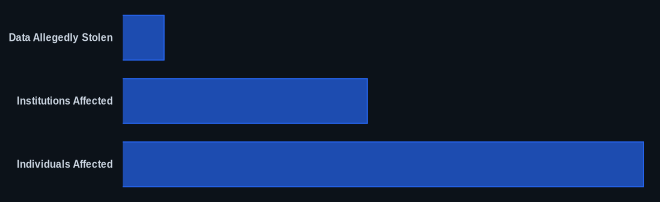
| Data Allegedly Stolen | 3.65 terabytes | ShinyHunters dark web claim |
| Institutions Affected | 9,000 | ShinyHunters dark web claim |
| Individuals Affected | 275 million | ShinyHunters dark web claim |
| Notification to Customers | May 1, 2026 | Instructure CISO Email |
| ShinyHunters Claim Date | May 3, 2026 | BleepingComputer |
Our Take
We're seeing a pattern here that's deeply concerning for critical infrastructure sectors like education. The education supply chain has become a soft target, and the repeated nature of these large-scale vendor breaches indicates a systemic lack of robust security practices and oversight. Simply containing an incident isn't enough; the focus needs to be on proactive threat hunting and continuous verification of third-party security postures. Proactive measures, such as deploying network access controls like Cloudflare Zero Trust, could have potentially limited lateral movement by ensuring only authorized users and devices could access critical internal resources.
The CVEDaily Take
Instructure's breach, particularly the alleged scale and the gap between official confirmation and threat actor claims, reflects a broader issue in vendor transparency and incident response within the ed-tech space. Institutions need to demand more than just reactive patching; they require proof of proactive security measures and rapid, transparent disclosure. Has your team thoroughly vetted the API security of all your critical third-party vendors in the last six months?
FAQ
Q: What data was confirmed to be compromised in the Instructure breach?
A: Instructure confirmed that names, email addresses, student ID numbers, and messages exchanged between users (Canvas/bCourses messages) were exposed. The company currently believes no passwords, dates of birth, government identifiers, or financial information were compromised.
Q: Who is the ShinyHunters hacking group, and what are their claims regarding the breach?
A: ShinyHunters is a known hacking group that has claimed responsibility for the Instructure breach. They allege the theft of 3.65 terabytes of data, impacting 9,000 educational institutions and 275 million individuals, and further claim that billions of private messages containing PII were involved.
Q: What steps did Instructure take to mitigate the incident?
A: Instructure revoked privileged credentials and access tokens, deployed security patches, heightened monitoring, and forced a rapid rotation of application keys requiring customers to reauthorize API access. They also temporarily took Canvas Data 2, Canvas Beta, and Canvas Test offline for maintenance.
