A new phishing campaign targeting employees across the global financial sector was publicly reported within the last 48 hours as of May 23, 2026, with security firms issuing alerts to their clients The Hacker News. This campaign relies heavily on advanced social engineering and custom-built phishing infrastructure, focusing purely on credential harvesting without deploying direct malware in its initial stages SecurityWeek.
What Happened
This newly identified phishing campaign does not use a specific CVE. Instead, attackers are meticulously crafting highly personalized emails impersonating senior executives or IT support within the target institution. These urgent-sounding emails prompt recipients to click a malicious link.
The links lead to near-perfect replicas of internal communications or banking login portals. These phishing pages mirror the target organization's actual branding, include realistic MFA prompts, and even display fake error messages to maintain credibility. Threat actors are registering new domains that are almost identical to legitimate corporate domains, often with a single character difference or an alternative TLD. After submitting credentials on these deceptive sites, victims are typically redirected to the real website or a benign page to prevent immediate suspicion.
No malware is deployed during this initial credential harvesting phase. The goal is solely to steal usernames, passwords, and potentially MFA codes.
Why It Matters
This campaign directly targets the critical IA-2 Identification and Authentication (Organizational Users) control. Initial reports, unconfirmed by affected organizations as of publication, suggest widespread attempts across numerous financial institutions in North America, Europe, and Asia. The exact number of affected users and organizations is still being determined, but the risk of compromise is high.
Stolen credentials and MFA codes can grant attackers access to internal systems and sensitive customer data. This is not a ransomware attack, so there are no ransom demands or data encryption for impact. However, the subsequent unauthorized access poses a severe risk of further penetration and data exfiltration.
Technical Breakdown
The attack chain begins with highly convincing T1566.002 Spearphishing Link emails. These emails employ T1036 Masquerading, impersonating trusted internal figures to manipulate recipients into clicking malicious URLs. Once clicked, users land on a meticulously cloned login portal hosted on a look-alike domain.
These phishing pages often use obfuscated JavaScript to capture submitted credentials, falling under T1027 Obfuscated Files or Information. The ultimate objective is T1078 Valid Accounts, gaining legitimate credentials for internal access. Indicators of Compromise (IoCs) include these newly registered look-alike domains, specific spoofed sender addresses, and the structural code of the phishing pages, which sometimes points to hosting providers with a history of supporting malicious activity.
Attackers are producing phishing pages indistinguishable from legitimate sites, right down to the texture and watermarks. The only tell might be the serial number, or in this case, a slightly off domain that most users won't notice. Organizations are finding traditional email security solutions challenged by the near-perfect mimicry; advanced security awareness platforms like KnowBe4 become critical for the human layer of defense.
Historical Context
This sophisticated phishing campaign echoes tactics employed by groups like Carbanak in 2015. Carbanak also relied heavily on sophisticated spear-phishing to gain initial access to financial institutions, targeting employees with highly convincing lures. Their campaigns ultimately led to significant financial theft through deep penetration and manipulation of banking systems.
While security researchers note the current campaign has not yet shown evidence of such deep penetration or direct financial manipulation, the initial credential harvesting phase shares similar methodologies, including highly crafted social engineering and targeting the financial sector for high-value access. The investment in near-perfect login portal replication highlights a continuity in attacker sophistication.
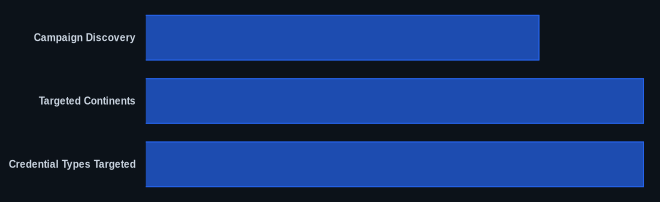
Data at a Glance
| Metric | Value | Source |
|---|---|---|
| Campaign Discovery | <2 days | The Hacker News |
| Targeted Continents | 3 | SecurityWeek |
| Malware Deployment (Initial) | 0 instances | The Hacker News |
| Credential Types Targeted | 3 types | SecurityWeek |
| Primary Attack Vector | Spearphishing Link | The Hacker News |
| Campaign Status | Active | SecurityWeek |
The CVEDaily Take
This campaign reinforces that the human layer remains a primary attack surface, especially when social engineering reaches this level of sophistication. Investing in email security that detects subtle domain variations and advanced URL analysis is critical. However, organizations must also provide robust employee training and foster a culture of skepticism. We believe this campaign highlights a critical vulnerability: the perceived trustworthiness of internal communication and login pages, even when accessed via an external link. Many organizations have implemented strict email filtering but have not prepared their employees for phishing pages that are virtually identical to internal resources.
Does your security team regularly conduct internal phishing simulations using near-perfect replicas to gauge employee vigilance against these advanced tactics, especially for pages that look legitimate?
FAQ
Q1: What makes this phishing campaign "sophisticated" compared to others?
A1: Its sophistication comes from the high degree of personalization in initial emails, the near-perfect replication of legitimate login portals, the use of newly registered but highly similar domains, and the redirection to benign pages post-credential theft, all designed to bypass immediate suspicion and traditional security controls.
Q2: How can organizations detect these highly deceptive phishing pages if they mimic legitimate sites so well?
A2: Detection requires a multi-layered approach: advanced email security gateways capable of heuristic analysis and URL reputation checks, browser extensions that warn about newly registered or look-alike domains, and robust employee training on verifying domain names pixel-by-pixel, even when branding looks correct.
Q3: What is the primary risk if credentials and MFA codes are stolen in this campaign?
A3: The primary risk is unauthorized access to internal systems, sensitive customer data, and potentially financial systems. While no malware is initially deployed, these stolen credentials serve as the keys for attackers to pivot into the network, escalate privileges, and conduct further malicious activities like data exfiltration or internal fraud.