
LiteSpeed cPanel Plugin CVE-2026-48172 Actively Exploited
On May 26, 2026, CISA added CVE-2026-48172 to its Known Exploited Vulnerabilities (KEV) Catalog, confirming active exploitation of this critical privilege escalation vulnerability in the LiteSpeed cPanel plugin. This vulnerability grants attackers root access to entire servers, exposing millions of sites to potential Mirai botnet and ransomware deployments. Federal civilian executive branch (FCEB) agencies face a tight May 29, 2026, deadline to patch or remove affected versions.
What Happened
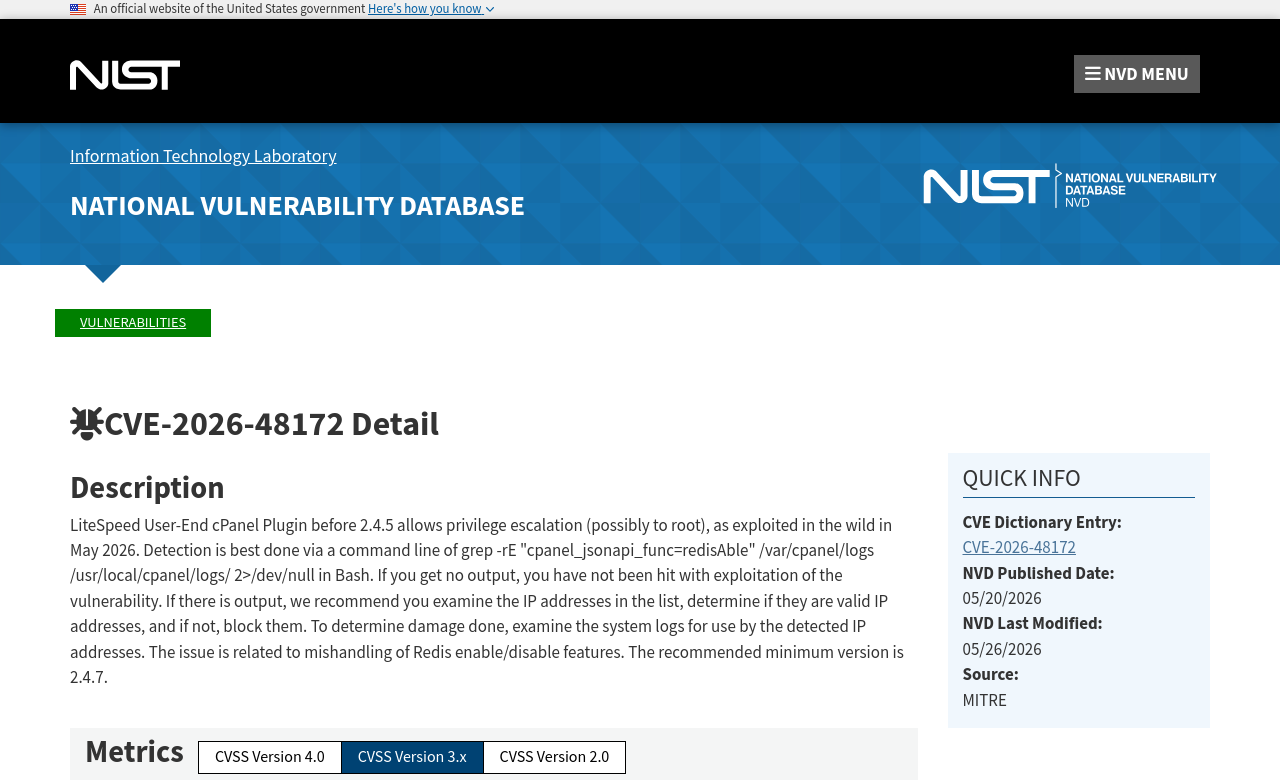
On May 26, 2026, CISA officially listed CVE-2026-48172 in its KEV Catalog, citing direct evidence of active exploitation in the wild (CISA Known Exploited Vulnerabilities Catalog). This critical flaw affects the LiteSpeed cPanel plugin, posing a severe risk to web hosting environments. Security researchers have rated this bug with a severity score of 9.8, placing it firmly in the critical category (NVD CVE-2026-48172).
Exploitation allows any compromised cPanel account to gain root access to the entire server. Jacob Krell, senior director for secure AI solutions and cybersecurity at Suzu Labs, emphasized this, stating, "CVE-2026-48172 gives any compromised cPanel account root access to the entire server" (BleepingComputer Article). Krell also highlighted the accelerating pace of exploitation, noting that "Agentic AI is compressing the window between disclosure and exploitation to hours." The CISA mandate for FCEB agencies to patch or remove vulnerable versions by May 29, 2026, a mere two days after its KEV listing, validates the immediate and severe nature of this threat.
Why It Matters
This is a systemic risk leveraging a critical component of the modern web. LiteSpeed is the third-largest web server globally (The Hacker News Article) and serves as the default web server in many cPanel shared hosting environments. This widespread adoption means that millions of websites are indirectly exposed to CVE-2026-48172 through their hosting providers.
On shared hosting, root-level compromise devastates. Gaining root access to a single server means compromising every tenant hosted on that server—every website, every database, every email account. This makes the LiteSpeed cPanel plugin a high-value target for attackers, who are increasingly focusing on platforms and plugins that companies use, rather than directly attacking individual company networks (SecurityWeek Article). Root access enables threat actors to deploy Mirai botnets, large-scale ransomware, or exfiltrate sensitive data including customer information, website content, and credentials stored on the server. This vulnerability represents a clear and present danger to the stability and security of a significant portion of the internet.
Affected Scope & Remediation
Organizations running the LiteSpeed cPanel plugin are immediately exposed to this critical vulnerability, especially those operating in shared hosting environments. Given the active exploitation confirmed by CISA, patch it now.
Organizations should prioritize patching vulnerable versions of the LiteSpeed cPanel plugin. If specific patch versions aren't immediately available from your vendor or host, monitor their official channels closely. After patching, conduct thorough Incident of Compromise (IOC) checks across your cPanel servers. Assume attacker persistence if any indicators are found and initiate your incident response protocols.
| Product | Version Range | Fixed Version | Source |
|---|---|---|---|
| LiteSpeed cPanel Plugin | All vulnerable versions | Update to latest patched version | NVD |
Patch Links & Advisories:
- NVD Entry: CVE-2026-48172
- CISA KEV Catalog Entry: Known Exploited Vulnerabilities Catalog (Search for CVE-2026-48172)
- Vendor Advisory: Check LiteSpeed Technologies' official website and your cPanel provider for specific plugin update instructions.
While a direct patch is the primary remediation, if immediate patching isn't feasible, isolate cPanel instances, apply stricter network access controls to the cPanel interface, and review all cPanel user permissions. Continuously monitor your endpoints with solutions like SentinelOne, configured to detect unusual process execution or privilege escalation attempts within your cPanel server environment.
The CISA KEV deadline for FCEB agencies is May 29, 2026. This tight timeframe confirms active exploitation and the severity of the potential impact.
Technical Breakdown
CVE-2026-48172 is a privilege escalation vulnerability within the LiteSpeed cPanel plugin. This means an attacker who has already gained access to a standard, non-privileged cPanel account—perhaps through credential stuffing, phishing, or exploiting a separate web application vulnerability on one of the hosted sites—can then elevate their privileges to root on the underlying server. This is not just gaining control of one website; it's gaining total control of the entire physical or virtual machine hosting potentially hundreds or thousands of sites.
Think of it like this: a tenant in a large apartment building finds a defect in their apartment door lock. This defect allows them to pick their own lock easily. This isn't the vulnerability. The actual vulnerability is if they then discover a master key hidden in their apartment that, due to a flaw in the building's design, opens every single apartment door in the building, as well as the building manager's office. The compromised cPanel account is the tenant, and the LiteSpeed plugin vulnerability is the master key.
From a MITRE ATT&CK perspective, this maps directly to T1068 Exploitation for Privilege Escalation, where an attacker uses a vulnerability to gain higher-level permissions. Given that it targets a widely used plugin, it also involves T1190 Exploit Public-Facing Application if the initial cPanel compromise occurred via an external attack path. To defend against such attacks, apply NIST SP 800-53 controls like SI-2 Flaw Remediation, which mandates prompt patching of identified vulnerabilities, and AC-6 Least Privilege, ensuring that even compromised accounts operate with the minimum necessary permissions. Continuous monitoring and detection capabilities are critical. Tools like CrowdStrike Falcon can help identify suspicious activity indicative of privilege escalation attempts or unauthorized root access in real-time.
Historical Context
The active exploitation of CVE-2026-48172 fits a disturbing trend of attackers targeting widely adopted hosting components. Less than a month prior, attackers exploited a similar critical cPanel bug, CVE-2026-41940, at scale. Itai Goldman, co-founder and CTO at Miggo Security, highlighted that CVE-2026-41940 compromised approximately 44,000 cPanel servers, leading to the deployment of Mirai botnet and ransomware across the same hosting stack (BleepingComputer Article).
The similarity lies in the target: both vulnerabilities attack critical components of the cPanel hosting environment. This gives threat actors a single point of failure to achieve broad impact, rather than individually targeting thousands of separate endpoints. The methods—privilege escalation to gain root access—are also consistent. The difference lies in the specific technical flaw being exploited, but the attack surface (shared hosting component) and the desired outcome (mass compromise, botnet/ransomware deployment) remain largely the same. These incidents confirm a strategic shift by adversaries towards supply chain vulnerabilities in widely used infrastructure.
Data at a Glance
| Metric | Value | Source |
|---|---|---|
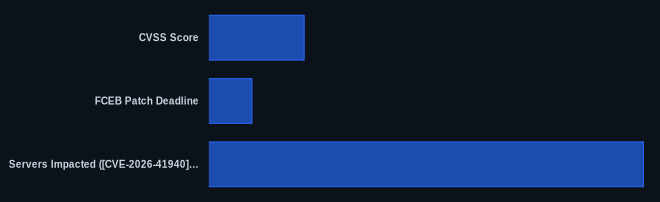
| CVSS Score | 9.8 | NVD |
| CISA KEV Listing | Yes | CISA |
| FCEB Patch Deadline | 2 days | CISA |
| Servers Impacted (CVE-2026-41940) | 44,000 | BleepingComputer |
| Exploitation Window (AI-driven) | Hours | BleepingComputer |
| Attack Type | Privilege Escalation | NVD |
The CVEDaily Take
The LiteSpeed cPanel plugin vulnerability confirms how quickly a supply chain flaw turns into a critical enterprise risk. The repeated successful targeting of cPanel components, coupled with Agentic AI compressing the window between disclosure and mass exploitation to mere hours, means traditional patch management is too slow. This requires proactive threat hunting, kernel-level telemetry, and a comprehensive understanding of the dependencies in your web stack. We think many organizations are underestimating how quickly this vulnerability is being exploited and the full impact of a successful root compromise on shared hosting.
Has your team audited third-party cPanel plugins and their associated permissions since CVE-2026-48172 came to light?
FAQ
Q1: What is CVE-2026-48172?
A1: CVE-2026-48172 is a critical privilege escalation vulnerability found in the LiteSpeed cPanel plugin, actively exploited in the wild, which allows any compromised cPanel account to gain root access to the entire server.
Q2: Why is this vulnerability particularly critical for organizations using shared hosting?
A2: For organizations on shared hosting, a single compromised LiteSpeed cPanel plugin can grant root access to the entire server. This means an attacker can compromise all other customer accounts and websites hosted on that server, leading to widespread data exposure, Mirai botnet deployment, or ransomware infections affecting numerous tenants simultaneously.
Q3: What immediate actions should organizations take to address CVE-2026-48172?
A3: Organizations should immediately identify if they are using the LiteSpeed cPanel plugin and update it to the latest patched version. Following patching, conduct thorough IOC checks on affected servers for any signs of compromise, and review cPanel account permissions, assuming potential attacker persistence if any anomalies are detected.