
In early June 2026, an unnamed US healthcare provider operating across multiple states experienced a Medusa ransomware attack, leading to significant operational disruptions across patient scheduling, billing, and access to electronic health records. The Medusa group claims responsibility for the attack, asserting they exfiltrated sensitive patient data and are demanding a substantial ransom, reportedly in the tens of millions of dollars, payable in Bitcoin, to prevent publication. The healthcare provider has confirmed operational disruption and a data breach, with investigations ongoing regarding the exact scope of data exfiltration and the specific ransom amount.
What Happened
The attack was detected around June 5-7, 2026, prompting the affected healthcare provider to activate its incident response plan, isolate affected systems, and engage cybersecurity experts. The provider confirmed operational disruption and a data breach, and investigations are ongoing to pinpoint the exact scope of data exfiltration and the specific ransom amount. The Medusa ransomware group, known for its double-extortion tactics, quickly claimed responsibility, posting alleged samples of exfiltrated patient data on their dark web leak site by June 7, 2026, as reported by BleepingComputer.
Initial access is suspected to have occurred via a compromised third-party vendor portal or a sophisticated phishing campaign targeting IT staff. This aligns with Medusa's frequent use of multi-stage infection chains, often exploiting vulnerable RDP or known vulnerabilities for initial footholds. Following initial access, the attackers engaged in lateral movement and privilege escalation, then deployed Medusa ransomware across the network.
They specifically targeted critical systems and data repositories, encrypting a wide array of file types and appending unique extensions. The attackers left a ransom note, typically named "HOW_TO_RECOVER_FILES.html", demanding cryptocurrency payment, as analyzed by Mandiant. Law enforcement has been notified, and the provider is fully cooperating with the ongoing investigation. No specific CVE ID has been publicly associated with this attack, suggesting the use of previously identified, unpatched flaws or sophisticated social engineering tactics.
Why It Matters
This incident potentially affects millions of patients across multiple states, not only through service disruption but also due to the group's claim of exfiltration of highly sensitive data. The Medusa group claims to have obtained Personally Identifiable Information (PII) such as names, addresses, and social security numbers. More critically, Protected Health Information (PHI), including medical records, treatment information, and insurance details, is also reportedly exposed, according to SecurityWeek. No affected organization has confirmed the scope of data exfiltration.
Ransomware groups frequently target the healthcare sector because of the critical nature of their services and the high value of patient data, which significantly increases the likelihood of ransom payments, as highlighted by SecurityWeek. Beyond the immediate disruption and potential data compromise, such attacks erode patient trust and incur substantial financial costs related to incident response, system restoration, and potential regulatory fines. The threat of public data release further amplifies the pressure on victims.
Affected Scope & Remediation
Given no specific CVE has been publicly linked to this Medusa attack, an "affected versions vs. patched versions" table doesn't directly apply. However, Medusa ransomware commonly exploits known but unpatched vulnerabilities, relies on weak remote access security, and uses social engineering. Organizations, especially those in healthcare, must implement a defense-in-depth strategy.
Patch known vulnerabilities promptly; establish a rigorous RA-5 Vulnerability Monitoring and Scanning program and a strict SI-2 Flaw Remediation process. Secure all remote access points, particularly RDP, with strong multi-factor authentication (MFA). Consider hardware tokens like YubiKey for critical staff. Network segmentation is vital to contain lateral movement; treat every network segment as a potential breach point under a zero-trust model.
Deploy endpoint detection and response (EDR) solutions like CrowdStrike Falcon across all endpoints to detect and prevent malicious activity. Ensure regular, verifiable backups of all critical data are stored offline and tested regularly, leveraging solutions like Veeam to aid in rapid recovery from T1490 Inhibit System Recovery attempts. Conduct frequent security awareness training, perhaps using KnowBe4, to inoculate staff against phishing attempts, which are a primary initial access vector.
Review and harden all third-party vendor portals and connections. This includes strict access controls (AC-3 Access Enforcement) and continuous monitoring of associated accounts. Develop and regularly practice your IR-4 Incident Handling plan, focusing on isolation, eradication, recovery, and post-incident analysis. Regularly audit configurations for critical systems to align with CM-6 Configuration Settings best practices, reducing attack surface.
Technical Breakdown
Medusa ransomware typically initiates its multi-stage infection chain with an initial access vector such as a sophisticated phishing campaign (T1566.002 Spearphishing Link), brute-forcing or exploiting vulnerable RDP instances (T1021.001 Remote Desktop Protocol), or by exploiting public-facing applications (T1190 Exploit Public-Facing Application). Once inside, attackers don't just drop the payload. They persist, moving laterally across the network to identify and compromise high-value targets.
This lateral movement often involves credential dumping (T1003 OS Credential Dumping), frequently targeting LSASS memory (T1003.001 LSASS Memory) to extract NTLM hashes or cleartext credentials. Attackers then use these credentials for privilege escalation (T1068 Exploitation for Privilege Escalation), gaining administrative access necessary to deploy the ransomware across the entire domain.
After establishing extensive access, the Medusa ransomware payload is deployed. It encrypts a wide array of file types, appends a unique extension to each encrypted file, and drops its distinctive ransom note, as described by CrowdStrike. Concurrently, the group employs its signature double-extortion tactic, exfiltrating vast amounts of sensitive data—in this case, PII and PHI—to their command-and-control servers (T1041 Exfiltration Over C2 Channel). This exfiltrated data serves as leverage, with the threat of public release on their dark web leak site if the ransom isn't paid. The entire process often includes attempts to inhibit system recovery (T1490 Inhibit System Recovery) by deleting shadow copies or disabling backup processes, further pressurizing victims. Organizations should ensure SI-3 Malicious Code Protection is continuously updated.
Historical Context
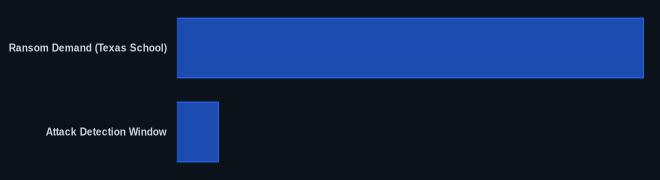
The Medusa ransomware group previously demonstrated its aggressive double-extortion capabilities in September 2025, when it targeted a large school district in Texas. In that incident, the group demanded a $5 million ransom and, upon the district's refusal to pay, proceeded to publish sensitive student and staff data on its dark web leak site, as reported by The Hacker News. This prior attack mirrors the current healthcare incident in its reliance on data exfiltration and the subsequent public release threat as a primary coercive tactic. The school district's refusal to pay and the subsequent data release were confirmed.
Both incidents highlight Medusa's operational consistency: target critical infrastructure organizations, demand substantial cryptocurrency ransoms, and follow through on threats of data publication. While the sectors differ—education versus healthcare—the playbook remains largely the same. The current attack on a multi-state healthcare provider, however, likely carries a far broader scope of potential patient impact and data sensitivity, escalating the stakes considerably. The consistent targeting of vulnerable sectors with high-value data emphasizes the group's strategic focus.
Data at a Glance
| Metric | Value | Source |
|---|---|---|
| Ransom Demand (Healthcare Claim) | Tens of millions of dollars | BleepingComputer |
| Ransom Demand (Texas School) | $5 million | The Hacker News |
| Attack Detection Window | 3 days | BleepingComputer |
| Patients Potentially Affected | Millions (unconfirmed) | SecurityWeek |
| Exfiltration Data Types (Claimed) | PII, PHI | SecurityWeek |
| Ransom Note Filename (Example) | HOW_TO_RECOVER_FILES.html |
Mandiant |
The CVEDaily Take
The Medusa group continues to prove that its double-extortion model is highly effective against organizations with sensitive data and critical operational needs. We think the healthcare provider's confirmed operational disruption, combined with Medusa's rapid posting of alleged data samples, suggests a significant compromise, regardless of the unconfirmed exact breach size or ransom amount. It raises questions about the robustness of their incident response and if they had adequate defenses against known Medusa tactics.
What preventative measures could have been implemented earlier to detect initial access via a compromised third-party vendor portal?
FAQ
Q1: What is Medusa ransomware?
A1: Medusa ransomware is a specific strain of malware known for its double-extortion tactics, encrypting victims' files and exfiltrating sensitive data. It typically appends unique extensions to encrypted files and leaves a ransom note demanding cryptocurrency for decryption and to prevent data publication.
Q2: How does Medusa ransomware typically gain initial access to networks?
A2: Medusa commonly gains initial access through methods like exploiting vulnerable Remote Desktop Protocol (RDP) configurations, sophisticated spearphishing campaigns targeting employees (especially IT staff), or by exploiting known but unpatched vulnerabilities in public-facing applications or third-party vendor portals.
Q3: What types of data did the Medusa group claim to have exfiltrated in this healthcare attack?
A3: The Medusa group claims to have exfiltrated both Personally Identifiable Information (PII), such as names, addresses, and social security numbers, and Protected Health Information (PHI), including medical records, treatment details, and insurance information. The healthcare provider has not confirmed these specific data types or the volume of data exfiltrated.