
AryStinger Malware Hijacks 4,300 Routers as Global Proxy Network
Over 4,300 end-of-life (EOL) routers, primarily D-Link models, have been infected by the AryStinger malware, transforming them into a covert global network for reconnaissance and proxy activities. QiAnXin's XLab identified this threat, which exploits decade-old vulnerabilities in consumer-grade devices and a recently patched QNAP NAS flaw, underscoring the severe, persistent risk posed by unpatched legacy hardware. AryStinger's objective is not DDoS or cryptomining; it's about establishing a distributed, anonymous infrastructure for pre-intrusion footprinting and traffic tunneling. For teams managing diverse network perimeters, unpatched edge devices are prime targets.
What Happened
QiAnXin's XLab initially detected AryStinger activity on March 12, 2026, with widespread news reports emerging on June 21-22, 2026 (The Hacker News, BleepingComputer). The malware primarily targets outdated D-Link models like the DIR-850L (accounting for 75% of infections reported by BleepingComputer) and DIR-818LW, alongside some Linksys models using Realtek RTL819X chips. A more advanced variant also compromises QNAP NAS devices by exploiting a recently patched code injection flaw, CVE-2025-11837, which was demonstrated at Pwn2Own Ireland 2025 and QNAP patched in November 2025 (The Hacker News).
AryStinger is a malware family that establishes a distributed network of compromised devices for reconnaissance and proxy operations. It exploits vulnerabilities like CVE-2013-3307 for Linksys routers and CVE-2016-5681 for D-Link models, some of which are over a decade old (BleepingComputer). The malware operates on a controller/executor model, communicating with a Command and Control (C2) server over HTTP/HTTPS using Protobuf-encoded traffic, obfuscated with simple XOR encryption (QiAnXin's XLab). Its low detection rate makes it particularly dangerous.
Why It Matters
AryStinger builds a covert global proxy and reconnaissance network, providing attackers with a distributed, anonymized springboard for future operations. This isn't about immediate financial gain or widespread disruption; it's about establishing a persistent, hard-to-trace infrastructure for pre-intrusion footprinting. The compromised devices conduct internet scanning, service fingerprinting, subdomain enumeration, and traffic tunneling. This allows attackers to silently gather intelligence, map targets, and launch subsequent attacks while masking their true origin.
At least 4,300 routers worldwide are infected, with the majority located in South Korea (approximately 48.5%) and China (approximately 31.8%) according to The Hacker News. Smaller clusters exist in Sweden, Malaysia, and Singapore. These devices also enable DNS tampering, potentially hijacking user browsing and silently monitoring network traffic. For security teams, this signifies a problem: unmonitored and unpatched edge devices in remote offices or homes can become critical components of a broader threat network, turning consumer-grade hardware into a security liability for enterprise assets.
Affected Scope & Remediation
The primary affected devices are D-Link DIR-850L and DIR-818LW routers, Linksys models utilizing Realtek RTL819X chips, and QNAP NAS devices vulnerable to CVE-2025-11837. The router vulnerabilities, including CVE-2013-3307 and CVE-2016-5681, target devices that are largely end-of-life and no longer receive official security updates. This puts users in a difficult position, requiring immediate action beyond simple patching.
For the router vulnerabilities, there are no patches. You need to either replace these end-of-life devices entirely or isolate them on a segmented network, strictly limiting their exposure. Disable remote administration features on any such legacy device if you can't replace it immediately. For QNAP NAS devices, ensure all available patches have been applied to address CVE-2025-11837, which QNAP patched in November 2025 following its demonstration at Pwn2Own Ireland 2025 (The Hacker News). Regularly scan for unexpected services or processes like syswapd0h or syswapd0w, or listening on non-standard ports like 2332 for Dropbear SSH. Consider implementing a solution like Cloudflare Zero Trust for remote access to ensure that even home office networks aren't directly exposed to the internet, providing an additional layer of boundary protection.
| Product | Version Range | Fixed Version | Details |
|---|---|---|---|
| D-Link DIR-850L | All firmware versions (End-of-Life) | Replace / Retire Device | Exploits CVE-2016-5681 |
| D-Link DIR-818LW | All firmware versions (End-of-Life) | Replace / Retire Device | Exploits CVE-2016-5681 |
| Linksys (Realtek RTL819X) | All firmware versions (End-of-Life) | Replace / Retire Device | Exploits CVE-2013-3307 |
| QNAP NAS Devices | Vulnerable to CVE-2025-11837 | Patched in November 2025 | See QNAP security advisories for specific models/firmware |
Patch Links:
- CVE-2013-3307: NVD Entry
- CVE-2016-5681: NVD Entry
- CVE-2025-11837 (QNAP): QNAP released a patch in November 2025; consult the official QNAP security advisories for your specific model and firmware (The Hacker News).
Workarounds/Mitigations:
For EOL routers, physical replacement or aggressive network segmentation is crucial. If replacement isn't immediate, ensure remote administration is disabled and that these devices are not directly exposed to the internet. Implement egress filtering to block unexpected outbound C2 traffic. For QNAP devices, verify current patching levels and consider endpoint detection and response (EDR) solutions like SentinelOne to monitor for anomalous process execution or binary drops. This aligns with SI-2 Flaw Remediation and CM-7 Least Functionality from NIST SP 800-53, advocating for proactive vulnerability management and minimizing attack surface.

Technical Breakdown
AryStinger employs a modular design with two primary variants: a C-based version targeting older routers and a Go-based version for NAS devices. Both communicate with C2 servers (e.g., dybic.ajb8.com, opi7.com (Recorded Future)) using Protobuf over HTTP/HTTPS, with data obfuscated via simple XOR encryption, a technique mapping to T1027 Obfuscated Files or Information. The C2 distributes scanning tasks for parallel execution across the compromised fleet.
The C-based variant, designed for resource-constrained routers, focuses on mass DNS scanning and traffic tunneling. Its persistence mechanism involves downloading and running a Dropbear SSH server, listening on port 2332, which falls under T1547 Boot or Logon Autostart Execution. This ensures continued remote access even after reboots. The Go-based variant is more feature-rich, enabling internal and external network scanning, command execution, and direct execution of Go, Java, or Python source code. It integrates open-source penetration testing tools like fscan, ksubdomain, and httpx, representing T1105 Ingress Tool Transfer. Persistence here is either via Dropbear or gs-netcat.
Think of AryStinger as setting up a series of anonymous relay stations in a dense urban environment. Instead of directly attacking a target from their own location, attackers use these compromised routers and NAS devices as jumping-off points. Each device performs a small, specialized task – scanning for open ports, enumerating subdomains, or simply forwarding traffic. This distributed approach, initiated by T1190 Exploit Public-Facing Application, makes it incredibly difficult to trace the original source of an attack, using the T1071 Application Layer Protocol (HTTP/HTTPS) for stealthy communication. It effectively creates a vast, untraceable footprinting infrastructure. Organizations should also apply RA-5 Vulnerability Monitoring and Scanning to regularly identify such aging, vulnerable devices across their distributed networks before they become part of the next botnet.
Historical Context
The operational pattern of AryStinger—compromising end-of-life routers to build a distributed relay infrastructure—is not new. This aligns with tactics seen in "Operational Relay Box (ORB) networks" often associated with state-linked actors or sophisticated cybercriminal groups seeking to obscure their origins.
A closely related incident was the dismantling of 5socks/Anyproxy services in May 2025, which relied on TheMoon malware to create a vast botnet from compromised routers for proxying illicit traffic (Recorded Future). Furthermore, Lumen's disruption of the AVrecon botnet in 2023 provides another direct parallel, as it also notably targeted D-Link DIR-850L and DIR-818LW routers – the very same models heavily impacted by AryStinger. While previous botnets like TheMoon and AVrecon were often used for large-scale fraud, DDoS, or cryptomining, AryStinger's distinctive focus on pre-intrusion reconnaissance and establishing a covert proxy network highlights an evolution in botnet objectives. It emphasizes intelligence gathering and anonymity as primary goals rather than direct, resource-intensive exploitation, a more subtle but equally dangerous long-term threat.
Data at a Glance
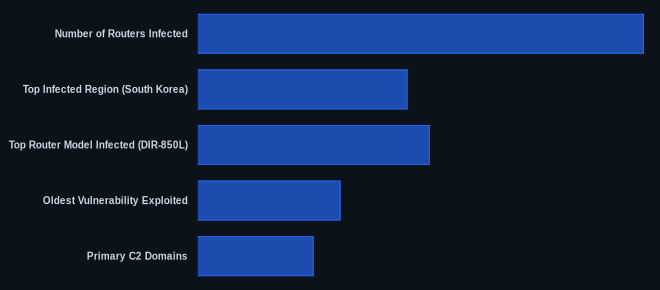
| Metric | Value | Source |
|---|---|---|
| Number of Routers Infected | 4,300+ | QiAnXin's XLab |
| Top Infected Region (South Korea) | 48.5% | The Hacker News |
| Top Router Model Infected (DIR-850L) | 75% | BleepingComputer |
| Oldest Vulnerability Exploited | 13 years | BleepingComputer |
| Qianxin Detection Date | March 12, 2026 | QiAnXin's XLab |
| Primary C2 Domains | dybic.ajb8.com, opi7.com |
Recorded Future |
The CVEDaily Take
AryStinger highlights that organizations must address the persistent, long-tail risk of EOL network hardware. These devices, once dismissed as consumer-grade, are now global reconnaissance nodes, turning forgotten assets into active threats. The attack chain's reliance on readily available, albeit old, vulnerabilities highlights a systemic failure to lifecycle manage network devices. We believe the observed geographic distribution, with a significant concentration in South Korea and China, suggests a targeted interest in specific regions or types of networks, rather than purely opportunistic exploitation.
Does your organization have a strict policy and enforcement mechanism for identifying and replacing or isolating end-of-life network equipment, especially in remote or distributed environments?
FAQ
Q: What is AryStinger's primary objective?
A: AryStinger's primary goal is to establish a covert global reconnaissance and proxy network, enabling attackers to perform pre-intrusion footprinting, information gathering, traffic tunneling, and command execution while masking their true location, rather than engaging in DDoS attacks or cryptomining.
Q: Which devices are primarily affected by AryStinger?
A: AryStinger predominantly affects end-of-life D-Link routers, specifically models DIR-850L and DIR-818LW, as well as some Linksys routers using Realtek RTL819X chips. A newer variant also targets QNAP NAS devices by exploiting the recently patched CVE-2025-11837.
Q: What is the most urgent mitigation for organizations using these legacy routers?
A: The most urgent mitigation for affected end-of-life routers is to immediately replace them with currently supported hardware. If immediate replacement isn't feasible, strictly isolate them on a segmented network, disable all remote administration features, and monitor for any anomalous outbound connections or unexpected services like Dropbear on port 2332.