A critical zero-day vulnerability, officially tracked as CVE-2026-50656 and dubbed 'RoguePlanet', has been discovered in Microsoft Defender. This flaw, publicly disclosed by researcher 'Nightmare Eclipse' on June 22, 2026, allows attackers to gain full system access on Windows 10 and 11 systems, even on fully patched devices, by exploiting a race condition. It directly undermines system integrity and presents an immediate, severe risk to organizations due to Microsoft Defender's widespread use.
What Happened
On June 22, 2026, security researcher 'Nightmare Eclipse' publicly disclosed a critical zero-day vulnerability, CVE-2026-50656 'RoguePlanet', found within Microsoft Defender. This flaw, which affects Windows 10 and Windows 11 systems, enables attackers to achieve full system access by exploiting a race condition. 'Nightmare Eclipse' provided a proof-of-concept (PoC) exploit, hosted on a self-managed Git repository; the researcher stated this was necessary after Microsoft had previously targeted and removed their exploit-hosting repositories on GitHub and GitLab.
The race condition allows attackers to generate command prompts with system privileges, bypassing the security controls of Microsoft Defender and the operating system itself, as reported by PCWorld on the same day. Microsoft has acknowledged the vulnerability and confirmed it is developing a patch. The ability to subvert a core security product with system-level access on fully patched devices indicates a significant security challenge that demands immediate attention.
Why It Matters
The 'RoguePlanet' zero-day is significant because of Microsoft Defender's pervasive deployment across enterprise and individual Windows 10 and 11 endpoints, making millions of systems immediately vulnerable to full compromise. Gaining system-level control through a zero-day in an endpoint security solution poses a substantial and direct risk to organizational data integrity, confidentiality, and operational continuity.
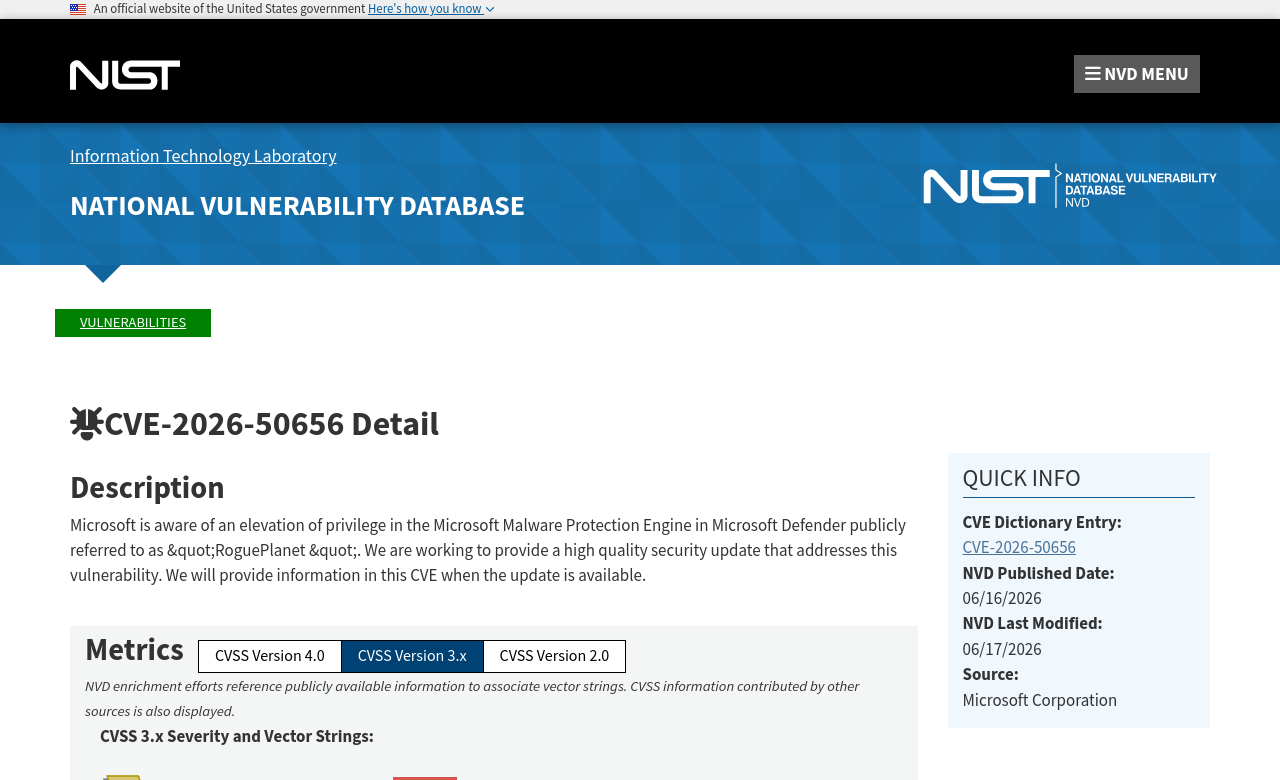
Zero-day exploits actively used in the wild numbered 90 in 2025, according to analysis reported by The Hacker News. This represented a 15% increase from 2024. Nearly half of these, 48%, specifically targeted enterprise infrastructure. The rapid weaponization of such vulnerabilities means the window between discovery and active exploitation is increasingly narrow, often non-existent, leaving defenders with little to no time to react. The impact of CVE-2026-50656 is amplified by this current environment.
Affected Scope & Remediation
The 'RoguePlanet' vulnerability, CVE-2026-50656, critically impacts all currently supported versions of Microsoft Defender running on Windows 10 and Windows 11 operating systems. Since this is a zero-day with active exploitation, all devices relying on Microsoft Defender for endpoint protection are considered exposed until a patch is released.
Microsoft has acknowledged the flaw and is actively working on a fix. As of the time of this report, no official patch has been released, making mitigation strategies critical for immediate protection. Without a patch, organizations must focus on detecting post-exploitation activity and minimizing the attack surface where possible. Tools like CrowdStrike Falcon or SentinelOne offer advanced Endpoint Detection and Response (EDR) capabilities to spot anomalous system-level process creation or suspicious command execution that might follow successful exploitation.
| Product | Version Range | Fixed Version |
|---|---|---|
| Microsoft Defender | All versions on Windows 10 & 11 | Patch Pending |
Patch Links:
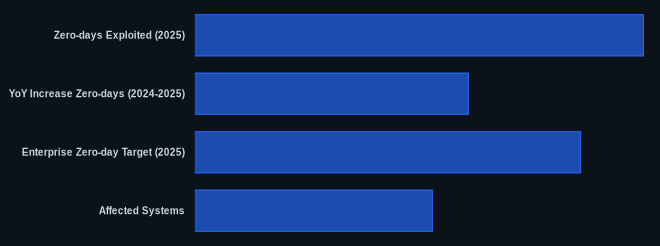
- NVD Entry: CVE-2026-50656
- Microsoft Advisory (General): https://www.microsoft.com
Workaround/Mitigation:
Until a patch is available, focus on defense-in-depth strategies. Monitor Windows systems for unusual process creations originating from Defender's process tree (e.g., MsMpEng.exe spawning unexpected child processes like cmd.exe or powershell.exe with SYSTEM privileges). Enforce least privilege principles rigorously, ensuring users and applications operate with the minimum necessary permissions. Review and strengthen network segmentation to limit lateral movement should an endpoint be compromised.
Timeline:
- Disclosure Date: June 22, 2026 (by 'Nightmare Eclipse', reported by PCWorld)
- First Known Exploit: June 22, 2026 (PoC released by 'Nightmare Eclipse')
- Patch Release: Pending (Microsoft acknowledgement)
CISA KEV Deadline: Not yet listed on CISA's Known Exploited Vulnerabilities catalog.
Technical Breakdown
CVE-2026-50656 in Microsoft Defender exploits a classic race condition to achieve full system access. A race condition occurs when two or more operations or threads attempt to access and manipulate the same shared resource at the same time, and the outcome depends on the sequence or timing of their execution. In the context of 'RoguePlanet', an attacker uses this specific timing vulnerability within Defender to gain a critical advantage.
Think of it like two drivers trying to merge into a single lane, but there's a tiny, specific moment when both signals are green, and a fast, aggressive driver can sneak through before the system resolves the conflict. In this attack, Defender might be performing a privileged operation, like scanning a file, which temporarily opens a small window of opportunity or creates a temporary, privileged resource. The attacker meticulously times their malicious action to coincide with this window, tricking the system into executing their code with the elevated privileges Defender temporarily held. This specific flaw allows the attacker to generate a command prompt that inherits the SYSTEM privileges of the Defender process itself.
This technique aligns directly with MITRE ATT&CK T1068: Exploitation for Privilege Escalation. Attackers exploit a vulnerability in software or an operating system to gain higher-level permissions than initially authorized. Here, they're moving from user-level access to SYSTEM, the highest privilege level on a Windows machine. From there, they can disable security software, install persistent backdoors, dump credentials (like via T1003 OS Credential Dumping), or execute arbitrary code across the system. This kind of flaw also highlights the importance of the NIST SP 800-53 SI-2 Flaw Remediation control, emphasizing the need for timely identification, reporting, and patching of vulnerabilities, especially in critical security infrastructure.
Historical Context
The 'RoguePlanet' zero-day in Microsoft Defender isn't an isolated incident; it's part of a recurring pattern where core Microsoft products are targeted and exploited before a patch is available. A recent, pertinent example occurred in February 2026 with CVE-2026-21509, a high-severity security feature bypass vulnerability in Microsoft Office that was actively exploited in the wild. Microsoft released an out-of-band patch for this Office flaw, indicating the urgency and severity of zero-day attacks on widely used software.
Similarities between CVE-2026-50656 and CVE-2026-21509 lie in their zero-day nature and the fact that they were both actively exploited before an official patch was released. This demonstrates the shrinking window defenders have. However, the difference is critical: CVE-2026-21509 targeted a productivity suite (Office), while 'RoguePlanet' targets Microsoft Defender, the operating system's primary endpoint security solution. Exploiting Defender bypasses the very mechanism designed to protect the system, making it arguably more insidious and dangerous than an application-layer vulnerability, as it compromises the foundation of trust.
Data at a Glance
| Metric | Value | Source |
|---|---|---|
| CVE ID | CVE-2026-50656 | NVD |
| Vulnerability Type | Race Condition PE | PCWorld |
| Disclosure Date | June 22, 2026 | PCWorld |
| Zero-days Exploited (2025) | 90 | The Hacker News |
| YoY Increase Zero-days (2024-2025) | 15% | The Hacker News |
| Enterprise Zero-day Target (2025) | 48% | The Hacker News |
| Affected Systems | Windows 10, Windows 11 | Microsoft |
The CVEDaily Take
This 'RoguePlanet' zero-day in Microsoft Defender underscores that no security product is infallible. Attackers will always find the seams, especially when race conditions in privileged processes offer a direct path to SYSTEM. The critical takeaway here isn't just "patch immediately" (which you can't yet), but "verify your controls and hunt for the behaviors this enables." We think relying solely on vendor patches for core security products is becoming untenable; organizations must shift to an active hunting stance.
What specific behavioral detections has your team deployed to catch T1068 activity initiated by Defender processes?
FAQ
-
What is 'RoguePlanet' (CVE-2026-50656)?
'RoguePlanet' is a critical zero-day vulnerability (CVE-2026-50656) in Microsoft Defender that allows attackers to gain full system-level access on Windows 10 and 11 by exploiting a race condition. It was publicly disclosed on June 22, 2026, by researcher 'Nightmare Eclipse'. -
Are fully patched systems vulnerable to CVE-2026-50656?
Yes, CVE-2026-50656 affects fully patched Windows 10 and Windows 11 systems running Microsoft Defender. Since it is a zero-day vulnerability, no patch is currently available to mitigate it. -
What mitigations exist for CVE-2026-50656 before a patch is released?
Before a patch is released, focus on kernel-level telemetry and defense-in-depth. Implement enhanced endpoint detection and response (EDR) solutions to monitor for unusual process creation (e.g.,MsMpEng.exespawning shells withSYSTEMprivileges), enforce strict least privilege, and strengthen network segmentation to contain potential lateral movement if a system is compromised.