
On May 19, 2026, a GitHub employee's device was compromised, resulting in the exfiltration of approximately 3,800 internal private repositories. This incident highlights a shift in attack vectors, leveraging developer tools rather than traditional network perimeters, similar to the complex supply chain dynamics observed with SolarWinds.
What Happened
A GitHub employee's device was compromised on May 19, 2026, after they installed a malicious Visual Studio Code (VS Code) extension. This was not a zero-day exploit or a spearphishing email; attackers instead used a poisoned developer tool, designed to appear legitimate. The threat actor group, self-identified as TeamPCP and tracked by Sophos as UNC6780, claims to have exfiltrated approximately 3,800 internal private repositories from GitHub's internal systems. GitHub's incident response team detected and contained the compromise on the same day, isolating the affected device and removing the malicious extension version. Critically, GitHub confirmed no evidence suggests customer repositories or customer data outside their internal systems were affected.
Why It Matters
Enterprise security perimeters have expanded. Developer laptops, their Integrated Development Environments (IDEs), and the plugins they contain are now primary targets. This is a direct attack on the software supply chain's human element, mirroring the 2020 SolarWinds compromise but occurring earlier in the development pipeline. Attackers did not use a novel vulnerability; instead, they exploited trust in developer tooling, a vector many organizations overlook. Defense strategies must extend beyond traditional network defenses to scrutinize every tool, dependency, and extension developers install. The attack surface for modern software organizations increasingly exists within the daily workflow of engineering teams.
Affected Scope & Remediation
While there is no specific CVE or patch for this incident, the affected scope includes any organization where developers use VS Code and install extensions without rigorous vetting. The risk extends to virtually any environment relying on developer-centric tooling and a broad range of third-party dependencies.
To remediate this, implement proactive supply chain integrity and advanced endpoint security. Define strict policies for VS Code extension approval, especially for less-verified or newly installed extensions; this should be a standard part of SA-10 Developer Configuration Management. Tools like CrowdStrike Falcon or SentinelOne can provide kernel-level telemetry to flag suspicious process behavior or unauthorized data exfiltration originating from developer machines.
- Vendor Advisory: GitHub's official statement
- Mitigation: Implement strict controls over approved VS Code extensions. Enforce code signing and integrity checks for all development tools. Conduct regular audits of developer workstation configurations, ensuring least privilege and network segmentation for dev environments. Mandate security awareness training specifically focused on software supply chain risks. Consider using Cloudflare Zero Trust for securing access to internal development resources, ensuring only authorized devices and identities can connect.

Technical Breakdown
Attackers used a malicious VS Code extension as their initial access vector, falling under the MITRE ATT&CK technique T1195.002 Compromise Software Supply Chain. Developers download extensions to enhance their workflow, implicitly trusting the extension publisher and the marketplace. Once installed, the malicious extension gained execution on the employee's workstation. This access likely allowed TeamPCP to escalate privileges or steal credentials already present on the compromised device. From there, the exfiltration of the claimed 3,800 internal private repositories would involve techniques like T1041 Exfiltration Over C2 Channel, where the stolen data is covertly transmitted via a command-and-control infrastructure. This bypasses typical network egress filtering that might catch bulk transfers, as the traffic likely masqueraded as legitimate development activity. This incident highlights the need for SI-3 Malicious Code Protection specifically tailored for developer environments.
Historical Context
This GitHub incident draws immediate parallels to the 2020 SolarWinds supply chain attack. In SolarWinds, threat actors (UNC2452/Nobelium) compromised the company's build system to inject malicious code into legitimate software updates for their Orion platform. Customers then downloaded these poisoned updates, granting attackers a foothold within their networks. The similarity lies in exploiting trust within the software supply chain, turning a seemingly innocuous software component into an initial access vector. However, the GitHub incident differs in its specific vector: an individual developer's IDE extension rather than a broader enterprise software update mechanism. SolarWinds targeted the build and distribution system; this targeted the individual developer workstation, signifying a further shift downstream in the attack surface.
Data at a Glance
| Metric | Value | Source |
|---|---|---|
| Date of Compromise | May 19, 2026 | GitHub Blog |
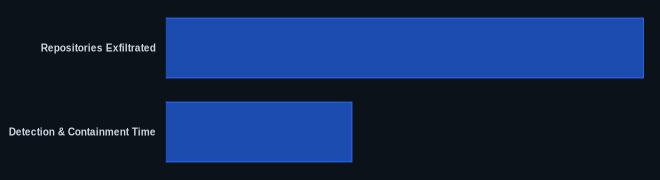
| Repositories Exfiltrated | 3,800 | BleepingComputer (claimed by attackers, GitHub has not confirmed the exact number) |
| Threat Actor Group | TeamPCP | SecurityWeek (Self-identified by the group, also tracked as UNC6780 by Sophos) |
| Detection & Containment Time | < 24 hours | GitHub Blog |
| Customer Data Affected | 0 | The Hacker News (confirmed by GitHub) |
Our Take
We have discussed supply chain risk for years, but this GitHub incident confirms that developer toolchains are the new frontier. It is no longer just about third-party libraries; it is about the extensions, the plugins, the package managers – the entire ecosystem developers use. Traditional endpoint security might catch some of this, but we need specialized tooling and processes to vet everything that touches a development environment. This requires a cultural shift, where security is a core part of the developer workflow.
The CVEDaily Take
This breach is a wake-up call for every organization hosting critical intellectual property, especially those relying on ubiquitous developer tools. GitHub's immediate containment is commendable, but the vector itself is insidious. We believe organizations are underestimating the risk inherent in unvetted developer tools. Have you implemented a formal vetting process for VS Code extensions, or are your developers still free to install whatever they want?
FAQ
Q: Was this a zero-day exploit in VS Code itself?
A: No, GitHub confirmed the incident did not involve a zero-day exploit. Attackers compromised an employee's device through a malicious VS Code extension, not a flaw in the core VS Code application.
Q: Were GitHub customers' repositories or data affected?
A: GitHub has confirmed there is no evidence that customer repositories or customer data outside its internal systems were affected by this incident. The exfiltrated data consisted of internal private repositories.
Q: What specific VS Code extension was malicious?
A: GitHub has not publicly identified the specific malicious VS Code extension involved in the compromise. Security researchers recommend increased scrutiny of recently installed and less-verified extensions.