
CISA KEV: Supply Chain & PAN-OS Vulnerabilities Actively Exploited
CVE-2026-0257, an authentication bypass in Palo Alto Networks PAN-OS GlobalProtect, was actively exploited for 12 days before CISA added it to its Known Exploited Vulnerabilities (KEV) Catalog. This vulnerability, alongside three supply chain compromises affecting Daemon Tools Lite, TanStack, and Nx Console, demands immediate attention. Attackers are using these flaws right now, making proactive patching and strong supply chain security controls critical for any organization running these widely deployed components.
What Happened
CISA added three supply chain vulnerabilities to its KEV Catalog on May 27, 2026, mandating federal agencies patch them by June 10, 2026 CISA. These include CVE-2026-8398 in Daemon Tools Lite, CVE-2026-45321 affecting 42 @tanstack npm packages, and CVE-2026-48027 for Nx Console. Each represents a compromise at different stages of the software delivery pipeline.
Two days later, on May 29, 2026, CISA added CVE-2026-0257, an authentication bypass in Palo Alto Networks PAN-OS, setting a federal patch deadline of June 19, 2026 AIWeekly. Rapid7 confirmed active exploitation of the PAN-OS flaw began as early as May 17, 2026, a full 12 days before its KEV listing AIWeekly. This lag between confirmed exploitation and official cataloging is a critical gap. SC Media reported on the Daemon Tools, TanStack, and Nx Console additions on May 29, 2026, with Security Affairs also covering them on May 28, 2026.
Why It Matters
The immediate concern here is active exploitation. Attackers are already using these vulnerabilities in the wild, often targeting enterprise local admin accounts, as AIWeekly reported with the PAN-OS vulnerability. This means organizations are exposed and likely under attack right now if they haven't patched.
The supply chain vulnerabilities are particularly insidious. For instance, the TanStack compromise affected 42 npm packages, publishing 84 malicious versions, as Security Affairs reported. This scale of impact for a widely used JavaScript library means countless projects could be compromised, propagating credential-stealing malware deep into development and production environments. Similarly, a trojanized Daemon Tools Lite installer, downloaded directly from the vendor, bypasses many traditional security measures because the binaries are signed NVD – CVE-2026-8398.
CISA's strong advice is for everyone, not just federal agencies. If you're running these components, you're a target.
Affected Scope & Remediation
Organizations using Daemon Tools Lite, TanStack packages, Nx Console, or Palo Alto Networks PAN-OS GlobalProtect are immediately exposed. CVE-2026-8398 impacts Daemon Tools Lite installers downloaded between April and May 2026. For CVE-2026-45321, any of the 42 @tanstack npm packages that received the 84 malicious versions are affected, as Security Affairs claims. CVE-2026-48027 specifically targets Nx Console extension version 18.95.0, which was briefly available on official marketplaces. The PAN-OS flaw, CVE-2026-0257, affects PAN-OS versions 10.2 through 12.1 for GlobalProtect firewalls AIWeekly.
Patching is the only full remediation. For FCEB agencies, CVE-2026-8398, CVE-2026-45321, and CVE-2026-48027 must be patched by June 10, 2026. CVE-2026-0257 has a deadline of June 19, 2026. All organizations should treat these dates as immediate, critical deadlines.
Here's the breakdown:
| Product | Version Range | Fixed Version / Action | Source |
|---|---|---|---|
| Daemon Tools Lite | Installers from April-May 2026 | Update to latest clean version | NVD – CVE-2026-8398 |
| TanStack npm packages | All 84 malicious versions | Remove; audit projects; rebuild | NVD – CVE-2026-45321 |
| Nx Console extension | 18.95.0 | Remove; avoid specific version | NVD – CVE-2026-48027 |
| Palo Alto Networks PAN-OS | 10.2 through 12.1 | Apply vendor-released patches | NVD – CVE-2026-0257 |
For PAN-OS, consult Palo Alto Networks' official advisory for specific patch versions. If immediate patching for PAN-OS is not possible, a temporary mitigation involves restricting access to GlobalProtect portals and gateways and implementing a Cloudflare Zero Trust architecture as an identity-aware proxy in front of VPN access points to add an extra layer of authentication and authorization. For supply chain compromises, a comprehensive audit of all affected systems is essential, including reinstalling software from verified clean sources and rotating any credentials that may have been exposed. Consider using endpoint detection and response (EDR) like CrowdStrike Falcon or SentinelOne to identify and quarantine any persistent malicious code.
Technical Breakdown
The four KEV additions illustrate diverse attack vectors. For CVE-2026-8398 in Daemon Tools Lite, attackers compromised AVB Disc Soft's build or distribution systems, trojanizing three signed binaries within official installers between April and May 2026. This meant users downloaded seemingly legitimate software that contained malicious code, bypassing signature checks. This maps directly to T1195.002 Compromise Software Supply Chain. The CVSS v4.0 score is 9.3.
CVE-2026-45321 in TanStack packages was a sophisticated supply chain attack targeting GitHub Actions workflows. Attackers exploited cache poisoning, a pull_request_target misconfiguration, and OpenID Connect (OIDC) token theft from the runner's memory to publish 84 malicious package versions under TanStack's legitimate identity, Security Affairs claims. These contained credential-stealing malware. This is also T1195.002 Compromise Software Supply Chain. It has a CVSS v3.1 score of 9.5.
CVE-2026-48027 for Nx Console involved a malicious version of the extension (18.95.0) briefly available on the Visual Studio Marketplace and OpenVSX for up to 36 minutes on May 19, 2026, before removal. While less complex in execution, it still uses the trust in official marketplaces. Its CVSS v4.0 score is 9.3. This falls under T1195.002 Compromise Software Supply Chain as well.
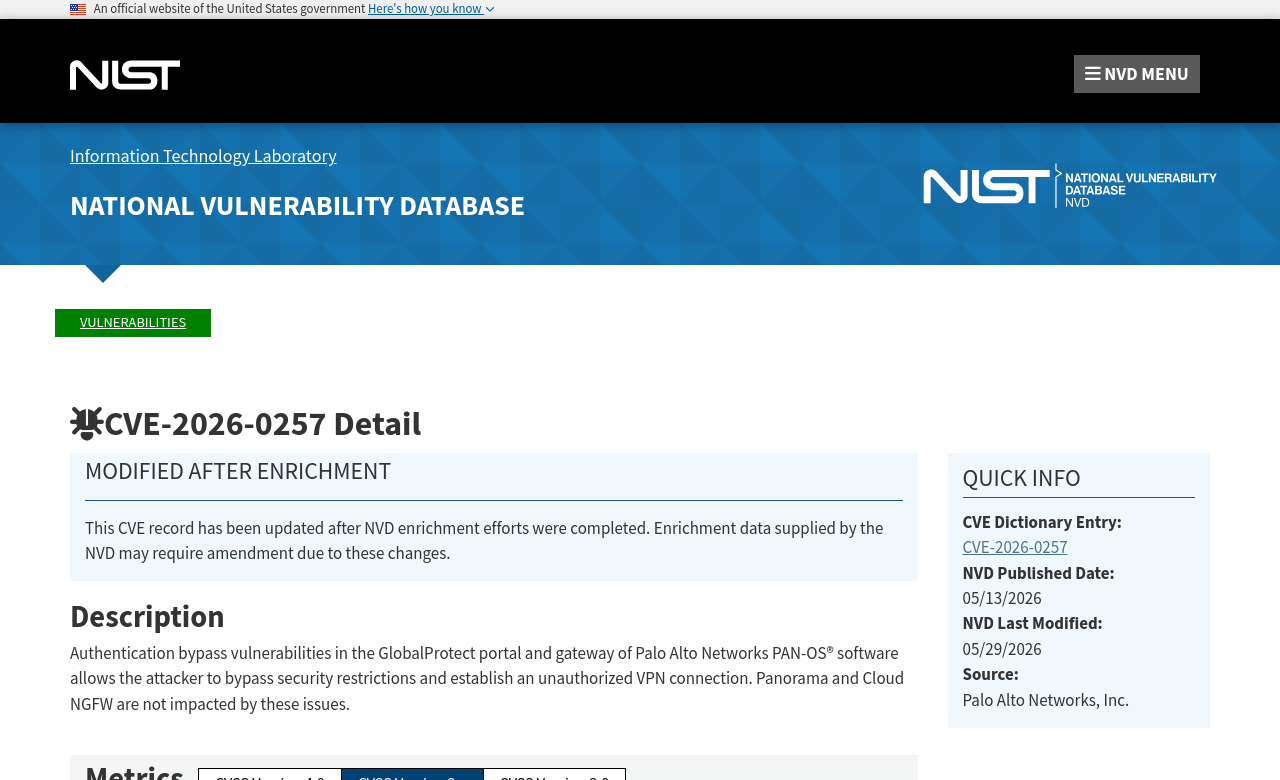
Finally, CVE-2026-0257 in Palo Alto Networks PAN-OS is an authentication bypass. Unauthenticated attackers can forge session cookies on GlobalProtect firewalls, establishing unauthorized VPN connections without needing credentials, as AIWeekly reported. Rapid7 observed active exploitation via Vultr-hosted IPs targeting enterprise local admin accounts. This is a direct T1190 Exploit Public-Facing Application leading to T1078 Valid Accounts (via forged session). From a NIST perspective, IA-2 Identification and Authentication (Organizational Users) is clearly bypassed, and SI-2 Flaw Remediation is the urgent control needed.
Historical Context
The recurring theme of supply chain attacks highlighted by Daemon Tools Lite, TanStack, and Nx Console is not new. In 2026, the "Megalodon Campaign" saw over 5,000 GitHub repositories impacted by malicious code injections, leveraging compromised developer accounts or CI/CD pipelines to distribute malware. This parallels the TanStack attack's use of GitHub Actions and OIDC token theft, though the "Megalodon" campaign often involved direct repository compromise rather than workflow exploitation. Another example is the prior supply-chain attack on npm packages affecting a GitHub workflow token, which ultimately led to a data breach at Grafana. These incidents underscore that the software supply chain, from development to distribution, remains a high-value target for sophisticated attackers. The difference often lies in the specific exploitation method — whether it's direct code injection, compromising build environments, or using misconfigured automation workflows. All roads lead to trusted code becoming malicious.
Data at a Glance
| Metric | Value | Source |
|---|---|---|
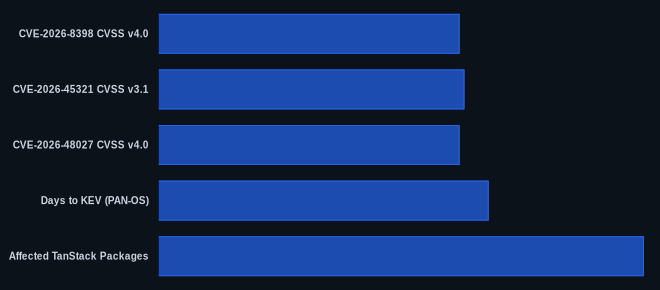
| CVE-2026-8398 CVSS v4.0 | 9.3 | NVD – CVE-2026-8398 |
| CVE-2026-45321 CVSS v3.1 | 9.5 | NVD – CVE-2026-45321 |
| CVE-2026-48027 CVSS v4.0 | 9.3 | NVD – CVE-2026-48027 |
| Days to KEV (PAN-OS) | 12 days | AIWeekly |
| Affected TanStack Packages | 42 packages | Security Affairs |
| Malicious TanStack Versions | 84 versions | Security Affairs |
| FCEB Patch Due Date (Supply Chain) | June 10, 2026 | CISA |
| FCEB Patch Due Date (PAN-OS) | June 19, 2026 | CISA |
The CVEDaily Take
This batch of KEVs is a direct challenge to the "patch only when mandated" mindset. Active exploitation before KEV listing means your network is a live-fire range. We think the 12-day lag for CVE-2026-0257 between confirmed exploitation and CISA's official listing demonstrates that threat intelligence from Rapid7 and similar firms often precedes government mandates. It's time to review your incident response and patching priorities for anything with a confirmed exploit. Has your team implemented additional integrity checks for third-party software beyond basic signature verification?
FAQ
Q1: What's the immediate risk from these new KEV additions?
A1: The immediate risk is active exploitation. Attackers are already using these vulnerabilities, meaning any unpatched systems are direct targets for unauthorized access, credential theft, or further lateral movement within your network. You need to patch Daemon Tools Lite CVE-2026-8398 and the others now.
Q2: How do supply chain attacks like Daemon Tools and TanStack bypass traditional security measures?
A2: These attacks succeed by compromising a trusted source (vendor build systems, official npm packages, popular extension marketplaces). The malicious code appears legitimate, often signed with valid certificates or published under trusted developer identities, making it difficult for endpoint security or static analysis to flag it as malicious during initial deployment.
Q3: Is the Palo Alto Networks PAN-OS vulnerability limited to GlobalProtect?
A3: Yes, CVE-2026-0257 specifically impacts GlobalProtect firewalls, allowing unauthenticated attackers to forge session cookies and establish unauthorized VPN connections. While the core PAN-OS may not be directly affected, the critical GlobalProtect VPN component is compromised.