
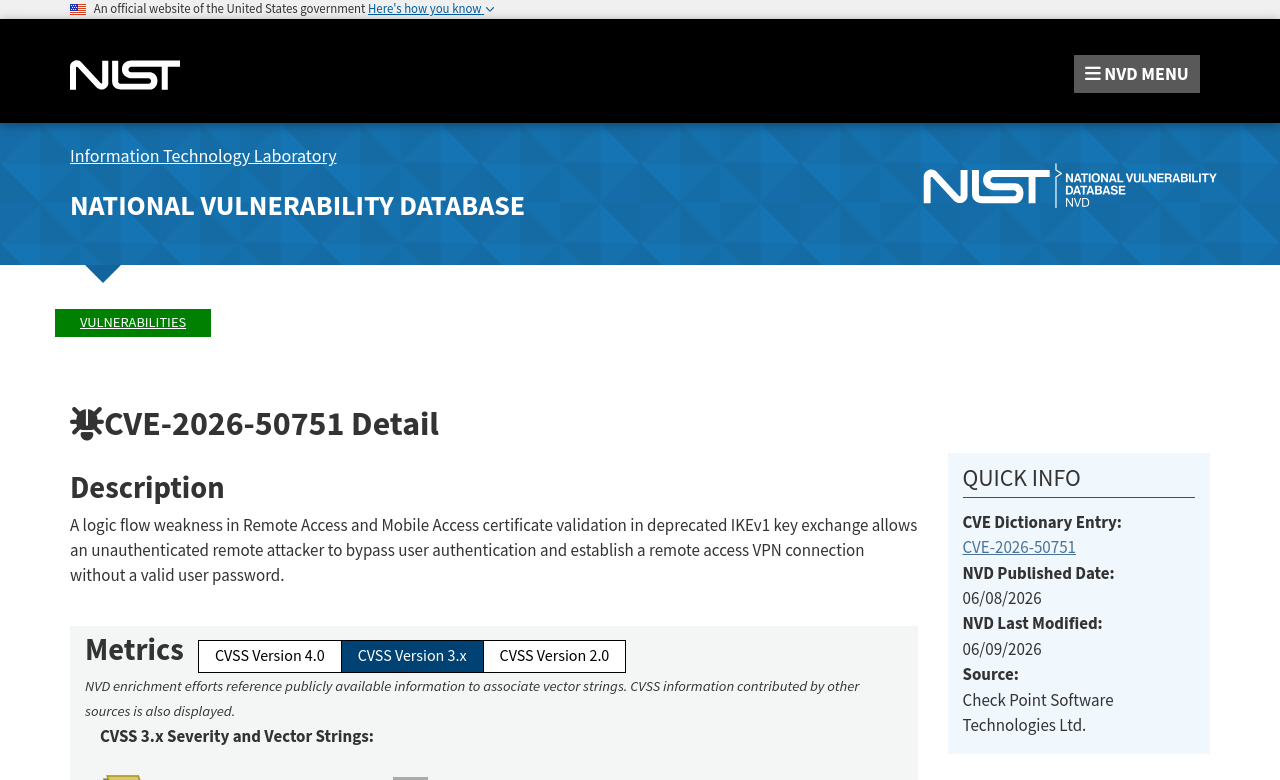
A critical authentication bypass vulnerability, CVE-2026-50751, in Check Point Remote Access VPN and Mobile Access deployments has been actively exploited as a zero-day since May 4, 2026, by an affiliate of the Qilin ransomware group, Check Point confirms. The flaw, rated 9.3 CVSS (Critical), allows attackers to establish VPN sessions without a valid password, presenting a direct path for initial access into targeted networks. Check Point has confirmed at least one attack by a Qilin affiliate, highlighting a persistent trend where financially motivated threat actors target critical network infrastructure vulnerabilities.
What Happened
Exploitation of CVE-2026-50751 began on May 4, 2026, according to Check Point's investigation. Check Point identified suspicious activity on June 6, 2026, and launched an investigation, confirming active exploitation. The vulnerability is a logic flaw in the certificate validation process within the deprecated Internet Key Exchange v1 (IKEv1) protocol, allowing remote attackers to bypass authentication entirely.
Rapid7 researchers have confirmed at least one incident involving the exploitation of CVE-2026-50751, leading to post-compromise activities. In at least one confirmed instance, this led directly to an affiliate of the Qilin ransomware group gaining initial access and conducting follow-on operations. The threat actor infrastructure linked to this campaign is not new; it has a documented history of targeting other VPN vulnerabilities across platforms like Palo Alto Networks, F5, and Fortinet.
On June 9, 2026, CISA added CVE-2026-50751 to its Known Exploited Vulnerabilities (KEV) catalog. This triggered a mandatory deadline for federal agencies to patch the vulnerability by June 11, 2026. Check Point has since released hotfixes for the vulnerable appliances, providing immediate remediation alongside indicators of compromise (IoCs) and mitigation guidance.
Why It Matters
CVE-2026-50751 is a critical authentication bypass actively weaponized by a prominent ransomware group. It offers attackers a direct, unauthenticated path into an organization's internal network via its VPN, which is exactly what ransomware affiliates look for. The 9.3 CVSS score reflects the severity of bypassing perimeter authentication.
Check Point states dozens of organizations globally have already been targeted by this exploitation, highlighting the widespread appeal of VPN vulnerabilities for initial access. The Qilin ransomware affiliate's choice to exploit this zero-day demonstrates a clear investment in high-impact initial access vectors. This group specifically hunts for vulnerabilities in critical network infrastructure like VPNs, understanding they represent high-value targets.
The observed threat actor infrastructure's history of targeting VPNs from Palo Alto Networks, F5, and Fortinet products paints a clear picture. These groups are consistent: they are strategic in their pursuit of network perimeter vulnerabilities. Organizations running Check Point Remote Access VPN or Mobile Access with IKEv1 are now high-priority targets. Ignoring this means leaving your front door wide open.
Affected Scope & Remediation
CVE-2026-50751 impacts Check Point Remote Access VPN and Mobile Access deployments configured to use the deprecated Internet Key Exchange v1 (IKEv1) protocol. Of the nine affected product version branches, four have already reached end-of-service status, meaning official support and standard patching might be unavailable for some organizations. This significantly complicates remediation for unsupported environments, forcing immediate migration or complete decommissioning.
The immediate and critical step is to apply the hotfixes released by Check Point. These hotfixes directly address the authentication bypass flaw. For federal agencies, CISA's directive mandates patching by June 11, 2026, for systems running affected Check Point products.
Organizations that cannot immediately patch should disable IKEv1 on their Check Point appliances and migrate to IKEv2 where possible. IKEv2 offers enhanced security features and is the recommended protocol. Enforce multi-factor authentication (MFA) on all VPN access points, even with hotfixes applied; this will add a critical layer of defense. Products like Cloudflare Zero Trust can help reduce direct exposure of VPNs by establishing secure, identity-aware access for applications.
| Component | Version Range / Status | Fixed Version / Remediation | Source |
|---|---|---|---|
| Check Point VPN | All IKEv1 deployments | Hotfixes applied | Check Point |
| CVE ID | CVE-2026-50751 | N/A | NVD |
| KEV Listing | Listed | N/A | CISA |
| Affected | 9 product branches | N/A | Check Point |
| Out-of-Service | 4 product branches | Migrate / Decommission | Check Point |
Patch Links & Advisories:
Timeline:
- First known exploit: May 4, 2026
- Check Point investigation begins & hotfixes released (estimated): June 6, 2026 (33 days after first exploit)
- CISA KEV listing: June 9, 2026 (36 days after first exploit)
- CISA KEV deadline for federal agencies: June 11, 2026 (2 days after KEV listing)
Technical Breakdown
The core of CVE-2026-50751 is a critical logic flaw in the certificate validation process within the Internet Key Exchange v1 (IKEv1) key exchange. Specifically, when Check Point Remote Access VPN and Mobile Access deployments are configured to use IKEv1, this flaw can be used by a remote attacker. The vulnerability permits the establishment of a VPN session without requiring a valid password, effectively bypassing the primary authentication mechanism.
Imagine your VPN as a bouncer at a club, checking IDs and guest lists. The IKEv1 protocol is an old, specific type of ID. Due to this logic flaw, a malicious actor presents a corrupted or specially crafted IKEv1 "ID." The bouncer, instead of verifying the name and photo against a valid guest list, sees the "ID" format and, due to the flaw, simply waves the attacker in, completely bypassing the actual identity check. The gate is open, no password required.
This authentication bypass provides initial access, mapping directly to T1190 Exploit Public-Facing Application within the MITRE ATT&CK framework. Once inside, the threat actor has an authenticated VPN session, enabling various post-compromise activities, which, in the case of the Qilin affiliate, includes deploying ransomware, typically falling under T1486 Data Encrypted for Impact. The underlying vulnerability also directly implicates NIST SP 800-53 control IA-2 Identification and Authentication (Organizational Users), as the mechanism for user authentication is critically broken. It also highlights deficiencies related to AC-17 Remote Access controls, specifically concerning the secure configuration and use of remote access components.
The presence of a second vulnerability, CVE-2026-50752, also in the IKEv1 key exchange's certificate validation logic, suggests broader issues with IKEv1 implementations. While CVE-2026-50752 could enable man-in-the-middle attacks on VPN site-to-site connections, Check Point has not observed it in the wild. For now, CVE-2026-50751 remains the immediate, actively exploited threat. Kernel-level telemetry can help detect anomalous post-exploitation activity, even if the initial VPN bypass succeeds.
Historical Context
The exploitation of CVE-2026-50751 by a ransomware affiliate is unfortunately part of a well-established pattern where critical VPN vulnerabilities serve as primary initial access vectors. We saw a similar dynamic in 2020 with the widespread exploitation of CVE-2020-2021 in Palo Alto Networks GlobalProtect VPNs. That flaw also allowed unauthenticated remote code execution, and it was quickly used by various threat groups, including state-sponsored actors and financially motivated cybercriminals.
Another significant example from 2022 involved Fortinet FortiOS (CVE-2022-42475), an SSL-VPN heap-based buffer overflow that was actively exploited as a zero-day. Just like the Check Point issue, this vulnerability offered a direct route for attackers to gain unauthorized access. The core similarity across these incidents is the targeting of VPN appliances, which are inherently internet-facing and act as trusted gateways to internal networks. They represent a single point of failure that, if compromised, can unravel an entire network's security posture.
What's different here is the explicit and confirmed link to a specific financially motivated group, Qilin ransomware, and their affiliate network's observed history. This is being integrated into specific ransomware playbooks. While past VPN exploits were often used by a mix of threat actors, including state-sponsored groups, this incident particularly highlights the growing sophistication and resource allocation of financially driven groups to acquire and weaponize zero-day vulnerabilities in high-value targets. This persistent focus on VPNs signals that perimeter security remains a top priority for initial access campaigns.
Data at a Glance
| Metric | Value | Source |
|---|---|---|
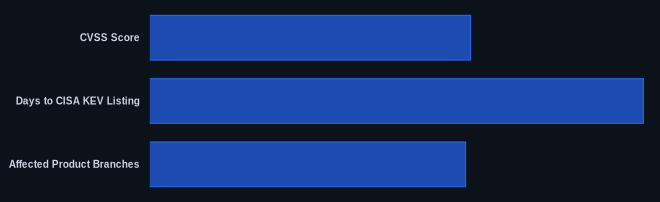
| CVSS Score | 9.3 (Critical) | NVD |
| First Known Exploit | May 4, 2026 | Check Point |
| Days to CISA KEV Listing | 36 days | CISA |
| Affected Product Branches | 9 | Check Point |
| Ransomware Group | Qilin | Check Point |
| CISA KEV Patch Deadline | June 11, 2026 | CISA |
The CVEDaily Take
VPN zero-days are a goldmine for financially motivated groups, and the 36-day gap between initial exploitation of CVE-2026-50751 and its public KEV listing highlights the immediate danger. We think Check Point's belated detection date of June 6, 2026 (33 days after initial exploitation), given the critical nature of the flaw, suggests many organizations likely remain unaware of their exposure. Don't wait; patch it now, and more importantly, migrate off IKEv1. Do you have a process to audit and decommission deprecated protocols like IKEv1 across all your perimeter devices?
FAQ
Q: What is CVE-2026-50751?
A: CVE-2026-50751 is a critical authentication bypass vulnerability (CVSS 9.3) in Check Point Remote Access VPN and Mobile Access deployments that allows attackers to establish VPN sessions without needing a valid password.
Q: Which Check Point products are affected by this vulnerability?
A: The vulnerability affects Check Point Remote Access VPN and Mobile Access deployments specifically configured to use the deprecated Internet Key Exchange v1 (IKEv1) protocol.
Q: What is the immediate remediation for CVE-2026-50751?
A: Organizations should immediately apply the hotfixes released by Check Point. Additionally, disable IKEv1 on affected appliances and migrate to the more secure IKEv2 protocol as a long-term solution.