
Microsoft's June 2026 Patch Tuesday addressed an unprecedented 206 security vulnerabilities across its Windows operating systems and supported software, including 33 classified as 'critical'. Three of the patched vulnerabilities were publicly disclosed zero-days, though none were confirmed to be actively exploited in the wild at the time of release. This record volume of patches, partly attributed to increasing AI tool usage in vulnerability discovery and targeted releases by security researcher 'Nightmare Eclipse', means security teams face an escalating operational burden.
What Happened
Microsoft's June 2026 Patch Tuesday was a landmark event, rectifying an all-time high of 206 security flaws across its product portfolio, as reported by BleepingComputer. This update included 33 vulnerabilities designated as critical, emphasizing the severe potential impact on systems if left unpatched. Notably, the patches addressed three zero-day vulnerabilities that had been publicly disclosed prior to the patch release; Microsoft confirmed these zero-days were disclosed but stated none were under active exploitation at the time.
The first zero-day, CVE-2026-49160 (CVSS 7.5), is a denial-of-service (DoS) flaw in HTTP.sys, exploitable via an HTTP/2 Bomb attack against web servers, including Microsoft Internet Information Services (IIS). Its discovery by OpenAI's Codex, as cited by SecurityWeek, illustrates the growing role of AI tools in vulnerability research. The second, CVE-2026-45586 (CVSS 7.8), is an elevation of privilege (EoP) flaw within the Windows Collaborative Translation Framework (CTFMON), which could allow an attacker to gain SYSTEM privileges.
The third zero-day, CVE-2026-50507 (CVSS 6.8), involves a security feature bypass in Windows BitLocker, which could allow an attacker with physical access to a device to circumvent BitLocker Device Encryption and access sensitive data. Both CVE-2026-45586 and CVE-2026-50507 are linked to recent disclosures by the security researcher 'Nightmare Eclipse', who had previously released exploits codenamed "GreenPlasma" (CTFMON EoP) and "YellowKey" (BitLocker bypass) The Hacker News. This Patch Tuesday update did not include the 360 Microsoft Edge/Chromium vulnerabilities patched by Google separately this month.
Why It Matters
The record-breaking volume of 206 patches in this release signals a broad and expanding attack surface within Microsoft's ecosystem. A high volume of vulnerabilities creates significant operational challenges for security teams, increasing the risk of widespread compromise if patching lags. The inclusion of three zero-days, particularly with public knowledge of their existence, puts immediate pressure on organizations.
Elevation of Privilege vulnerabilities like CVE-2026-45586 are critical; they are highly sought after by attackers because they enable a standard user to gain full system control, turning a limited foothold into a full compromise. This makes lateral movement and persistence significantly easier. The CVE-2026-50507 BitLocker bypass is a severe threat to data confidentiality for any device susceptible to physical access, such as laptops, servers in less secure environments, or even workstations accessible by disgruntled insiders. It directly undermines a core data protection mechanism.
OpenAI's Codex discovering CVE-2026-49160 highlights a new era of vulnerability discovery. Satnam Narang, Senior Staff Research Engineer at Tenable, commented that this volume of patches may become the new norm due to increasing AI tool usage among security professionals, as reported by BleepingComputer. The ongoing retaliatory campaign by 'Nightmare Eclipse', who claims to have released six Windows zero-day exploits since early April 2026 due to personal grievance, adds another layer of unpredictable and persistent threat; Microsoft has confirmed patching these vulnerabilities.
Affected Scope & Remediation
The 206 vulnerabilities patched affect a vast array of Microsoft products and Windows operating systems. This includes Windows 10, Windows 11, Windows Server versions, Microsoft Office, Internet Information Services (IIS), and various development components. The broad scope necessitates a thorough patch management strategy, prioritizing critical vulnerabilities and known zero-days.
For the three zero-days:
- CVE-2026-49160 (HTTP.sys DoS): Affects Windows Server versions running IIS and any Windows system leveraging HTTP.sys.
- CVE-2026-45586 (CTFMON EoP): Impacts a wide range of Windows desktop and server operating systems where the Collaborative Translation Framework is present.
- CVE-2026-50507 (BitLocker Bypass): Relevant to any Windows system configured with BitLocker Device Encryption, particularly those in environments where physical access is possible.
Apply these updates immediately. While no active exploitation was confirmed for these specific zero-days at the time of patch release, the public disclosure and researcher activity mean time is of the essence. Implementing endpoint detection and response (EDR) solutions like CrowdStrike Falcon or SentinelOne can help detect post-exploitation activity, even if patching is delayed.
| Product | Version Range | Fixed Version |
|---|---|---|
| Windows 10 | All supported versions | Latest June 2026 Update |
| Windows 11 | All supported versions | Latest June 2026 Update |
| Windows Server 2016 | All supported versions | Latest June 2026 Update |
| Windows Server 2019 | All supported versions | Latest June 2026 Update |
| Windows Server 2022 | All supported versions | Latest June 2026 Update |
| Microsoft Internet Information Services (IIS) | N/A (component-based) | Latest June 2026 Update |
| Windows BitLocker | N/A (component-based) | Latest June 2026 Update |
Patch Links:
- Microsoft Security Update Guide: https://msrc.microsoft.com/update-guide/ (Search by CVE ID for specific advisories)
- CVE-2026-49160 (NVD)
- CVE-2026-45586 (NVD)
- CVE-2026-50507 (NVD)
Workarounds/Mitigations:
For CVE-2026-49160, while a direct workaround isn't ideal for a DoS in HTTP.sys without patching, implementing network boundary protection using Cloudflare Zero Trust to filter malicious HTTP/2 traffic can help mitigate some exposure for public-facing IIS servers. For CVE-2026-45586, ensure least privilege is strictly enforced; even if an attacker exploits the flaw, limited user privileges restrict post-exploitation actions. For CVE-2026-50507, physical security controls remain paramount, but strong pre-boot authentication can add a layer of defense.
Timeline:
- CVE-2026-49160 Disclosure: Prior to June 2026 Patch Tuesday.
- CVE-2026-45586 Disclosure: Prior to June 2026 Patch Tuesday, linked to Nightmare Eclipse's "GreenPlasma" released since early April 2026.
- CVE-2026-50507 Disclosure: Prior to June 2026 Patch Tuesday, linked to Nightmare Eclipse's "YellowKey" released since early April 2026.
- Patch Release: June 10, 2026.
- First Known Exploit: Not confirmed in the wild as of patch release, but public PoC (from Nightmare Eclipse) existed for similar flaws.

Technical Breakdown
Let's dissect the three zero-days that rolled out with this Patch Tuesday. The CVE-2026-49160 vulnerability in HTTP.sys is a Denial-of-Service (DoS) flaw. HTTP.sys acts as the traffic cop for all HTTP requests on a Windows system. An HTTP/2 Bomb attack is analogous to an attacker sending the traffic cop an impossibly large stack of tickets, each containing nonsense. The cop must process each one, consuming all their attention and resources, eventually collapsing under the load and preventing legitimate traffic from passing through. This can be mapped to T1071 Application Layer Protocol for its use of an application-layer protocol (HTTP/2) to achieve its impact, and specifically exploits a flaw in how the system processes that protocol. Effective mitigation falls under SI-10 Information Input Validation, ensuring the system properly handles and rejects malformed or oversized requests before they can exhaust resources.
CVE-2026-45586 represents an Elevation of Privilege (EoP) within the Windows Collaborative Translation Framework (CTFMON). CTFMON is a legitimate Windows process supporting language input and text services. An EoP flaw here is akin to a janitor having access to the CEO's office. Normally, they can only clean common areas, but due to a broken lock or an oversight in their badge permissions, they can access sensitive data and tools. In cybersecurity terms, an attacker, starting with low user privileges, exploits this CTFMON flaw to elevate their permissions to SYSTEM. This technique maps directly to T1068 Exploitation for Privilege Escalation. Organizations can combat such vulnerabilities proactively through AC-6 Least Privilege, ensuring that users and processes operate with the absolute minimum set of permissions necessary to perform their functions, thereby limiting the blast radius of any successful privilege escalation.
Finally, CVE-2026-50507 is a security feature bypass in Windows BitLocker. BitLocker is designed to encrypt entire drives, safeguarding data even if the physical device is stolen. This bypass is like having a locked safe, but due to a manufacturing defect, a specific sequence of actions allows someone with physical access to open it without the key. While not directly "dumping credentials," this vulnerability allows an attacker to bypass the encryption mechanism to gain access to the data, which is typically the goal of T1003 OS Credential Dumping or similar data access techniques. The relevant NIST SP 800-53 control is CM-6 Configuration Settings, as the bypass often exploits an improper configuration or a flaw in the implementation of the security settings, allowing the protection to be circumvented.
Historical Context
The current deluge of patches, particularly those addressing privilege escalation flaws, echoes challenges seen with the PrintNightmare vulnerabilities (e.g., CVE-2021-34527) discovered in mid-2021. PrintNightmare was a critical Remote Code Execution (RCE) and EoP vulnerability in the Windows Print Spooler service. Similar to CVE-2026-45586, it allowed attackers to gain SYSTEM privileges on vulnerable Windows machines, leading to extensive lateral movement and arbitrary code execution.
Both scenarios involved high-value targets (core Windows components) and the immediate, widespread impact of such flaws, demanding urgent patching and rigorous attention to privilege management. However, the landscape of vulnerability discovery has changed. PrintNightmare was a more traditional researcher-discovered flaw. Today, CVE-2026-49160 being linked to AI tools like OpenAI's Codex, shows automated systems now contribute to the sheer volume. This, combined with the personal grievance-driven campaign by 'Nightmare Eclipse', signifies a broader, more diversified, and potentially faster pace of zero-day discovery and disclosure. The threat now comes not just from sophisticated state actors or financially motivated groups, but also from accessible AI tools and highly motivated individuals operating outside traditional bug bounty programs.
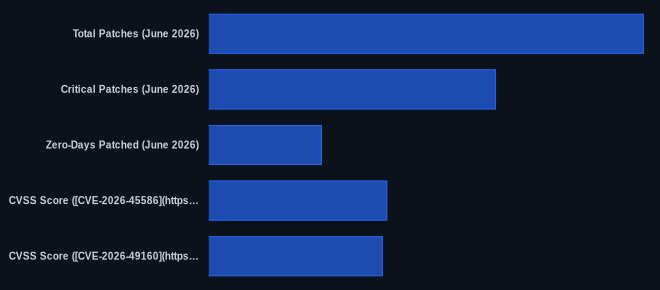
Data at a Glance
| Metric | Value | Source |
|---|---|---|
| Total Patches (June 2026) | 206 | BleepingComputer |
| Critical Patches (June 2026) | 33 | BleepingComputer |
| Zero-Days Patched (June 2026) | 3 | BleepingComputer |
| CVSS Score (CVE-2026-45586) | 7.8 | NVD |
| CVSS Score (CVE-2026-49160) | 7.5 | NVD |
| Nightmare Eclipse Zero-Days (since April 2026) | 6 | The Hacker News |
| Edge/Chromium Patches Excluded | 360 | BleepingComputer |
The CVEDaily Take
This record patch volume is unsustainable for most teams without significant automation and a focus on critical assets. The blend of AI-driven and retaliatory zero-days represents a dual-pronged threat vector that will stretch even mature security operations. We think the immediate shift to AI-assisted vulnerability discovery fundamentally changes the timeline for organizations to respond to new threats. We believe Microsoft is likely seeing an internal acceleration of vulnerability reports that will only increase this already massive patch volume.
Has your team evaluated their incident response plans for a major zero-day chain exploiting both remote and local vulnerabilities simultaneously, especially when PoCs exist from groups like 'Nightmare Eclipse'?
FAQ
Q: What is the most critical vulnerability patched in the June 2026 Patch Tuesday?
A: While there were 33 critical vulnerabilities, CVE-2026-45586, an Elevation of Privilege flaw in the Windows Collaborative Translation Framework (CTFMON), is particularly concerning due to its ability to grant SYSTEM privileges, which is a prime target for attackers to gain full control of a compromised system.
Q: How does AI contribute to the record number of patches?
A: Artificial intelligence tools, such as OpenAI's Codex, are increasingly used by security researchers and engineers to automate the discovery of vulnerabilities. This allows for faster and more extensive scanning of codebases and systems, leading to a higher volume of identified flaws like CVE-2026-49160, which was discovered by an AI tool.
Q: What is the significance of the 'Nightmare Eclipse' researcher's activity?
A: 'Nightmare Eclipse' is a security researcher engaged in a retaliatory campaign against Microsoft, having claimed to release six Windows zero-day exploits since early April 2026, including flaws similar to CVE-2026-45586 and CVE-2026-50507. Microsoft has confirmed patching these related vulnerabilities. This activity highlights the risk posed by individual researchers driven by non-financial motives, contributing to a volatile and less predictable zero-day landscape with promised future disclosures.