
On June 8, 2026, CISA added Check Point's Security Gateway Improper Authentication Vulnerability, CVE-2026-50751, to its Known Exploited Vulnerabilities (KEV) Catalog, mandating federal agencies patch by June 23, 2026. This critical vulnerability, scored 9.3 CVSS, allows unauthenticated attackers to establish remote access VPN sessions, granting initial access to networks. Attackers have actively exploited this since May 7, 2026, with at least one incident linked to an affiliate of the Qilin ransomware group, indicating an immediate threat to organizations relying on vulnerable Check Point VPN infrastructure.
What Happened
Attackers first observed exploiting CVE-2026-50751 on May 7, 2026, according to Check Point's advisory. Activity escalated in early June, prompting Check Point to release security updates and an advisory on June 8, 2026. On the same day, CISA added the vulnerability to its KEV Catalog, marking it as a critical threat requiring immediate attention for federal agencies, with a hard deadline of June 23, 2026, to apply patches. The flaw is an improper authentication vulnerability (CWE-287) affecting Check Point Remote Access VPN, Mobile Access, and Spark Firewall products, specifically when configured to use the deprecated IKEv1 key exchange protocol, especially without requiring machine certificates for legacy remote access clients.
The attack uses a logic weakness in certificate validation during the IKEv1 key exchange process. This allows attackers to bypass authentication entirely, establishing an unauthorized VPN session. While initial access doesn't immediately grant full control, it provides a critical foothold. Check Point assesses with medium confidence that a financially motivated affiliate of the Qilin ransomware group is behind at least one observed incident of exploitation, as reported by SecurityWeek. This group, known for its Ransomware-as-a-Service (RaaS) operation, has claimed over 400 victims since August 2022, as detailed by BleepingComputer.
Why It Matters
This vulnerability represents a direct, unauthenticated entry point into your network if your Check Point VPN is misconfigured. A CVSS score of 9.3 underscores its severity. An attacker establishing a remote access VPN session without valid credentials completely bypasses your front-door security.
Once inside, the attacker gains initial network access, which serves as a launchpad for further post-authentication activities. These typically include internal reconnaissance, privilege escalation, lateral movement, data exfiltration, and ultimately, ransomware deployment. We have observed this attack chain repeatedly with other VPN exploits. The link to Qilin ransomware affiliates, a group with significant financial motivation and a track record of hundreds of victims, confirms the critical risk of data theft and encryption. The group claims to have targeted a "few dozen" organizations globally, as reported by The Hacker News, which indicates targeted, high-value attacks. This highlights the importance of shoring up critical access vectors that specific threat actors, like Qilin affiliates, exploit.
Affected Scope & Remediation
CVE-2026-50751 primarily affects Check Point Security Gateway products configured to use the deprecated IKEv1 key exchange protocol, particularly when they accept legacy Remote Access clients without enforcing machine certificate requirements. This configuration significantly widens the attack surface. If your organization uses Check Point Remote Access VPN, Mobile Access, or Spark Firewall products, especially in an IKEv1 setup, you are directly exposed.
Check Point released security updates on June 8, 2026, to address this vulnerability. Apply these patches immediately. For federal agencies, the CISA KEV catalog entry mandates patching by June 23, 2026. Patch CVE-2026-50751 now. For smaller teams, services like Cloudflare Zero Trust can provide an additional layer of access control and network segmentation, reducing reliance on traditional perimeter VPNs for critical applications.
Affected Versions vs. Fixed Versions
| Product | Version Range | Fixed Version |
|---|---|---|
| Check Point Remote Access VPN | All versions configured with IKEv1 and without mandatory machine certificate for legacy Remote Access clients | Latest updates (June 8, 2026) |
| Check Point Mobile Access | All versions configured with IKEv1 and without mandatory machine certificate for legacy Remote Access clients | Latest updates (June 8, 2026) |
| Check Point Spark Firewall Products | All versions configured with IKEv1 and without mandatory machine certificate for legacy Remote Access clients | Latest updates (June 8, 2026) |
Patch Links:
- Check Point Security Advisory: https://support.checkpoint.com/results?id=sk182335
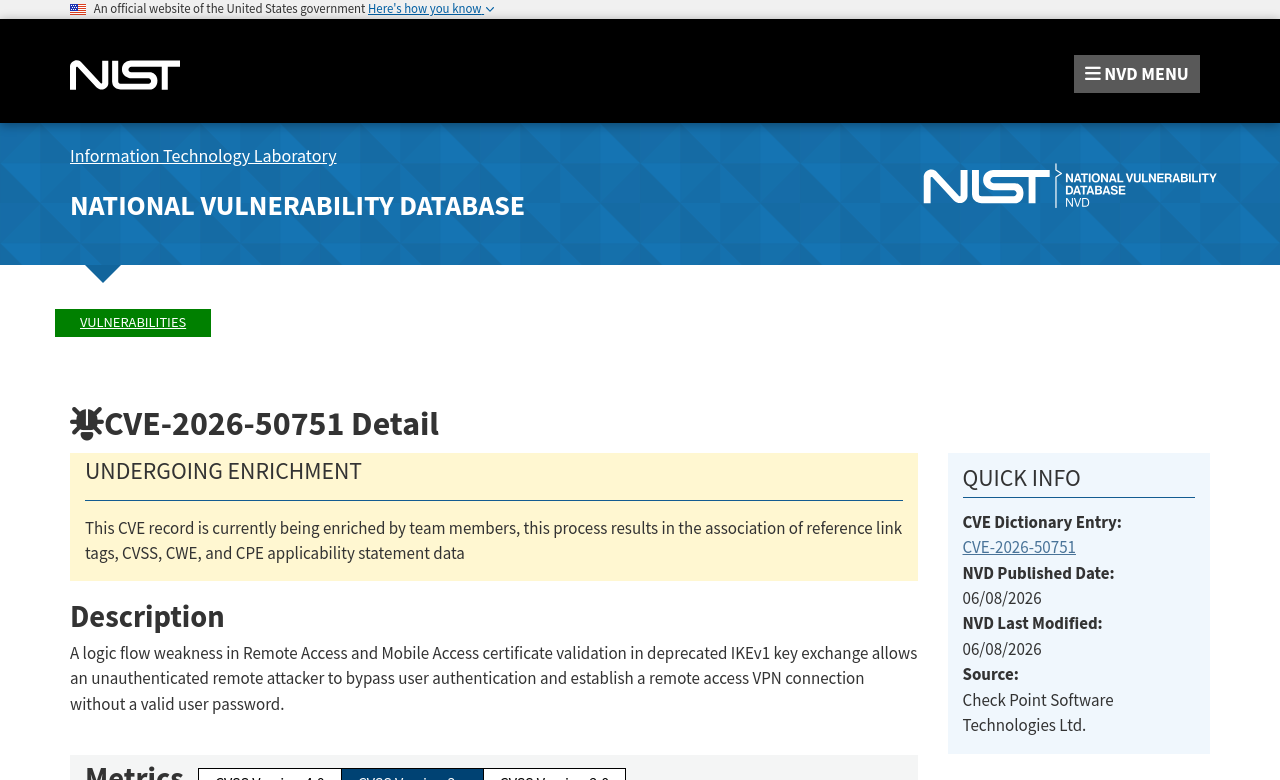
- NVD Entry: CVE-2026-50751
- CISA KEV Entry: https://www.cisa.gov/known-exploited-vulnerabilities-catalog
Mitigation:
If immediate patching isn't possible, Check Point recommends disabling the IKEv1 key exchange protocol entirely or, at a minimum, enforcing machine certificate authentication for all Remote Access VPN clients. This directly addresses the attack vector by removing the deprecated protocol or strengthening the authentication within it.
Timeline:
- First known exploit: May 7, 2026 (Check Point)
- Check Point advisory & patch release: June 8, 2026 (Check Point)
- CISA KEV addition: June 8, 2026 (CISA)
- Days from first exploit to patch release: 32 days
- CISA KEV patch deadline: June 23, 2026
Technical Breakdown
CVE-2026-50751 is an improper authentication flaw (CWE-287) stemming from a logic weakness in how Check Point VPN gateways validate certificates during the IKEv1 key exchange. Essentially, an attacker can trick the VPN gateway into believing it has successfully authenticated a client, even without providing valid credentials or certificates.
Think of it like this: You have a bouncer at a club (the VPN gateway) checking IDs (credentials/certificates). Normally, he checks your ID, verifies it, and then lets you in. With this IKEv1 vulnerability, the bouncer (due to a flaw in his training, IKEv1) gets confused during the initial ID check for certain legacy systems. He receives a complex, slightly malformed ID request, and instead of rejecting it, he incorrectly processes it, concluding the ID must be valid, even though no proper ID was ever presented. The door swings open.
This bypass allows an unauthenticated attacker to establish an initial remote access VPN session. From a MITRE ATT&CK perspective, this falls squarely under T1133 External Remote Services. Attackers exploit public-facing services, in this case, a VPN, to gain initial access to an organization's network. Once this initial VPN connection is established, the Qilin affiliate can then proceed with post-compromise activities. These often include T1078 Valid Accounts (if they manage to obtain or create internal credentials), followed by T1068 Exploitation for Privilege Escalation, and ultimately T1486 Data Encrypted for Impact if they deploy their ransomware.
Addressing this vulnerability directly relates to several NIST SP 800-53 controls. First, IA-2 Identification and Authentication (Organizational Users) is clearly violated by the improper authentication. The very purpose of this control is to ensure users (or, in this case, VPN clients) are properly identified and authenticated. Second, AC-17 Remote Access is paramount, as the vulnerability directly compromises the integrity of remote access mechanisms. Finally, SI-2 Flaw Remediation compels organizations to identify, report, and correct information system flaws in a timely manner, which is precisely what the CISA KEV catalog and Check Point's advisory demand here.
Historical Context
Check Point VPN products have been targeted by zero-days previously. In May 2024, Check Point VPN products were targeted by CVE-2024-24919, an information disclosure vulnerability. That flaw allowed attackers to read arbitrary files from the gateway, including hashed passwords for local accounts. While CVE-2024-24919 focused on data exfiltration and credential theft before full network access, CVE-2026-50751 is a more direct, unauthenticated entry point to establish a VPN session.
Both incidents highlight a consistent trend: threat actors view VPN solutions as highly valuable critical entry points. Exploiting VPNs allows them to bypass traditional perimeter defenses and gain a foothold inside corporate networks. The previous CVE-2024-24919 exploited a different technical mechanism, but the strategic goal remained the same: compromise the VPN to gain initial access or critical information. This latest incident, with its direct authentication bypass, is arguably more severe in terms of immediate network access. It demonstrates that VPNs, while essential, remain a prime target and require rigorous security and patching.
Data at a Glance
| Metric | Value | Source |
|---|---|---|
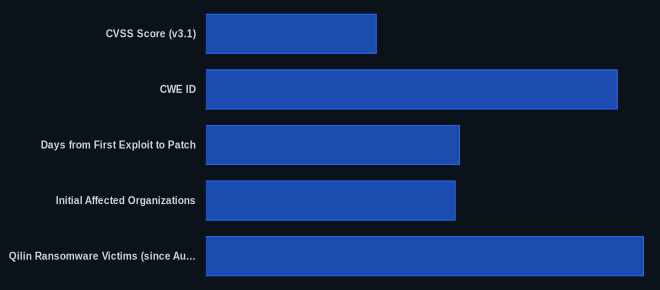
| CVSS Score (v3.1) | 9.3 | NVD |
| CWE ID | CWE-287 | NVD |
| Days from First Exploit to Patch | 32 days | Check Point |
| Initial Affected Organizations | ~30 organizations | The Hacker News |
| Qilin Ransomware Victims (since Aug 2022) | 400+ victims | BleepingComputer |
| CISA KEV Patch Deadline | June 23, 2026 | CISA |
The CVEDaily Take
This Check Point vulnerability illustrates the critical danger of relying on deprecated protocols and lax authentication. The fact that an authentication bypass was exploited for over a month before public disclosure and patching is a serious concern for any organization's risk posture. We think Check Point's assessment of exploitation being limited to "a few dozen" organizations, while good news for overall scope, might understate the specific risk to those targeted. Ransomware affiliates like Qilin prioritize high-value targets, meaning these "few dozen" likely represent significant compromises. The pattern of VPN exploitation across multiple vendors, as SecurityWeek noted, suggests that the Qilin affiliate's infrastructure may be seeking similar weaknesses in Palo Alto, Fortinet, and F5 VPNs. This isn't just about updating; it's about reviewing your entire remote access strategy.
Did your team already audit your VPN configurations for IKEv1 usage and machine certificate enforcement, or are you waiting for the patch?
FAQ
Q: Which specific Check Point products are vulnerable to CVE-2026-50751?
A: Check Point Remote Access VPN, Mobile Access, and Spark Firewall products are vulnerable, specifically deployments configured to use the deprecated IKEv1 key exchange protocol, especially when gateways accept legacy Remote Access clients without requiring a machine certificate.
Q: What is the primary impact if CVE-2026-50751 is exploited?
A: Successful exploitation allows an unauthenticated attacker to establish remote access VPN sessions, gaining initial network access to your environment. This initial access can then be used for further post-compromise activities like data exfiltration or ransomware deployment by groups such as Qilin.
Q: Is there a workaround if we can't patch immediately?
A: Yes, Check Point recommends disabling the IKEv1 key exchange protocol entirely or, at a minimum, ensuring that machine certificate authentication is strictly enforced for all Remote Access VPN clients. This mitigates the specific authentication bypass mechanism.