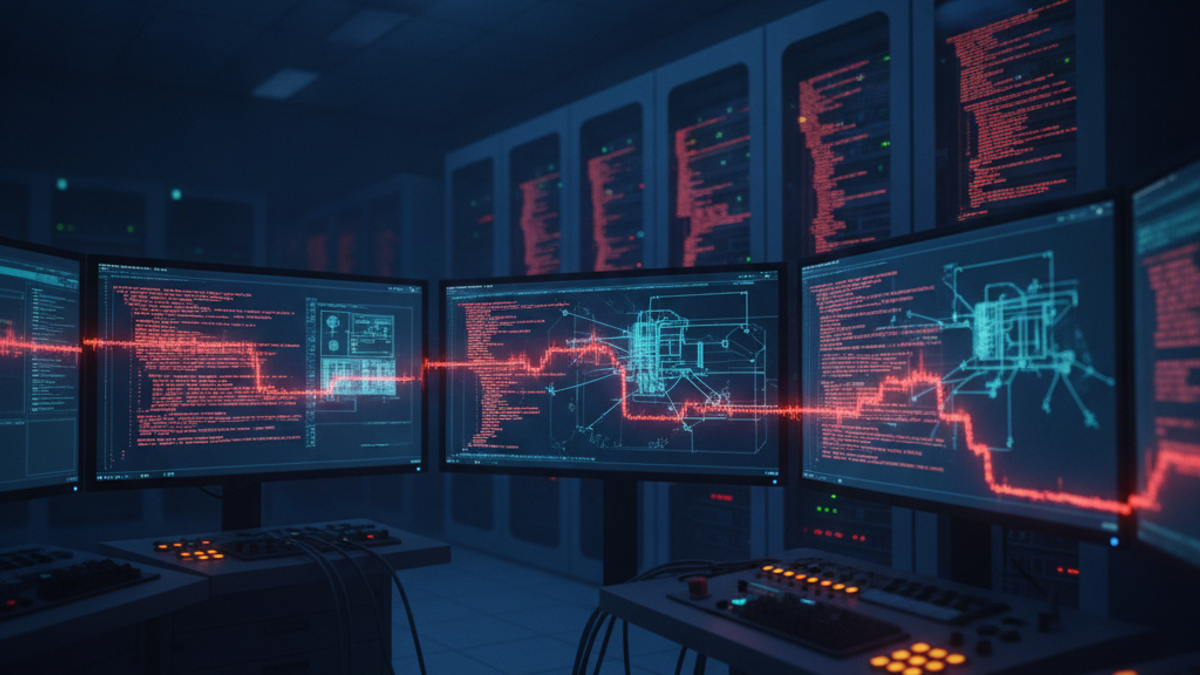
Over 30 Minnesota water utilities reportedly experienced a coordinated operational technology (OT) attack, marking a significant escalation in critical infrastructure targeting beyond typical data breaches or ransomware. The incident, which came to light around July 29 or 30, 2026, represents a direct assault on the systems that manage physical processes, posing distinct challenges compared to IT network compromises. This widespread disruption highlights the urgent need for enhanced OT security postures as threat actors increasingly pivot to impact real-world services.
What Happened
Security feeds, notably from BleepingComputer, began reporting a coordinated OT attack affecting more than 30 water utilities across Minnesota within the last 48 hours. The campaign focused on disrupting operational technology systems essential for water utility functions. Initial reports do not detail specific service outages or control manipulations, and affected organizations have not confirmed the extent of disruption as of publication.
This is not a single CVE exploitation but a broader, organized effort against industrial control systems, according to initial reports. There is no public CVE ID, malware signature, or specific initial access vector identified yet. Attackers have not made ransom demands or been linked to data exfiltration, distinguishing this from a typical financially motivated ransomware event, per BleepingComputer's reporting.
The scale, affecting numerous distinct utilities simultaneously, points to a well-resourced and strategic actor, according to security researchers. This underscores a shift in adversary focus from data theft to direct operational interference. We are waiting on CISA and affected utilities for more specific technical details as their investigations progress.
Why It Matters
This incident bypasses conventional data security concerns to directly threaten public services. Disrupting water utilities means potential impacts on public health, safety, and economic activity. When OT systems are compromised, the stakes move from financial loss and privacy violations to tangible physical consequences, like interrupted water supply or even altered chemical balances.
The targeting of over 30 utilities simultaneously indicates a sophisticated campaign, not opportunistic attacks, security researchers suggest. This goes beyond the IT realm, where most security efforts currently reside, exposing vulnerabilities in specialized industrial control systems. A successful OT attack can destabilize communities, erode public trust, and demand a far more complex and costly remediation than a standard data breach. It shows critical infrastructure remains a prime target for nation-state actors or highly capable cybercriminals.
Affected Scope & Remediation
The attack's scope, as reported, encompasses various operational technology systems within Minnesota's water utilities, ranging from supervisory control and data acquisition (SCADA) systems to programmable logic controllers (PLCs) and human-machine interfaces (HMIs). Since this is a coordinated campaign rather than a vulnerability in a specific product, there are no patch versions or CVEs to list. However, general exposure lies with any water utility having inadequate segmentation between IT and OT networks, or weak access controls for their industrial systems.
Immediate remediation focuses on isolating compromised systems and enhancing network defenses. Physically disconnecting affected OT networks from IT networks is a primary first step if compromise is suspected. Enforce multi-factor authentication for all remote access to OT systems, even for maintenance. Adopt a Cloudflare Zero Trust architecture for remote access and internal segmentation; this can significantly reduce lateral movement potential, even if an IT system is initially breached.
Teams should conduct thorough forensic analysis to identify initial access vectors and persistence mechanisms. For detection, deploy endpoint detection and response (EDR) solutions like CrowdStrike Falcon on any integrated IT endpoints to flag suspicious activity that might precede or accompany an OT breach. Regular backups of OT configurations and system images are critical, enabling quicker recovery. Utilities must also establish manual override capabilities and have detailed incident response plans specific to OT environments, including physical security protocols.
There is no specific CVE with a CISA KEV deadline since this isn't a vulnerability. Instead, the timeline reflects ongoing detection and response efforts, with the incident coming to public light around July 29-30, 2026.
Technical Breakdown
A coordinated OT attack against water utilities often begins with compromising the less-secure IT network as an initial access vector, then pivoting to the OT environment. Attackers might exploit internet-facing IT applications (MITRE ATT&CK T1190 Exploit Public-Facing Application) or use external remote services (T1133 External Remote Services) to gain a foothold. Once inside the IT network, they could use valid accounts (T1078 Valid Accounts) or escalate privileges (T1068 Exploitation for Privilege Escalation) to reach the OT network.
Think of an OT network as the circulatory and nervous system of a factory. The IT network is like the brain's internet connection. A hacker might get into your brain through a phishing email (IT), but then they need to bypass internal defenses to directly affect your heart rate or breathing (OT). This often involves exploiting specific protocols or vulnerabilities inherent to industrial control systems, which were often designed for reliability and uptime, not security. They might use techniques to disable or modify tools (T1562.001 Disable or Modify Tools) within the OT environment to disrupt water flow, chemical treatments, or pumping schedules.
MFA enforcement and password rotation policies (NIST SP 800-53 AC-3 Access Enforcement) are critical to mitigating such attacks. This means ensuring that only authorized individuals and processes can access specific OT components, often requiring strict least privilege configurations. Additionally, strong boundary protection (NIST SP 800-53 SC-7 Boundary Protection) between IT and OT networks, implemented through firewalls, unidirectional gateways, and secure proxies, is paramount to contain breaches and prevent lateral movement.
Historical Context
This Minnesota incident strongly echoes the 2021 Oldsmar, Florida water treatment plant attack, where an attacker gained remote access and attempted to increase the sodium hydroxide (lye) levels to a dangerous degree. The Oldsmar incident involved a single plant and focused on direct manipulation of chemical levels, which was thankfully caught by an alert operator.
The key similarity is the direct targeting of water infrastructure OT systems with the intent to disrupt or cause harm, moving beyond data theft. However, the Minnesota attack appears significantly broader, impacting over 30 distinct utilities, suggesting a more coordinated and potentially sophisticated campaign. While Oldsmar saw an attempted change in a single parameter, the Minnesota incident reports "disruption to operational technology systems," implying a wider range of potential impacts across multiple control points. Both incidents underscore the inherent vulnerabilities of critical infrastructure and the need for dedicated OT security strategies.
Data at a Glance
| Metric | Value | Source |
|---|---|---|
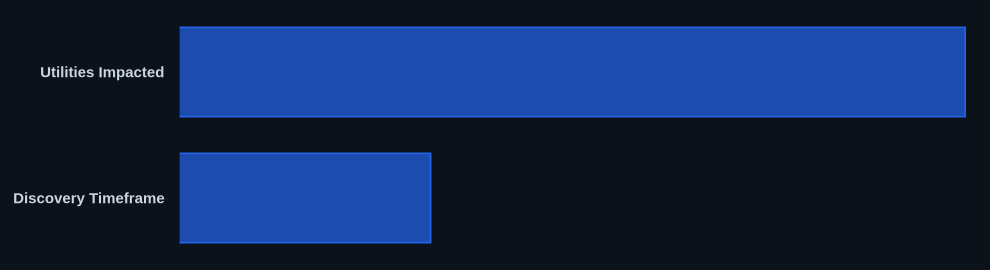
| Utilities Impacted | 30+ (claimed) |
BleepingComputer |
| Discovery Timeframe | ~2 days |
BleepingComputer |
| Attack Type | Coordinated OT |
BleepingComputer |
| Confirmed Ransom Demand | 0 |
BleepingComputer |
| Associated CVEs | 0 |
BleepingComputer |
| Reported Date | July 29-30, 2026 |
BleepingComputer |
| Geographic Scope | Minnesota |
BleepingComputer |
| Historical Parallel | Oldsmar, FL (2021) |
BleepingComputer |
Our Take
This Minnesota incident is a wake-up call that the distinction between IT and OT security is rapidly blurring, and attackers are ready to exploit that convergence. We need to move beyond thinking of OT as an air-gapped ideal and build true resilience through network segmentation, continuous kernel-level telemetry, and rigorous incident response plans specifically tailored for industrial environments. Waiting for a specific CVE to drop won't cut it here; this is about architectural shifts and operational preparedness.
The CVEDaily Take
This coordinated OT attack on Minnesota's water utilities underlines a critical shift: adversaries are increasingly capable and motivated to directly disrupt critical services. Focusing solely on data exfiltration and ransomware misses the real danger of operational interference. We think the 30+ utilities impacted signals a campaign far more sophisticated than opportunistic attacks. What specific steps has your organization taken to segment and monitor access between your IT and OT networks since the Oldsmar incident?
FAQ
Q1: What exactly is an Operational Technology (OT) attack?
A1: An OT attack targets industrial control systems (ICS) or supervisory control and data acquisition (SCADA) systems that manage physical processes, such as those in water treatment, power grids, or manufacturing. Unlike IT attacks that focus on data, OT attacks aim to disrupt, manipulate, or destroy physical equipment and operations, with potential real-world safety or functional consequences.
Q2: What is the immediate concern for the affected Minnesota water utilities?
A2: The immediate concern is to understand the extent of the disruption, restore normal operations safely, and ensure public water supply integrity. This involves forensic analysis to identify the breach's entry point, contain any active threats, and verify the correct functioning of all control systems, potentially reverting to manual operations if automated systems are compromised.
Q3: Is there a specific CVE associated with this coordinated OT attack?
A3: No, initial reports, including from BleepingComputer, indicate this is a "coordinated OT attack" targeting multiple utilities, not an exploit of a single, publicly identified vulnerability (CVE). This suggests a broader campaign possibly using multiple tactics, techniques, and procedures (TTPs) against various systems rather than a specific software flaw.