CDK Global Ransomware Disrupts Auto Dealerships Nationwide
A ransomware attack against CDK Global, a critical cloud-based software provider for auto dealerships, has severely disrupted operations for thousands of dealerships across North America since the week of June 9 – June 16, 2026. This incident, coupled with recent third-party data breaches impacting Frost Bank and Oak View Group, shows a persistent threat where operational continuity and supply chain security are under constant assault. We are seeing less zero-day exploitation and more downstream impact from successful attacks on core service providers. The cascading effects are immediate and painful.
What Happened
CDK Global, a major cloud software provider for auto dealerships, was hit with a ransomware attack during the week of June 9 – June 16, 2026. This crippled vital systems dealerships rely on for vehicle sales, financing, repairs, and customer relations across thousands of locations. Dealerships have been forced back to manual processes for sales, inventory, and customer communication. This severely impacts an industry heavily reliant on digital platforms.
Beyond CDK, two other notable incidents emerged. Oak View Group (OVG) discovered unauthorized access to its legacy systems on January 19, 2026, tracing the initial compromise back to December 16, 2025. File exfiltration from these systems then continued from December 2025 through April 2026. This potentially compromised names and taxpayer identification numbers. A report to the Massachusetts Office of Consumer Affairs and Business Regulation suggests Social Security numbers may also be involved, as BleepingComputer reported. The number of affected individuals has not been publicly specified by OVG.
Concurrently, a data breach at Frost Bank, publicly reported on May 20, 2026, stemmed from a compromise at their third-party software provider, Sefas Innovation. Unauthorized access to Sefas Innovation's SFTP server occurred intermittently between December 2025 and April 2026, leading to the download of highly sensitive Frost Bank customer data. SecurityWeek detailed that this included names, addresses, Social Security numbers, taxpayer identification numbers, account numbers, dates of birth, loan numbers, tax information forms, and even bill pay check images. The incident is classified as medium severity due to the high value of the exposed data for fraud. Frost Bank has not publicly confirmed the total number of affected customers.
Why It Matters
The CDK Global ransomware attack shows how deeply integrated, single-point-of-failure providers can bring entire industries to a halt. Thousands of auto dealerships across North America are now operating largely offline, manually processing sales, managing inventory, and handling customer interactions. CDK Global has advised dealerships to brace for alternative month-end financial close processes, signaling a significant financial and operational headache. This is a business continuity nightmare for every affected dealership. Full functionality is not expected until at least June 30, 2026, meaning weeks of revenue loss and operational chaos.
The Frost Bank and Oak View Group breaches highlight the persistent and often underestimated risk posed by third-party vendors. For Frost Bank, sensitive customer PII and financial data were exposed not through their direct systems, but through a software provider’s SFTP server. This means their customers now face increased risk of identity theft and financial fraud. Similarly, OVG’s legacy systems, likely less scrutinized, provided an avenue for months of data exfiltration. These incidents reiterate that an organization's security posture is only as strong as its weakest link in the supply chain. We must treat vendor security as a core component of the overall security program.
Affected Scope & Remediation
The immediate affected scope for the CDK Global ransomware attack covers thousands of auto dealerships reliant on their cloud-based software across North America. Dealerships are currently operating under severe disruption, reverting to entirely manual processes for sales, orders, and customer service. As there is no CVE associated with a ransomware incident of this nature, remediation efforts focus on incident response, system recovery, and business continuity planning. CDK Global's primary advice has been to prepare for manual month-end financial closes, indicating a protracted recovery. Implementing immutable, tested backup and recovery solutions like Veeam or Acronis for critical on-premises data can significantly reduce recovery times during such outages, even if the primary vendor system remains down.
For the Frost Bank breach originating from Sefas Innovation, affected scope includes Frost Bank customers whose sensitive data resided on Sefas’s SFTP servers. This includes names, addresses, SSNs, TINs, account numbers, and more. Frost Bank is notifying affected individuals. Remediation for affected customers primarily involves heightened vigilance for phishing attempts and financial fraud, and using credit monitoring services. For organizations that use third-party vendors with access to sensitive data, implement stringent vendor risk management, including regular security assessments and continuous monitoring of vendor access. Consider tools like Cloudflare Zero Trust to tightly control and monitor third-party access to internal resources, minimizing exposure should a vendor be compromised.
The Oak View Group breach involves individuals whose names, taxpayer identification numbers, and potentially Social Security numbers were exfiltrated from OVG's legacy systems. While OVG has not specified the number of affected individuals, the type of data is high-risk. OVG will likely offer affected individuals credit monitoring and identity protection services. For all organizations, especially those with legacy systems, an immediate mitigation step is a comprehensive audit of all external-facing services and data stored on older platforms. Decommissioning unnecessary legacy systems or isolating them with strict network controls should be a priority. Zero new CVEs were added to CISA's Known Exploited Vulnerabilities catalog between June 9 and June 16, 2026, but this does not mean threats ceased. It simply shifted from active public vulnerability exploitation to operational disruption and supply chain attacks.
Technical Breakdown
The CDK Global ransomware attack, while light on publicly released technical specifics, likely involved common ransomware tactics. Initial access could have been achieved via methods like T1190 Exploit Public-Facing Application or T1078 Valid Accounts obtained through phishing (T1566.001 Spearphishing Attachment or T1566.002 Spearphishing Link). Once inside, attackers typically conduct reconnaissance, move laterally (e.g., via T1021.001 Remote Desktop Protocol or exploiting T1003 OS Credential Dumping to harvest NTLM hashes from LSASS memory), and escalate privileges using techniques like T1068 Exploitation for Privilege Escalation. The ultimate goal, and the impact seen, is T1486 Data Encrypted for Impact, often combined with T1490 Inhibit System Recovery by deleting backups or shadow copies.
For the Frost Bank and Oak View Group breaches, the common thread is third-party vendor compromise. This falls under T1195.002 Compromise Software Supply Chain or, more broadly, T1133 External Remote Services if the vendor's system was directly exposed. The Sefas Innovation breach specifically mentioned unauthorized access to an SFTP server. This implies either weak authentication (T1110.001 Password Guessing or T1110.003 Password Spraying) or stolen credentials (T1078 Valid Accounts). Once access was gained, the critical step was T1041 Exfiltration Over C2 Channel or T1567 Exfiltration Over Web Service, where sensitive customer data was downloaded.
Trusting a third-party vendor with your data is like giving them a spare key to your house. You expect them to keep it safe. But if they leave that key under their doormat, anyone can pick it up and walk in. The Frost Bank and OVG incidents show what happens when that spare key isn't adequately protected. For both direct ransomware incidents and third-party compromises, strong security controls are critical. Key NIST SP 800-53 controls that apply here include IR-4 Incident Handling for rapid response to ransomware and data breaches, RA-5 Vulnerability Monitoring and Scanning to proactively identify weaknesses in exposed systems, and SC-7 Boundary Protection to segment and secure sensitive data, especially when accessed by third parties. Additionally, SA-10 Developer Configuration Management is vital for ensuring secure practices within the software supply chain itself, minimizing vulnerabilities that attackers could exploit. Implementing an EDR solution like SentinelOne or CrowdStrike Falcon can significantly improve detection and response capabilities against these types of attacks.
Historical Context
The widespread operational paralysis inflicted by the CDK Global ransomware attack echoes the February 2024 Phobos ransomware attack that severely impacted healthcare facilities across Romania. In that incident, Phobos ransomware encrypted systems at over 20 hospitals, forcing doctors and nurses to revert to pen-and-paper for patient records and appointments. Both scenarios highlight ransomware's devastating capacity to halt critical services, forcing organizations to operate in a pre-digital era and underscoring the severe business continuity risks. The similarities lie in the immediate and far-reaching operational disruption, not just data theft.
The Frost Bank and Oak View Group data breaches, stemming from third-party compromises, follow a well-trodden path of supply chain attacks. A prominent historical parallel is the 2020 SolarWinds supply chain attack, where Russian state-sponsored actors compromised SolarWinds' software update mechanism to distribute malware to thousands of their government and private sector customers. While the SolarWinds attack was about sophisticated espionage and backdoor implantation, the underlying principle of a trusted third-party vendor becoming a vector for compromise is identical. These incidents illustrate that organizations are increasingly vulnerable through their interconnected digital ecosystems, where a single weak link can have a cascading, industry-wide effect, whether for data theft or operational disruption.
Data at a Glance
| Metric | Value | Source |
|---|---|---|
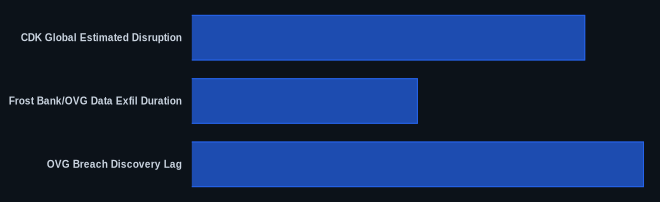
| CDK Global Estimated Disruption | ~21 days | BleepingComputer |
| New CISA KEV Entries (June 9-16) | 0 entries | CISA.gov |
| Frost Bank/OVG Data Exfil Duration | 5 months | SecurityWeek, BleepingComputer |
| Frost Bank Incident Severity | Medium | SecurityWeek |
| OVG Breach Discovery Lag | 34 days | BleepingComputer |
Our Take
We're seeing a clear shift. While zero-day exploits grab headlines, the relentless grind of operational disruption from ransomware and the insidious data exfiltration via third-party compromises are having a more tangible, immediate impact on daily business. It's easy to get caught up in the latest CVE, but these incidents underscore that fundamental security hygiene, vendor risk management, and tested incident response plans are often the weakest links. We think more investment is needed in proactive third-party security assessments and comprehensive backup strategies, because attackers are certainly not slowing down.
The CVEDaily Take
This past week highlights that relying on a single, critical cloud provider introduces significant blast radius risk. Organizations must assess their dependencies and build resilience. Has your team developed specific manual fallback procedures and communication plans for critical vendor outages?
FAQ
-
What is CDK Global, and how does this ransomware attack affect auto dealerships?
CDK Global is a major cloud-based software provider that supplies mission-critical systems to thousands of auto dealerships across North America. Their software handles everything from vehicle sales and financing to repair orders and customer relationship management. The ransomware attack crippled these systems, forcing dealerships to revert to manual processes, significantly disrupting their sales, operations, and ability to manage customer interactions and financial close processes. -
What kind of sensitive data was exposed in the Frost Bank and Oak View Group breaches?
The Frost Bank breach, originating from Sefas Innovation, exposed highly sensitive customer data including names, addresses, Social Security numbers, taxpayer identification numbers, account numbers, dates of birth, loan numbers, tax information forms, and bill pay check images. The Oak View Group breach potentially exposed names, taxpayer identification numbers, and possibly Social Security numbers from its legacy systems. OVG has not confirmed the full extent or type of data exfiltrated, nor the total number of individuals impacted. -
Are there any specific CVEs associated with the CDK Global ransomware attack?
As of the most recent public reports, specific details regarding the ransomware variant, CVE IDs, or the exact attack chain for the CDK Global incident are not yet publicly available. Ransomware attacks often use a combination of older vulnerabilities, stolen credentials, and social engineering rather than a single, recently disclosed CVE.