
Citrix Bleed [CVE-2023-4966] Enabled LockBit's $9 Billion ICBC Ransomware Strike
On November 8, 2023, the Industrial and Commercial Bank of China Financial Services (ICBC FS), the U.S. arm of the world's largest commercial bank, fell victim to a LockBit 3.0 ransomware attack, severely disrupting its ability to clear U.S. Treasury and equity trades. The incident exploited Citrix Bleed (CVE-2023-4966), an information disclosure vulnerability in unpatched Citrix NetScaler devices. This operational chaos forced ICBC FS to resort to manual processes, including physically delivering settlement details via USB drives, leading to a massive $60 billion spike in failed Treasury trades, as reported by InformationWeek, and a US$9 billion emergency capital infusion from its parent company just to cover uncleared positions, according to the same report. This incident directly shows the immediate cost of delayed vulnerability management.
What Happened
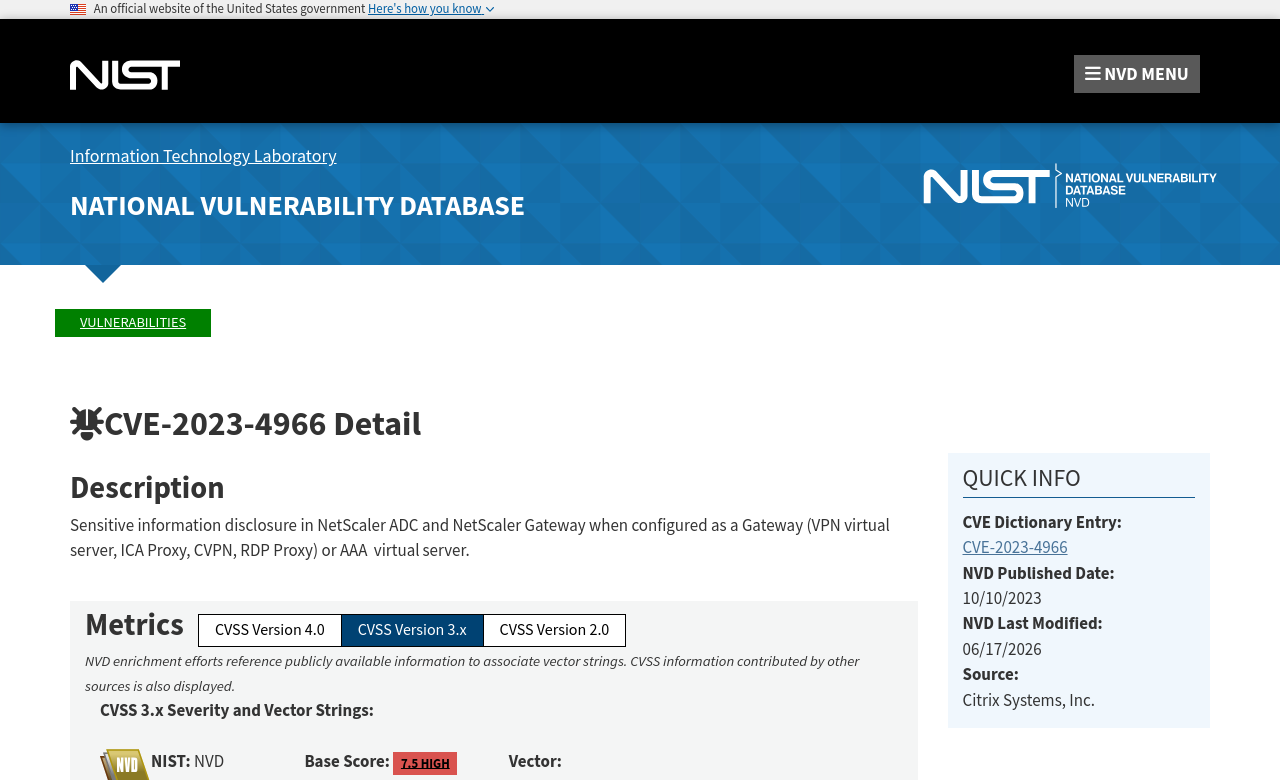
The November 8, 2023, LockBit 3.0 ransomware attack on ICBC FS originated from the exploitation of CVE-2023-4966, a critical Citrix Bleed vulnerability. This specific flaw, an information disclosure vulnerability with a CVSS score of 9.4, allows attackers to bypass multi-factor authentication (MFA) and hijack legitimate user sessions. Citrix issued a patch for CVE-2023-4966 on October 10, 2023, but attackers actively exploited the vulnerability as a zero-day since at least late August 2023, BleepingComputer reported. A suspected unpatched Citrix server was the entry point for the ICBC attack.
Once inside, LockBit 3.0, a Ransomware-as-a-Service (RaaS) operation, proceeded with its typical double extortion strategy. The group encrypts critical files and exfiltrates sensitive data, threatening to publish it if a ransom isn't paid. The attack crippled ICBC FS's systems, specifically impacting its U.S. Treasury and equity clearing operations. This forced the firm to disconnect and isolate affected systems, relying on manual processes to keep the market moving, including using physical USB drives for data transfer in Manhattan, as InformationWeek reported. LockBit later claimed ICBC paid a ransom, though the amount remains undisclosed and unverified by ICBC itself, according to BleepingComputer.
Why It Matters
The incident caused a significant spike in failed trading rates in the U.S. Treasury market, reaching $60 billion as of November 9, 2023, the day after the attack, InformationWeek reported. BNY Mellon, the sole settlement agent for Treasury securities, had to loan ICBC money and similarly resort to manual processes to manage the fallout. The bank's head office provided an emergency US$9 billion capital infusion to cover uncleared trades, as InformationWeek reported, demonstrating the immediate, tangible cost of unpatched vulnerabilities in critical infrastructure.
The ICBC incident directly shows the fragility of global financial systems to a single point of failure. Other major organizations, including Boeing, DP World, and Allen & Overy, also experienced exploits related to the Citrix Bleed vulnerability, underscoring its widespread impact, as noted by resecurity.com. The U.S. Securities and Exchange Commission (SEC) later filed settled charges against ICBC FS in December 2024 for deficient books and records during the incident, although the firm's prompt remedial measures and cooperation were acknowledged. This was not about the breach itself, but the operational failure to maintain accurate records under duress.
Affected Scope & Remediation
The Citrix Bleed vulnerability, CVE-2023-4966, affects several versions of Citrix NetScaler ADC and NetScaler Gateway appliances. It's an information disclosure flaw that allows unauthenticated attackers to hijack active user sessions, bypassing MFA and gaining unauthorized access. Attackers actively exploited this as a zero-day since late August 2023, 40 days before Citrix released a patch on October 10, 2023, BleepingComputer reported. CISA has included CVE-2023-4966 in its Known Exploited Vulnerabilities (KEV) Catalog, meaning federal agencies must patch it promptly. You should too.
To remediate this, patch all affected Citrix NetScaler ADC and Gateway appliances to the recommended fixed versions. If patching isn't immediately possible, Citrix advised customers to assume that session tokens may have been compromised and to terminate all active sessions to mitigate ongoing exploitation. Running an EDR solution like CrowdStrike Falcon can help detect post-exploitation activities and potential lateral movement if a session was indeed hijacked before patching.
Here are the specific versions affected and their respective fixes:
| Product | Version Range (Affected) | Fixed Version |
|---|---|---|
| NetScaler ADC & Gateway | 13.1 prior to 13.1-50.15 | 13.1-50.15 and later |
| NetScaler ADC & Gateway | 13.0 prior to 13.0-92.19 | 13.0-92.19 and later |
| NetScaler ADC & Gateway | 12.1 prior to 12.1-65.42 (EOL) | 12.1-65.42 and later (EOL) |
| NetScaler ADC 13.1-FIPS | 13.1-FIPS prior to 13.1-50.15 | 13.1-50.15 and later |
| NetScaler ADC 12.1-FIPS | 12.1-FIPS prior to 12.1-55.302 (EOL) | 12.1-55.302 and later (EOL) |
| NetScaler ADC 12.1-NDcPP | 12.1-NDcPP prior to 12.1-55.302 (EOL) | 12.1-55.302 and later (EOL) |
Patch Links:
- Citrix Advisory: CTX579459
- NVD Entry: CVE-2023-4966
- CISA KEV Entry: CVE-2023-4966
Technical Breakdown
Citrix Bleed, CVE-2023-4966, is an information disclosure vulnerability primarily affecting Citrix NetScaler ADC and Gateway appliances. This flaw allows an unauthenticated attacker to extract sensitive memory data from the appliance. This is like a faulty bouncer at an exclusive club who, instead of checking IDs, just lets anyone holding a discarded VIP pass walk right in without verifying the name or expiration date. The attacker isn't getting a new pass; they're just showing a valid (though potentially expired) one that the system accepts.
In practice, this means an attacker can gain access to session authentication tokens. These tokens prove a user is logged in, effectively bypassing any multi-factor authentication (MFA) that might be in place. Once an attacker has a valid session token, they can hijack an active, legitimate user session, giving them authenticated access to internal networks and resources without needing credentials. This is a critical initial access vector, aligning with MITRE ATT&CK T1190 Exploit Public-Facing Application.
With this access, attackers like LockBit can then proceed with various post-exploitation activities, including credential harvesting (e.g., T1078 Valid Accounts via session hijacking), lateral movement, and ultimately, deploying ransomware. LockBit's typical ransomware deployment involves encrypting critical data for impact (T1486 Data Encrypted for Impact) and often includes inhibiting system recovery (T1490 Inhibit System Recovery) by deleting backups or shadow copies. The group is also notorious for double extortion, meaning they exfiltrate sensitive data before encryption, threatening to publish it if a ransom isn't paid. Organizations must ensure their incident response plans, as per NIST SP 800-53 IR-4 Incident Handling, are specific enough to manage the aftermath of such a rapid, pervasive compromise. The failure to patch this known vulnerability also highlights a lapse in NIST SP 800-53 SI-2 Flaw Remediation. Organizations using backup solutions like Veeam for immutable backups can significantly reduce the impact of the data encryption phase.
Historical Context
The ICBC FS LockBit attack, leveraging Citrix Bleed, echoes the widespread operational paralysis seen during the NotPetya attacks in June 2017. NotPetya, initially disguised as ransomware, was effectively a wiper malware that exploited the EternalBlue vulnerability (CVE-2017-0144) in Microsoft's Server Message Block (SMB) protocol. It rapidly spread through corporate networks worldwide, crippling critical infrastructure, including shipping giant Maersk, which estimated its losses at $300 million, according to Wired.
Both incidents demonstrate how a single, unpatched vulnerability in widely used software can cascade into global operational and financial chaos. In NotPetya's case, it was a networking protocol; for ICBC, it was a critical remote access appliance. The common thread is the interconnectedness of systems and the severe consequences of delayed patching, impacting not just individual organizations but entire sectors, like global shipping for NotPetya and the U.S. Treasury market for ICBC. The difference lies in the ultimate goal: NotPetya was primarily destructive, while LockBit is financially motivated, employing double extortion. Yet, the outcome of operational disruption and significant financial loss remains starkly similar.
Data at a Glance
| Metric | Value | Source |
|---|---|---|
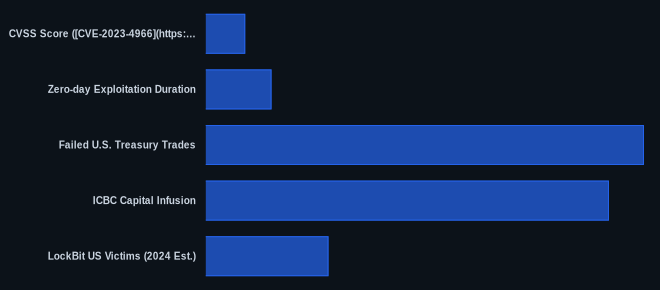
| CVSS Score (CVE-2023-4966) | 9.4 | NVD |
| Zero-day Exploitation Duration | ~40 days | BleepingComputer (late Aug 2023 to Oct 10, 2023) |
| Failed U.S. Treasury Trades | $60 billion | InformationWeek |
| ICBC Capital Infusion | $9 billion | InformationWeek |
| LockBit US Victims (2024 Est.) | 1,000+ | BleepingComputer |
| Primary Vulnerability | CVE-2023-4966 | resecurity.com |
The CVEDaily Take
ICBC FS's near-catastrophic operational failure wasn't just about a ransomware payload; it was about the immediate, tangible cost of patching delays and a failure of NIST SP 800-53 SI-2 Flaw Remediation. Relying on physically delivered USB drives for critical financial settlements in 2023 exposes a severe lack of incident response readiness for modern cyber threats, regardless of the promptness of their remedial measures post-incident. We question why, given the severity of the operational disruption, the $9 billion capital infusion, and the SEC charges for deficient record-keeping, the ransom payment amount claimed by LockBit remains "undisclosed and unverified" by ICBC, as BleepingComputer reported. This lack of transparency is concerning.
When was the last time your team simulated a full network outage requiring manual, physical processes for business continuity?
FAQ
Q: What is Citrix Bleed (CVE-2023-4966)?
A: Citrix Bleed is an information disclosure vulnerability (CVSS 9.4) in Citrix NetScaler ADC and Gateway appliances that allows an unauthenticated attacker to extract sensitive memory data, including session authentication tokens. This enables attackers to hijack legitimate user sessions, bypassing multi-factor authentication.
Q: How did the ICBC attack impact financial markets?
A: The attack severely disrupted ICBC Financial Services' ability to clear U.S. Treasury and equity trades, leading to a $60 billion spike in failed Treasury trades, as InformationWeek reported. The ICBC head office had to inject US$9 billion in capital to cover uncleared positions, according to InformationWeek, causing significant operational chaos for BNY Mellon and other market participants.
Q: What is LockBit 3.0's typical attack methodology?
A: LockBit 3.0 operates on a Ransomware-as-a-Service (RaaS) model, employing a 'double extortion' strategy. They encrypt critical files and data, rendering them inaccessible, and simultaneously exfiltrate sensitive information. The group then threatens to publish the stolen data on their leak site if a ransom isn't paid. LockBit claims ICBC paid a ransom, but ICBC has not confirmed this.