
Cisco Catalyst SD-WAN [CVE-2026-20262]: Actively Exploited Zero-Day Demands Immediate Patch
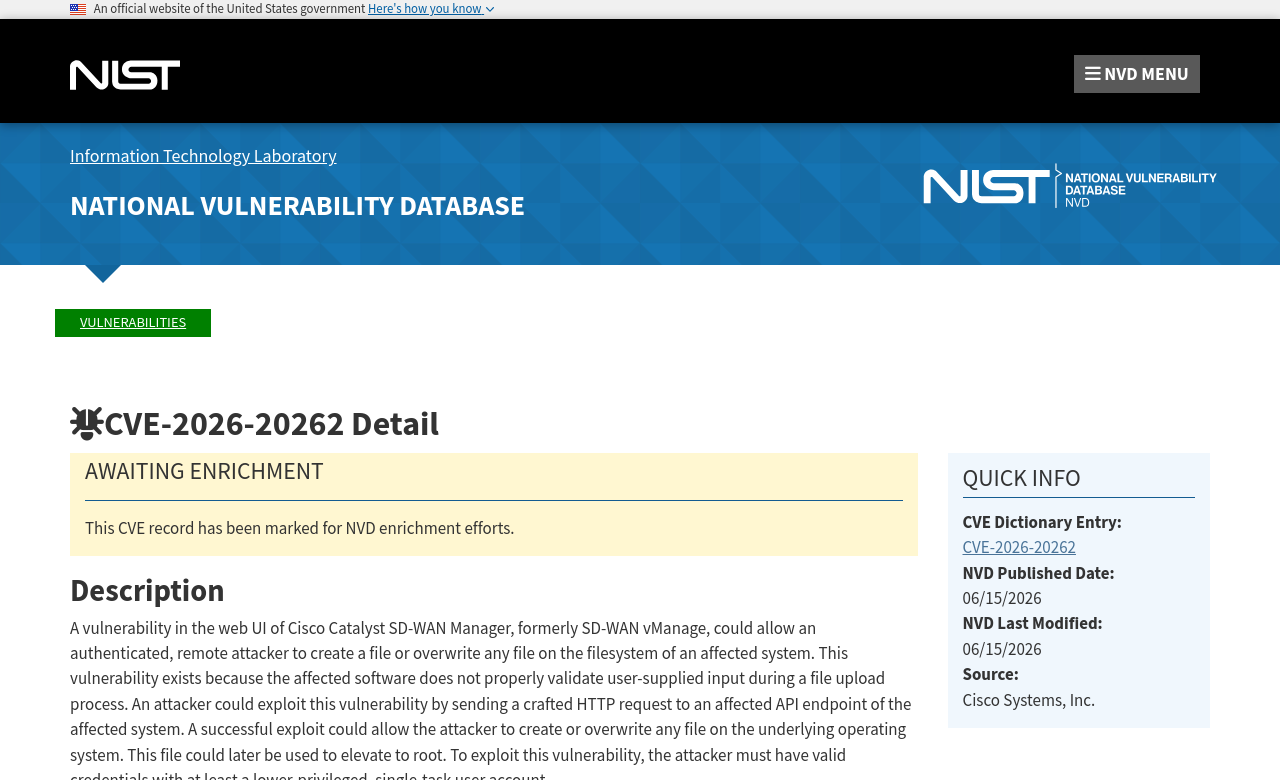
On June 15, 2026, CISA added CVE-2026-20262, a critical directory traversal vulnerability in Cisco Catalyst SD-WAN Manager, to its Known Exploited Vulnerabilities (KEV) Catalog, citing evidence of active exploitation in the wild. This flaw enables an authenticated remote attacker with netadmin privileges to execute arbitrary commands as root, leading to full system compromise. Federal Civilian Executive Branch (FCEB) agencies face a strict June 30, 2026, deadline to patch this flaw, underscoring CISA's intensified, risk-based vulnerability management posture under Binding Operational Directive (BOD) 26-04.
What Happened
On June 15, 2026, CISA escalated CVE-2026-20262 to its KEV catalog, confirming its active exploitation. Attackers are using this flaw against Cisco Catalyst SD-WAN Manager deployments. The vulnerability is a directory or path traversal issue, allowing a privileged, authenticated remote attacker — specifically one with netadmin access — to upload a specially crafted file. This file then executes commands as root, effectively granting full control over the SD-WAN Manager instance.
The root cause appears to be insufficient validation of user-supplied input within the SD-WAN Manager Command Line Interface (CLI). Cisco has observed similar vulnerabilities being exploited to push unauthorized configuration changes to edge devices, which is a known, dangerous pattern. While specific Indicators of Compromise (IoCs) for CVE-2026-20262 aren't immediately available, security teams should hunt for unauthorized file uploads via the CLI and any anomalous root-level command execution activity.
This KEV addition comes just days after CISA announced BOD 26-04 on June 10, 2026, which mandates a new risk-based vulnerability management approach for federal agencies. Under this directive, actively exploited flaws, especially those granting full control post-exploitation, require remediation and forensic triage within three days of internal discovery. For CVE-2026-20262, the explicit federal patch deadline is June 30, 2026. This week also saw CISA add CVE-2026-54420 (LiteSpeed cPanel Plugin Symlink Following Vulnerability) and CVE-2026-35273 (Oracle PeopleSoft Enterprise PeopleTools Missing Authentication) to the KEV catalog, with federal patch deadlines of June 30, 2026, and June 27, 2026, respectively.
Why It Matters
A root-level command execution vulnerability in a core network management platform like Cisco Catalyst SD-WAN Manager can lead to catastrophic outcomes. Attackers gaining root on an SD-WAN controller can fully compromise the system, manipulate global network configurations, exfiltrate sensitive operational data, and potentially steal user credentials. This provides a gateway to a complete network takeover.
The widespread adoption of Cisco Catalyst SD-WAN Manager across various deployment types — including on-prem, Cloud-Pro, Cisco Managed Cloud, and FedRAMP environments — makes the attack surface significant. While CVE-2026-20262 is not described as a direct ransomware attack vector, it absolutely provides the necessary access and privilege for threat actors to deploy ransomware or other destructive payloads, serving as a critical initial compromise.
The consistent targeting of Cisco network infrastructure, particularly its VPN and network management solutions, by sophisticated threat actors, is a persistent operational headache for defenders who are continually patching critical flaws. This situation emphasizes that all organizations, not just federal agencies, must prioritize patching highly privileged network devices.
Affected Scope & Remediation
All organizations running Cisco Catalyst SD-WAN Manager are exposed to CVE-2026-20262. The immediate action is to patch; apply the vendor-provided updates now. Given the requirement for an authenticated remote attacker with netadmin privileges, an effective mitigation strategy must also include stringent access control reviews for these accounts.
Here’s a general overview of affected systems and remediation steps:
| Product | Version Range | Fixed Version (or Remediation) | Source |
|---|---|---|---|
| Cisco Catalyst SD-WAN Manager | All actively supported versions prior to patched releases | Consult Cisco Security Advisory for specific updates | Cisco.com |
| Cisco Catalyst SD-WAN Manager | N/A | Apply latest software updates immediately | NVD |
| Federal Agencies (FCEB) | All vulnerable instances | Patch by June 30, 2026 | CISA KEV Catalog |
Patch Links:
- NVD Entry: CVE-2026-20262
- CISA KEV Catalog Entry: CVE-2026-20262
- Cisco Advisories: For specific patch versions, refer to the official Cisco Security Advisories page.
If immediate patching isn't possible, prioritize limiting netadmin privileges to the bare minimum necessary. Monitor for unusual CLI activity, unauthorized file uploads, and any unexpected processes running as root. Deploy Endpoint Detection and Response (EDR) solutions like CrowdStrike Falcon on any host interacting with or managing the SD-WAN infrastructure to catch post-exploitation behaviors. The federal patch due date for this vulnerability is June 30, 2026, as mandated by CISA. This 15-day window from the KEV listing highlights the critical nature, though CISA's BOD 26-04 implies a three-day remediation window for actively exploited vulnerabilities that grant full control post-exploitation, once they are internally identified by an agency. This distinction means agencies must have the capability to respond far faster than the mandated KEV deadlines for newly discovered threats.
Technical Breakdown
CVE-2026-20262 is a directory or path traversal vulnerability, a common but dangerous flaw. An authenticated remote attacker, already possessing netadmin privileges, can exploit inadequate input validation in the Cisco Catalyst SD-WAN Manager CLI. By crafting a special filename or path containing sequences like ../ (dot-dot-slash), the attacker can trick the system into writing a file outside the intended directory. This file, once uploaded, can be designed to execute arbitrary commands.
You can think of it like this: a delivery service is asked to place a package (a malicious file) in your mailbox (/var/uploads/). Because the delivery instructions don't properly validate the address, the attacker adds ../../../etc/cron.d/ to the front of their "mailbox" path. Suddenly, the package isn't in your mailbox; it's placed in a critical system directory like /etc/cron.d/ or /usr/local/bin/, where it can then be executed as root by the system itself or via a scheduled task. This sidesteps normal privilege boundaries and grants full system compromise.
Attackers typically use this for T1068 Exploitation for Privilege Escalation, moving from the netadmin role to root. It also relies on T1078 Valid Accounts, as the attacker needs to be authenticated with netadmin privileges in the first place. The successful exploitation of this vulnerability directly undermines SI-10 Information Input Validation, the NIST SP 800-53 control designed to ensure user-supplied data conforms to expected formats and ranges. Furthermore, it highlights a failure in AC-6 Least Privilege, as the netadmin role (even if initially legitimate) could escalate to an administrative level beyond its intended scope. Organizations can reduce this attack surface by ensuring critical management interfaces, like Cisco Catalyst SD-WAN Manager, are not directly exposed to the internet. Implementing solutions like Cloudflare Zero Trust can provide secure, authenticated access without requiring a public IP.
Historical Context
This isn't Cisco's first encounter with actively exploited SD-WAN Manager vulnerabilities. Just weeks prior, on June 5, 2026, CVE-2026-20245, another Cisco SD-WAN Manager zero-day, was disclosed, with Mandiant credited for its report. Like CVE-2026-20262, this previous flaw was also actively exploited, enabling threat actors to gain unauthorized access or execute arbitrary commands. The similarity lies in the target (Cisco SD-WAN Manager) and the criticality (zero-day, active exploitation). Both highlight the attractiveness of network orchestration platforms as high-value targets.
The difference often lies in the specific technical vector – CVE-2026-20262 is a directory traversal leading to root command execution, while the precise nature of CVE-2026-20245 might have been different (e.g., command injection through another vector). What remains consistent is Cisco's observed pattern of accelerating disclosures when exploitation is detected, which is good for transparency, but places a significant burden on security teams who are constantly patching critical infrastructure. This continuous stream of actively exploited flaws against their products demands constant vigilance.
Data at a Glance
| Metric | Value | Source |
|---|---|---|
| CVSS Score (estimated) | 9.8 | Cisco's Assessment |
| CISA KEV Addition Date | June 15, 2026 | CISA KEV Catalog |
| Federal Patch Deadline | 15 days (from KEV listing; June 30, 2026) | CISA KEV Catalog |
| Vulnerability Type | Directory or Path Traversal | NVD |
| Required Privileges | netadmin (Authenticated Remote Attacker) |
NVD |
| Exploit Status | Actively Exploited | CISA KEV Catalog |
Our Take
CISA is enforcing BOD 26-04 with explicit deadlines. The ongoing targeting of Cisco SD-WAN Manager isn't a coincidence; these are critical control points for massive networks, making them prime real estate for advanced persistent threats. If CISA is mandating a patch within two weeks, organizations outside of federal agencies should be patching immediately.
The CVEDaily Take
This isn't merely a patch; it's a litmus test for your vulnerability management program's agility and your least privilege enforcement. Requiring an authenticated netadmin user implies an initial access vector that needs scrutiny. Has your team audited the scope and security of all netadmin accounts on your critical infrastructure since this patch dropped?
FAQ
Q1: What is CVE-2026-20262?
A1: CVE-2026-20262 is an actively exploited directory or path traversal vulnerability in Cisco Catalyst SD-WAN Manager that allows an authenticated remote attacker with netadmin privileges to execute arbitrary commands as root.
Q2: Who is affected by CVE-2026-20262?
A2: All organizations utilizing Cisco Catalyst SD-WAN Manager, regardless of deployment type (on-prem, Cloud-Pro, Cisco Managed Cloud, FedRAMP), are at risk and should patch immediately.
Q3: What is the remediation deadline for federal agencies for CVE-2026-20262?
A3: Federal Civilian Executive Branch (FCEB) agencies are mandated by CISA to patch CVE-2026-20262 by June 30, 2026.