
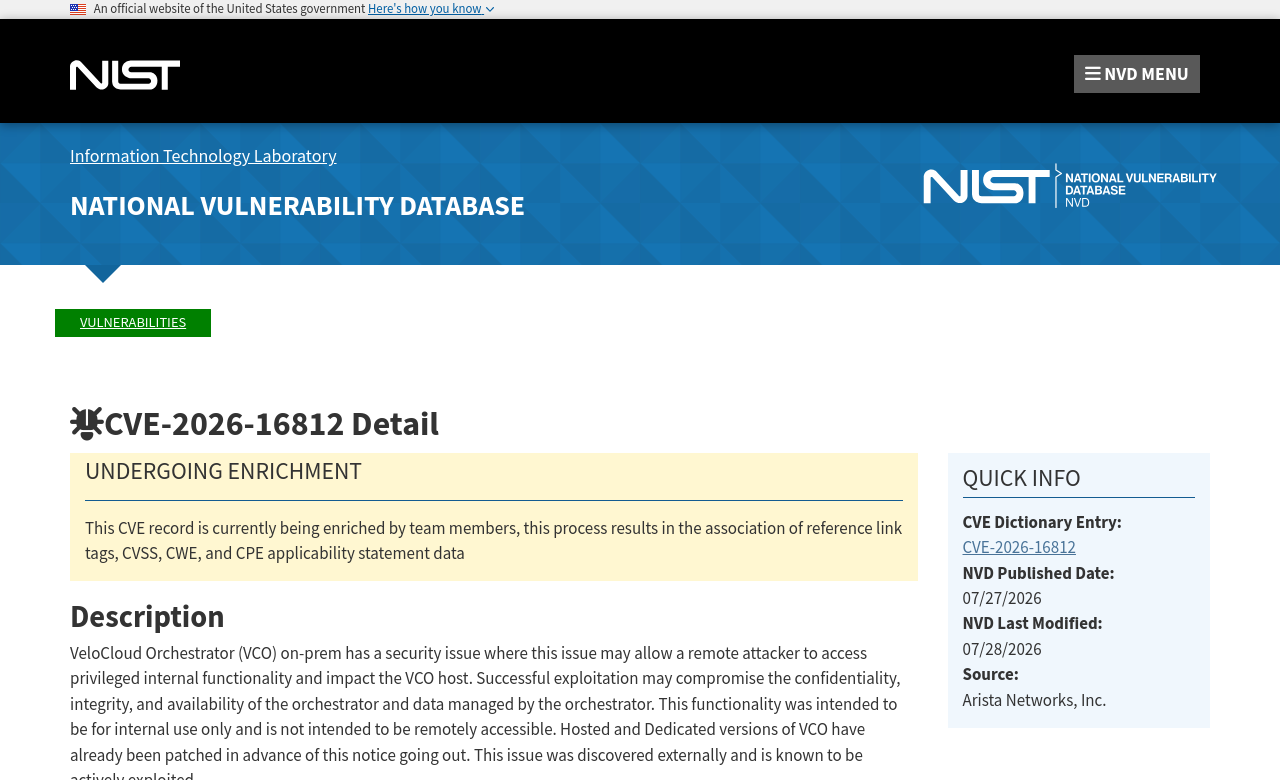
A critical command injection vulnerability, CVE-2026-16812, in Arista VeloCloud Orchestrator (VCO) on-premises deployments is under active exploitation by attackers. This zero-day flaw, rated CVSS 10.0, allows unauthenticated remote attackers with network access to the VCO web interface to execute arbitrary code with full system privileges. Exploiting this vulnerability leads to a complete compromise of the VCO host, affecting confidentiality, integrity, and availability of the orchestrator and its managed data. The U.S. Cybersecurity and Infrastructure Security Agency (CISA) added CVE-2026-16812 to its Known Exploited Vulnerabilities (KEV) catalog on July 27, 2026, mandating federal agencies patch it by July 30, 2026. Patch it now if you're running an affected on-premises VCO.
What Happened
Arista VeloCloud Orchestrator on-premises deployments are under active attack via a zero-day command injection vulnerability, CVE-2026-16812 (BleepingComputer). This flaw allows unauthenticated attackers to remotely execute arbitrary code with full system privileges, provided they have network access to the VCO web interface. A successful exploit grants administrative control over the VCO host, enabling threat actors to modify configurations, disrupt services, and establish a pivot point into the managed SD-WAN infrastructure. Arista released patches for the affected on-premises VCO versions on Monday, July 27, 2026 (SecurityWeek). The company has not publicly disclosed details about the attackers, the timeline of initial exploitation, or the specific number of affected customers.
Why It Matters
A CVSS 10.0 unauthenticated RCE on a central management platform like a VeloCloud Orchestrator is about as bad as it gets. Full system privileges mean attackers don't just gain a foothold; they own the orchestrator. From there, they can push unauthorized configurations across your entire SD-WAN fabric, exfiltrate sensitive network data, or even establish persistence for long-term access. This isn't about the VCO host; it's about the entire network it manages. The addition of CVE-2026-16812 to the CISA KEV catalog on July 27, 2026, confirms the severity and the active threat this zero-day poses. Federal agencies face a hard deadline of July 30, 2026, to implement the patch, a timeline that should prompt all organizations to patch immediately.
Affected Scope & Remediation
Only Arista VeloCloud Orchestrator on-premises deployments are affected by CVE-2026-16812. Hosted and Dedicated VCO deployments were proactively patched by Arista and do not require customer action. If you're running an on-premises VCO, patch it immediately.
Affected versions include:
- VCO 5.2.x releases before 5.2.3.14
- VCO 6.1.x releases before 6.1.3.4
- VCO 6.4.x releases before 6.4.2.4
- VCO 7.0.x releases before 7.0.0.1
The CISA KEV deadline to patch this flaw for U.S. federal civilian executive branch agencies is Thursday, July 30, 2026, just 3 days from its KEV catalog listing. This is an urgent fix.
Hunt for Indicators of Compromise (IoCs) by looking for:
- Unusual web requests to the VCO web interface, especially those with encoded characters or high rates.
- Connections from known malicious IP addresses like 8.19.75.217, 206.72.242.124, or 206.72.242.162.
- Unexpected outbound HTTP/HTTPS traffic originating from the VCO host.
- Unauthorized configuration changes within the VCO or managed SD-WAN devices.
- Unexpected command execution logs on the VCO host.
- Suspicious access attempts to VCO databases or credential stores.
Use your existing security tools, like CrowdStrike Falcon for endpoint detection and response on the VCO host, to scan for these IoCs.
| Product | Version Range | Fixed Version | Source |
|---|---|---|---|
| Arista VeloCloud (on-prem) | 5.2.x | 5.2.3.14 | Arista Advisory |
| Arista VeloCloud (on-prem) | 6.1.x | 6.1.3.4 | Arista Advisory |
| Arista VeloCloud (on-prem) | 6.4.x | 6.4.2.4 | Arista Advisory |
| Arista VeloCloud (on-prem) | 7.0.x | 7.0.0.1 | Arista Advisory |
Vendor Advisory: Arista Security Advisory 0099
NVD Entry: CVE-2026-16812
CISA KEV Entry: CVE-2026-16812
Technical Breakdown
CVE-2026-16812 is a classic command injection vulnerability within the Arista VeloCloud Orchestrator web interface. This means that instead of strictly validating user input, the application blindly executes user-supplied data as part of a system command. An unauthenticated attacker, with network access to the web interface, can craft malicious input that tricks the VCO into running arbitrary operating system commands. This effectively bypasses the application's intended functionality and gives the attacker direct control over the underlying system.
Think of it like this: You ask your assistant (the VCO web interface) to grab a file named report.txt. Instead of just asking for that file, you trick them into running an additional, unauthorized command, like "and also copy all my sensitive files to this external drive," by embedding it cleverly in your request for report.txt. The assistant, without proper validation, executes both. The outcome is code execution at the highest privilege level.
Attackers exploiting this flaw are engaging in T1190 Exploit Public-Facing Application to gain initial access. Given the arbitrary code execution with full system privileges, this also clearly involves T1068 Exploitation for Privilege Escalation. To mitigate such attacks, SI-10 Information Input Validation controls are critical, ensuring all user input is sanitized before being processed. Effective SI-2 Flaw Remediation, like applying this Arista patch, closes the window of opportunity. Organizations can also use solutions like Cloudflare Zero Trust to segment network access to critical management interfaces, limiting exposure of services like VCO to only necessary sources, even if a vulnerability exists.
Historical Context
This incident with Arista VeloCloud Orchestrator is not an isolated event but rather indicative of a trend in SD-WAN management platforms. We've seen similar critical vulnerabilities actively exploited in other centralized SD-WAN orchestration solutions recently. For instance, in January 2026, a critical authentication bypass flaw, CVE-2025-34026, was discovered in Versa Concerto SD-WAN, allowing unauthorized access (The Hacker News). That vulnerability also landed on the CISA KEV catalog due to active exploitation.
Just a few months later, in June 2026, Cisco Catalyst SD-WAN Manager (formerly Viptela vManage) faced its own active exploitation scenario with CVE-2026-20245 (SecurityWeek). This was a privilege-escalation zero-day that allowed authenticated attackers to execute root commands and push unauthorized configurations. The pattern is clear: SD-WAN orchestrators are high-value targets. Compromising these central brain-trusts allows threat actors to gain pervasive control over enterprise networks. The common thread here is the critical impact of these flaws and the speed with which they transition from disclosure to active exploitation, often before patches are widely deployed.
Data at a Glance
| Metric | Value | Source |
|---|---|---|
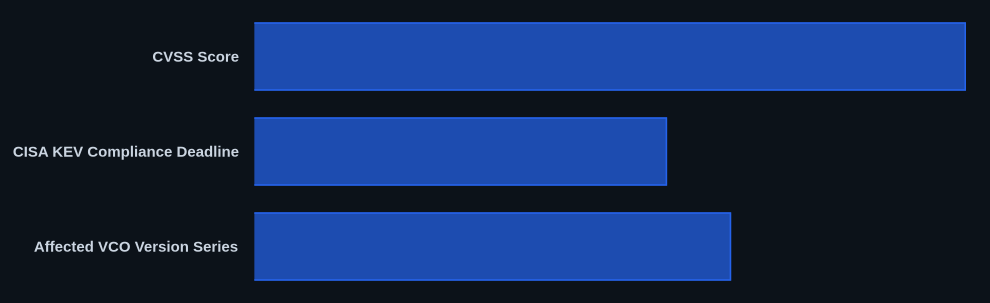
| CVSS Score | 10.0 | NVD |
| Exploitation Status | Active Zero-Day | CISA KEV Catalog |
| Patch Release Date | July 27, 2026 | BleepingComputer |
| CISA KEV Compliance Deadline | 3 days | CISA KEV Catalog |
| Affected VCO Version Series | 4 version series | Arista Advisory |
Our Take
We can't stress enough: if your SD-WAN management platform gets popped, your network is effectively compromised. These orchestrators are single points of failure for policy, routing, and access control. This Arista vulnerability, like the recent Versa and Cisco incidents, just hammers home the point that securing these systems is paramount. Don't wait; deploy these patches now. Also, consider the long game: network segmentation, strong access controls, and vigilant kernel-level telemetry of these critical management plane components are essential.
The CVEDaily Take
Another critical zero-day on a foundational networking control plane means SD-WAN architects and security teams are again playing catch-up. The CISA KEV inclusion and rapid deadline should be a wake-up call for anyone running a potentially exposed on-premises orchestrator. This isn't just a vulnerability; it's a direct path to total network compromise. We question if organizations are truly prepared to detect and recover from a compromise of their core SD-WAN orchestrator, given the lack of public details on the initial attack vector or duration of exploitation. How are you verifying integrity across your managed SD-WAN infrastructure post-VCO compromise?
FAQ
Q: Is my Arista VeloCloud Orchestrator (VCO) deployment affected by CVE-2026-16812?
A: This vulnerability specifically impacts on-premises VCO deployments running versions 5.2.x before 5.2.3.14, 6.1.x before 6.1.3.4, 6.4.x before 6.4.2.4, and 7.0.x before 7.0.0.1. Hosted and Dedicated VCO deployments were proactively patched by Arista and are not affected.
Q: What is the immediate action required for this zero-day?
A: If you operate an affected on-premises VCO, immediately apply the relevant patches from Arista to upgrade to a fixed version. Simultaneously, review your VCO host logs and network traffic for the Indicators of Compromise (IoCs) mentioned above to detect any signs of past or ongoing exploitation.
Q: What exactly is a command injection vulnerability?
A: A command injection vulnerability occurs when an application executes user-controlled input as part of a system command without proper validation or sanitization. This allows an attacker to inject arbitrary operating system commands into the application's inputs, which the application then executes, often with the same privileges as the application itself. In the case of CVE-2026-16812, this led to unauthenticated arbitrary code execution with full system privileges.