
How to Detect Credential Stuffing: Attack Chain, Warning Signs & Defense Playbook (2026)
Akamai observed over 130 billion credential stuffing attacks across their customer base in 2023, a significant year-over-year surge demanding immediate attention Akamai. This guide provides IT and security teams with actionable insights: identifying specific detection signals, executing an incident response, and implementing preventative controls to defend against these persistent threats. We'll detail the attack chain, highlight critical indicators of compromise, and outline a practical defense playbook.
How Credential Stuffing Works: The Attack Chain
Credential stuffing exploits the human tendency to reuse passwords across multiple online services. Attackers aren't guessing passwords; they're deploying automated tools to test previously stolen credentials against new targets. It's like a burglar with a box of found keys trying each one on every house door in a neighborhood, instead of picking a single lock repeatedly.
1. Initial Access: Data Acquisition and Preparation (CVE-YYYY-NNNNN T1078.004 – Credential Stuffing)
The attack begins with the acquisition of vast databases of breached username and password pairs. These "combo lists" are scraped from past data breaches, often purchased on dark web marketplaces for pennies per thousands of entries. Attackers meticulously curate these lists, sometimes enriching them with additional personal information to increase success rates.
2. Execution: Automated Login Attempts (CVE-YYYY-NNNNN T1059 – Command and Scripting Interpreter)
Using tools like Sentry MBA or OpenBullet, attackers automate the login process. These tools iterate through the stolen credential lists, sending rapid-fire login requests to a target application's authentication endpoint. They frequently use large networks of proxy servers (residential, data center, or compromised IoT devices) to rotate IP addresses, bypassing basic rate limiting and appearing as distinct users from varied geographic locations. This strategy makes real-time detection challenging without integrated bot management.
3. Impact: Account Takeover (ATO)
Successful logins lead directly to Account Takeover (ATO). From there, attackers can exfiltrate sensitive data, initiate financial fraud, perform identity theft, or use the compromised account for further attacks against the organization or its users. These ATOs can severely damage an organization's reputation and lead to significant financial losses, averaging $4.45 million per data breach globally in 2024 IBM.
Credential Stuffing Variants and Types
Credential stuffing isn't a monolithic attack; it changes with new tactics. Recognizing these nuances helps fine-tune your detection and prevention strategies.
Brute-Force vs. Credential Stuffing
While often confused, they differ in methodology. Brute-force attacks involve systematically guessing a password for a single known username until successful. Credential stuffing, conversely, uses known username/password pairs (from a breach) and tests them across many accounts on a target service. A successful brute-force attack against a WordPress admin account might reveal a password, whereas credential stuffing would use hundreds of thousands of leaked credentials against thousands of user accounts on a financial services platform.
“Reverse” Credential Stuffing
Instead of trying many username-password combinations, reverse credential stuffing uses a known password (often a common one or one found in a breach) and attempts to find associated usernames that use it. For example, if "password123" is discovered in a breach, attackers will attempt to log in using "password123" with a list of common usernames or email addresses.
Targeted Credential Stuffing
This variant focuses on compromising accounts specific to a particular organization's employees or high-value customers. Attackers might compile lists of employee email addresses or customer IDs and then test them against a breach list, aiming for highly privileged access. The LastPass incident in August 2022 began with targeted credential stuffing against a developer's home computer, ultimately leading to significant data loss.
How to Detect Credential Stuffing: Warning Signs and IOCs
Real-time detection requires a multi-layered approach, correlating signals across your infrastructure. Don't rely on a single control; attackers use rotating proxies specifically to evade isolated detections.
Endpoint Indicators
While credential stuffing primarily targets web applications, endpoint security tools can still pick up downstream effects if an attacker achieves initial access and attempts lateral movement or further compromise. Look for:
- EDR Alerts: Suspicious login activity reporting from CrowdStrike Falcon or SentinelOne, flagging an unusually high number of failed login attempts for a single user, followed by an immediate success from a new IP or device.
- Windows Event IDs: Monitor Event ID 4625 (An account failed to log on) and Event ID 4624 (An account successfully logged on) in rapid succession from the same source IP, especially if the source is outside expected geographic ranges. Also, look for multiple account lockouts impacting various users within a short timeframe, as seen in the PayPal attack impacting 35,000 accounts in December 2022. PayPal confirmed the attack and the number of affected accounts.
Network Indicators
Network telemetry offers critical, often immediate, insights into credential stuffing campaigns.
- Unusual Traffic Spikes: Monitor for sudden, sustained surges in HTTP/HTTPS POST requests directed at your
/login,/oauth, or/authendpoints. These requests often originate from geographically diverse IP addresses, many of which are associated with known proxy services or malicious IP lists. - IP Reputation and Geo-Mismatch: Flag source IPs identified as proxies, VPNs, or Tor exit nodes, especially if they don't align with expected user locations. Integrations with threat intelligence feeds like those from Akamai can quickly identify known malicious IPs or ranges.
- User-Agent Anomalies: Attackers often use non-standard, rapidly cycling, or generic User-Agent strings, or even legitimate ones in an unusual pattern. Monitor for a single User-Agent string hitting hundreds or thousands of unique accounts, or conversely, thousands of unique User-Agent strings from a single IP.
SIEM Detection
Your SIEM is critical for correlating disparate events and detecting patterns indicative of credential stuffing, especially when integrated with bot management solutions.
- Failed Login Thresholds: Implement rules that trigger an alert when a single IP address generates more than, for example, 50 failed login attempts within 5 minutes across multiple distinct usernames. A Splunk query might look like:
index=web_logs (uri="*/login*" OR uri="*/auth*") status=401 | stats dc(user) as distinct_users, count by src_ip | where count > 50 AND distinct_users > 1. - Success After Failures: Create rules to identify successful logins (Event ID 4624) immediately following a high volume of failed attempts (Event ID 4625) from the same or closely related source IPs.
- Geo-Location Mismatch & Concurrent Logins: Alert on successful logins from a new geographic location if a user has also logged in from their typical location within a short, improbable travel time (e.g., logging in from New York and then Singapore 30 minutes later).
- Bot Management Integration: Integrate logs from your Web Application Firewall (WAF) or dedicated bot management solution (like Akamai Bot Manager) directly into your SIEM. This provides critical real-time context on IP reputation, bot scores, and session anomalies, allowing for immediate blocking of sophisticated attacks leveraging rotating proxies that would otherwise appear as legitimate distributed traffic.
Response Playbook: What to Do When Credential Stuffing Hits
When you detect an active credential stuffing campaign, swift, decisive action is critical to minimize damage.
Phase 1: Immediate Containment (first 15 minutes)
Containment is about stopping the bleeding quickly. Don't wait for full analysis.
- Block Malicious IPs: Immediately block source IP addresses or ranges identified as malicious by your WAF, bot management, or SIEM. Use network ACLs or firewall rules, e.g.,
iptables -A INPUT -s [ATTACKER_IP] -j DROP. - Force Password Resets: For any accounts confirmed or highly suspected of compromise, immediately initiate a password reset. For large-scale attacks, consider a mass password reset for all affected users, requiring stronger, unique passwords.
- Enforce MFA: For all potentially affected users and especially for administrative accounts, enforce Multi-Factor Authentication (MFA) immediately if not already enabled. This is your strongest defense against ATO.
Phase 2: Forensic Preservation
Before attempting to remediate, ensure you've preserved crucial evidence for later analysis.
- Isolate and Log: Isolate affected systems or services if necessary. Preserve all relevant logs: web server access logs, application authentication logs, WAF/bot management logs, Identity Provider (IdP) logs (e.g., Azure AD, Okta), and SIEM logs.
- Snapshot Systems: If virtualized, snapshot virtual machines or cloud instances where suspicious activity occurred. This preserves the exact state for deeper forensic analysis without impacting ongoing operations.
- Collect Network Captures: If possible and where appropriate, capture network traffic related to the attack for detailed packet analysis, especially if you suspect advanced bot activity.
Phase 3: Recovery and Hardening
After containment and preservation, focus on restoring normalcy and preventing recurrence.
- Clean and Restore: Work with affected users to clean and restore their accounts. Ensure they're guided through secure password resets and MFA enrollment.
- Conduct Root Cause Analysis: Analyze collected logs and forensic data to understand the attack vectors, TTPs, and any vulnerabilities exploited. For the DoorDash incident in 2022, a third-party vendor compromise via phishing led to credentials being stolen, which were then used for credential stuffing against DoorDash customer accounts. DoorDash disclosed that the breach impacted approximately 4.9 million individuals. A thorough RCA would identify the vendor’s security gaps.
- Enhance Defenses: Implement or strengthen controls based on lessons learned. This includes refining SIEM rules, improving bot management configurations, and rolling out stronger authentication mechanisms. Use SOAR platforms to automate repetitive response actions and accelerate future incident handling.
How to Prevent Credential Stuffing: Controls That Work
Proactive measures are your first line of defense, significantly reducing the attack surface for credential stuffing.
Identity and Access Management Controls
Strong identity controls are foundational. MFA is non-negotiable.
- Multi-Factor Authentication (MFA): Maps this to CVE-YYYY-NNNNN NIST SP 800-53 IA-2 (Identification and Authentication (Organizational Users)) and CVE-YYYY-NNNNN MITRE ATT&CK T1110.003. Implementing MFA, especially hardware-based solutions like YubiKey (FIDO2/WebAuthn), is the single most effective deterrent. Even if credentials are stolen, MFA prevents their use.
- Account Lockout Policies: Directly addresses CVE-YYYY-NNNNN NIST SP 800-53 AC-7 (Unsuccessful Login Attempts) and CVE-YYYY-NNNNN MITRE ATT&CK T1078. Configure accounts to lock out after a set number of failed login attempts. This stops brute-force and credential stuffing attempts from cycling through many password combinations for a single account.
- Strong Password Policies: Aligns with CVE-YYYY-NNNNN NIST SP 800-53 IA-2 (Identification and Authentication (Organizational Users)) and CVE-YYYY-NNNNN MITRE ATT&CK T1136. Enforce minimum length, complexity, and unique passwords, preventing users from reusing easy-to-guess credentials. Implement password hashing and salting to protect stored credentials.
Network and Application Security Controls
Protecting the edge and the application itself is key to preventing attacks from reaching your user base.
- Web Application Firewalls (WAFs) & Bot Management: Maps to CVE-YYYY-NNNNN NIST SP 800-53 SC-7 (Boundary Protection). Deploy WAFs (e.g., Cloudflare, Akamai) that can detect and block automated traffic, abnormal request rates, and known bot signatures. Dedicated bot management solutions excel at identifying and mitigating sophisticated credential stuffing campaigns leveraging rotating IP proxies and varied User-Agents, significantly reducing the load on your authentication services.
- Rate Limiting: Align with CVE-YYYY-NNNNN NIST SP 800-53 SC-7. Implement strict rate limiting on login endpoints, allowing only a certain number of requests per IP address or session within a specific time frame. This slows down automated attacks and makes them economically unfeasible.
- IP Reputation Filtering: Directly relates to CVE-YYYY-NNNNN NIST SP 800-53 SC-7. Block known malicious IP addresses, Tor exit nodes, and IP ranges associated with VPNs or proxy services that are commonly used by attackers. Regularly update these blacklists with threat intelligence feeds.
Monitoring and Response Controls
Even with strong preventative measures, you need effective capabilities to detect and respond rapidly.
- Comprehensive Logging and Monitoring: Maps to CVE-YYYY-NNNNN NIST SP 800-53 AU-2 (Event Logging) and CVE-YYYY-NNNNN SI-4 (System Monitoring). Ensure comprehensive logging of all authentication attempts, successes, and failures across all applications and services. Centralize these logs into a SIEM for real-time analysis and alerting, correlating events from various sources.
- Incident Handling Plan: Aligns with CVE-YYYY-NNNNN NIST SP 800-53 IR-4 (Incident Handling). Develop and regularly test an incident response plan specifically for credential stuffing and account takeover scenarios. This ensures your team knows exactly what steps to take, from containment to communication.
Real-World Incidents
Credential stuffing isn't theoretical; it's a persistent, costly reality for many organizations. Understanding past incidents helps security teams prepare for the next wave.
PayPal (2022-2023)
Between December 6 and December 8, 2022, PayPal confirmed a credential stuffing attack impacting approximately 35,000 user accounts. Attackers used stolen credentials to gain unauthorized access, potentially viewing personal information such as names, addresses, Social Security numbers, and transaction history. While PayPal quickly detected and mitigated the attack, the incident underscores the difficulty even large financial institutions face in stopping sophisticated bot-driven campaigns. The lesson here is that even with advanced security, user password reuse remains a critical vulnerability, making MFA a mandatory control for any sensitive platform.
LastPass (2022)
The notorious LastPass breach in August 2022 had its initial access point attributed to credential stuffing. Attackers compromised a LastPass developer's home computer through a phishing attack, then used those stolen credentials to access a corporate VPN. This initial foothold led to the eventual theft of customer vault data. This wasn't a direct credential stuffing against the LastPass service itself but against an individual's personal credentials, which then granted access to corporate resources. The critical lesson is that corporate security extends to employee home environments and personal devices, and strong, unique credentials backed by MFA for all access points (including VPNs and internal tools) are critical.
DoorDash (2022)
In 2022, DoorDash disclosed a data breach stemming from a credential stuffing attack. The initial compromise wasn't directly against DoorDash but involved a third-party vendor. Attackers gained access to this vendor's system via a phishing attack, stealing credentials. They then used these stolen credentials in a credential stuffing attack against DoorDash's systems, leading to unauthorized access to customer and employee data for approximately 4.9 million individuals. This incident highlights the ripple effect of third-party vendor compromises and the importance of supply chain security. The key takeaway is to rigorously vet third-party vendors' security postures, enforce strict access controls for vendor accounts, and ensure comprehensive monitoring for suspicious activity originating from third-party integrations, even when the primary attack isn't directly on your application.
Data at a Glance
| Metric | Value | Source |
|---|---|---|
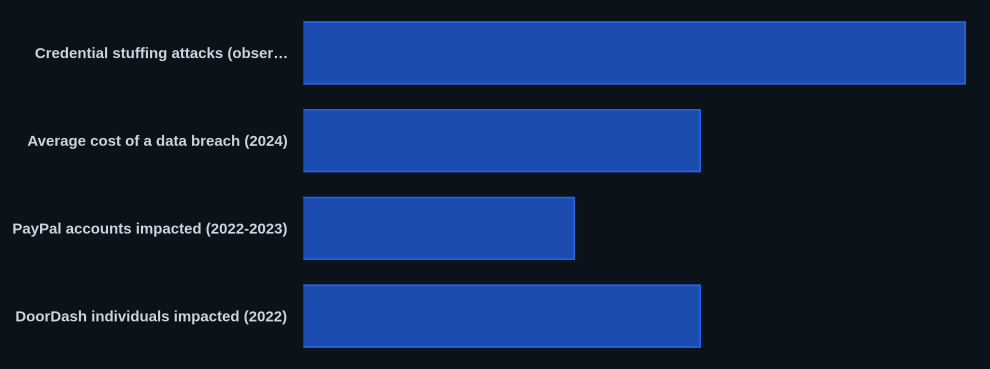
| Credential stuffing attacks (observed 2023) | 130 billion+ | Akamai |
| Average cost of a data breach (2024) | $4.45 million | IBM |
| PayPal accounts impacted (2022-2023) | 35,000 | SecurityWeek |
| DoorDash individuals impacted (2022) | 4.9 million | BleepingComputer |
| Year-over-year trend in attacks (2022 vs 2023) | Significant increase | Akamai |
The CVEDaily Take
We consistently see organizations struggle with credential stuffing because they treat all login attempts as equal, failing to integrate advanced bot management solutions with their SIEM for real-time anomaly detection. Relying solely on WAFs or basic rate limiting against attacks leveraging rotating IP proxies is a losing battle. How are you ensuring your SIEM can distinguish between legitimate traffic surges and sophisticated botnet activity targeting your authentication endpoints?
Tools & Resources
Deploying the right tools can make the difference between detection and disaster. Integrate these into your defense strategy.
Detection (SIEM/EDR)
- Splunk / Elastic Stack / Azure Sentinel: These SIEM platforms are essential for correlating logs from all sources – web servers, applications, WAFs, and bot management solutions. Use them to build sophisticated detection rules that identify high volumes of failed logins, geo-location anomalies, and unusual User-Agent patterns. Splunk Documentation, Elastic Documentation, Azure Sentinel Documentation
- CrowdStrike Falcon / SentinelOne: While not directly aimed at web applications, EDR solutions like CrowdStrike Falcon can detect post-exploitation activities if an attacker gains initial access and moves laterally within your network or attempts to exfiltrate data from an endpoint. CrowdStrike Falcon Documentation, SentinelOne Documentation
Prevention (Bot Management/IAM)
- Akamai Bot Manager / Cloudflare Bot Management: These dedicated bot management solutions are critical for identifying and blocking sophisticated credential stuffing campaigns that use rotating IP addresses and evasion techniques. They analyze behavioral patterns, device fingerprints, and IP reputation in real-time. Akamai Bot Manager Documentation, Cloudflare Bot Management Documentation
- YubiKey: A hardware security key that provides Multi-Factor Authentication (MFA), particularly using FIDO2/WebAuthn. Integrating YubiKeys drastically reduces the risk of account takeover even if credentials are stolen, as an attacker would also need physical possession of the key. YubiKey Documentation
Incident Response (SOAR)
- Palo Alto Networks Cortex XSOAR: A Security Orchestration, Automation, and Response (SOAR) platform like XSOAR can automate many steps in your credential stuffing incident response playbook, from blocking malicious IPs to initiating password resets and forensic data collection. This reduces response time and minimizes damage. Cortex XSOAR Documentation
FAQ
Q: How to detect credential stuffing?
A: Look for sudden spikes in failed login attempts from varied IPs, especially those known to be proxies. Monitor for high numbers of account lockouts across different users, and track successful logins immediately following numerous failures from the same source. Integrate bot management logs with your SIEM to correlate IP reputation and behavioral anomalies.
Q: How to respond to a credential stuffing attack?
A: First, immediately block identified malicious IP addresses via your WAF or firewall. Second, force password resets for all compromised accounts and enforce Multi-Factor Authentication (MFA). Third, preserve all relevant logs (web server, application, WAF, SIEM) for forensic analysis before attempting full recovery.
Q: How to prevent credential stuffing?
A: Implement Multi-Factor Authentication (MFA) across all user accounts, especially using FIDO2/WebAuthn standards. Deploy a dedicated bot management solution to detect and block automated login attempts from rotating proxies. Additionally, enforce strong password policies and enable account lockout mechanisms after a few failed login attempts.