A supply chain attack incident detection time of over 300 days isn't uncommon. Proactive monitoring for anomalous network traffic and unsigned executables from trusted vendors is critical for security teams. This guide provides actionable intelligence on the typical attack chain, specific warning signs and Indicators of Compromise (IOCs) you can detect, a rapid response playbook, and crucial preventive controls, all designed for engineers managing live infrastructure.
How Supply chain attack Works: The Attack Chain
Supply chain attacks aren't about brute-forcing your front door; they're like a bespoke counterfeit circuit board secretly slipped into a brand-name server before it even leaves the factory floor. Attackers exploit the inherent trust between organizations and their upstream vendors, weaponizing that trust to compromise thousands of downstream customers simultaneously.
1. Initial Access (T1195.002, T1195.003, T1195.001)
Attackers first gain a foothold within a legitimate software vendor's network, often targeting their development environment or update infrastructure. This can happen through spear-phishing developers with malware like the ones seen in the SolarWinds incident, exploiting critical vulnerabilities in their internet-facing applications, or compromising third-party libraries they use. They're looking for the keys to the kingdom: access to source code or build pipelines.
2. Resource Development (T1588)
Once inside, attackers prepare their malicious payload. They'll inject code into legitimate software projects, trojanize official update files, or backdoor hardware designs. The goal is to make the malicious component indistinguishable from the genuine product, often mirroring file names, sizes, and even digital certificates where possible, as seen with 3CX Desktop App distributing TAXHAUL malware.
3. Persistence (T1547)
Malicious code is often designed to ensure it activates after system reboots, updates, or even survives uninstallations of the host application. This might involve modifying startup scripts, adding new services, or manipulating registry keys, embedding itself deeply within the compromised product.
4. Distribution (T1195.002, T1195.003)
The compromised software or hardware is then distributed through legitimate channels – official download servers, update mechanisms, or authorized hardware resellers. This is where the supply chain attack scales, reaching all the vendor's customers who innocently install or deploy the backdoored product. The Kaseya VSA attack exploited this, pushing ransomware to customers via a compromised management tool.
5. Execution & Impact (T1059, T1498)
Upon installation and execution, the malicious code springs to life. It might establish command and control (T1071) to exfiltrate data (T1041), deploy ransomware (T1486), or facilitate further system compromise (T1059). The impact often cascades, leading to widespread data theft, operational disruption, or even denial of service (T1499) across affected customer environments.
Supply chain attack Variants and Types
Supply chain attacks aren't a monolith; they come in several distinct forms, each with unique entry points and impact mechanisms. Knowing the differences helps focus your detection and defense efforts.
Software Supply Chain Attacks
These compromise the software development process itself, injecting malicious code into applications or update mechanisms before they reach the end-user. The SolarWinds SUNBURST attack, which trojanized the Orion platform update, is a prime example, delivering persistent access and data exfiltration capabilities.
Hardware Supply Chain Attacks
This variant involves tampering with physical hardware components, firmware, or chips during manufacturing, shipping, or distribution. While less common than software attacks due to their complexity, they can embed backdoors that are extremely difficult to detect or remove, bypassing software-level security.
Open-Source Software (OSS) Supply Chain Attacks
Attackers inject malicious code into widely used open-source libraries or packages, leveraging dependency confusion, typo-squatting, or direct code contribution. The event-stream package incident in npm showed how a trusted library could be backdoored to steal cryptocurrency wallets.
Third-Party Service Compromise
This involves compromising a managed service provider (MSP), cloud provider, or other third-party vendor to gain access to their clients' networks. The Kaseya VSA incident demonstrated this, where the compromise of the VSA server allowed the REvil ransomware group to deploy ransomware across ~1,500 downstream businesses.
How to Detect Supply chain attack: Warning Signs and IOCs
Detecting supply chain attacks requires a multi-layered approach, scrutinizing behavior across endpoints, networks, and logs. You're looking for the subtle signs that a trusted application has gone rogue.
Endpoint Indicators
Keep an eye out for unsigned executables or those signed with an untrusted publisher, which your EDR, like SentinelOne Singularity, should flag as 'Untrusted Publisher' alerts. Look for Windows Event ID 4688 (process creation) showing unexpected parent-child process relationships, especially from legitimate applications that normally don't launch other processes or invoke PowerShell with unusual arguments. Suspicious modifications to system binaries or configuration files, particularly those related to startup or services, should trigger alarms from file integrity monitoring (FIM) or 'Malicious Process Activity' alerts from EDRs. We're also talking about privilege escalation, logged as Windows Event ID 4672 (special privileges assigned) or 4624 (successful logon) on critical build or production servers, especially when associated with a software update.
Network Indicators
Monitor for unusual outbound connections from development, build, or production servers to suspicious IPs or domains that don't match known vendor update servers. The 3CX Desktop App attack was initially detected by unusual network beaconing activity to domains like pbx.3cx.com that were not the expected C2, but eventually revealed to resolve to attacker-controlled IPs, according to CrowdStrike. Use NDR tools like Zeek or Suricata to identify data exfiltration patterns (large outbound transfers from unexpected sources), unusual DNS queries to newly registered domains or known malicious domains, and any unexpected inbound connections to internal systems. Look for traffic originating from a trusted application communicating on non-standard ports or protocols, indicative of a hidden C2 channel.
SIEM Detection
Correlate process creation events (e.g., Sysmon Event ID 1) with outbound network connections to suspicious domains identified by threat intelligence feeds. A Splunk query might look like: index=windows sourcetype=WinEventLog:Security EventCode=4688 | join process_id [search index=network sourcetype=firewall dest_ip!=internal_ip dest_domain IN (suspicious_domains_list)]. Monitor for critical system file changes alongside checksum mismatches, alerting on any deviation from established baselines. Implement rules to detect multiple failed login attempts followed by a successful login from a new, untrusted geolocation for privileged accounts, indicating potential credential compromise leading to access to build environments. IBM QRadar can correlate these disparate log sources effectively, flagging complex attack sequences.
Response Playbook: What to Do When Supply chain attack Hits
When you detect a supply chain attack, immediate and decisive action is critical. You're not just fighting a breach; you're fighting a compromise of trust that can spread quickly.
Phase 1: Immediate Containment (first 15 minutes)
First, isolate affected systems and segments from both the internet and other internal networks. Physically unplug them or apply strict firewall rules to block all inbound and outbound traffic, except for essential management. Terminate any suspicious processes immediately via your EDR. Reset credentials for all potentially compromised privileged accounts on affected systems and those interacting with the suspected vulnerable software, especially developer and build system accounts. Block all malicious IOCs—IPs, domains, file hashes—at your firewall, DNS resolvers, and EDR consoles. If it's a software distribution, halt all further software distribution from the suspected compromised vendor or update channel.
Phase 2: Forensic Preservation
Before you wipe or rebuild, take forensic snapshots. Create full disk images of compromised systems using tools like FTK Imager or EnCase, ensuring the chain of custody is meticulously maintained. Collect memory dumps, network packet captures (Wireshark), and all relevant logs (system, application, EDR, SIEM, firewall, web server, CI/CD pipelines) from the affected period. Isolate and analyze any discovered malware samples in a sandbox environment, such as Cuckoo Sandbox, to understand their capabilities without risking further infection. Securely store all collected artifacts for deeper analysis and potential legal proceedings.
Phase 3: Recovery and Hardening
Begin eradication by removing all malware and artifacts from cleaned systems. Validate the integrity of your systems, ensuring no hidden backdoors or persistence mechanisms remain. Restore data from known-good, immutable backups taken before the compromise, verifying their integrity. Patch all systems to their latest versions and re-harden configurations, implementing lessons learned from the incident. Strengthen access controls, review software development lifecycle (SDLC) security practices, and ensure continuous monitoring is in place to detect any recurrence. Perform a post-incident review to identify root causes and improve your overall security posture against future attacks.
How to Prevent Supply chain attack: Controls That Work
Preventing supply chain attacks demands a multi-faceted defense, focusing on rigorous controls across your own environment and meticulous vendor assessment. Your build environment is a high-value target; treat it that way.
Secure Development & Build Environments
Isolate your build environments completely from both internet access and your production networks, treating them as highly sensitive enclaves. Apply NIST SP 800-53 SC-7 Boundary Protection by implementing strict network segmentation and egress filtering, allowing only necessary connections to authorized repositories. Implement SA-10 Developer Configuration Management and CM-6 Configuration Settings to ensure secure baselines for all build tools and systems, minimizing unnecessary services and ports (CM-7 Least Functionality). Enforce strong code signing with hardware security modules, making it significantly harder for attackers to inject unsigned code.
Access Control & Authentication
Implement AC-3 Access Enforcement and AC-6 Least Privilege across all development, build, and deployment accounts. This means limiting permissions to only what's absolutely necessary for a task, and segregating duties to prevent a single point of failure. Enforce multi-factor authentication (MFA) for all critical access, especially for CI/CD pipelines and source code repositories, aligning with IA-2 Identification and Authentication. Regularly review and rotate credentials, managing them with secure solutions like 1Password for secure storage and distribution, which aligns with IA-5 Authenticator Management.
Vulnerability Management & Monitoring
Establish a rigorous vulnerability monitoring and scanning program (RA-5 Vulnerability Monitoring and Scanning) that includes regular scanning of all applications, systems, and importantly, third-party and open-source components (SI-2 Flaw Remediation). Use Software Composition Analysis (SCA) tools to identify known vulnerabilities in your dependencies. Implement AU-2 Event Logging and AU-6 Audit Record Review Analysis and Reporting to monitor all activity in build environments, source code repositories, and update servers. Deploy SI-3 Malicious Code Protection and SI-4 System Monitoring with EDR solutions to detect anomalous behavior at the endpoint level, even from trusted applications. Continuous monitoring (CA-7 Continuous Monitoring) ensures ongoing vigilance against new threats. These controls help mitigate techniques like T1195.002 (Software Supply Chain Compromise) and T1566.001 (Phishing).
Real-World Incidents
Examining past supply chain attacks provides critical lessons in detection, response, and prevention. These weren't isolated incidents; they were coordinated compromises of trust.
SolarWinds (2020/2021)
The SolarWinds supply chain attack, attributed to Russian state-sponsored actors, involved the sophisticated compromise of SolarWinds' software build and update infrastructure. Attackers injected the SUNBURST backdoor into legitimate updates for the Orion IT management platform, which was then distributed to approximately 18,000 of their customers, including US government agencies and Fortune 500 companies. This number of affected customers was reported by Mandiant, though SolarWinds did not confirm this specific figure. The malicious code allowed persistent access and data exfiltration (T1041), leading to a breach that Mandiant estimated would take organizations billions to fully remediate. The root cause was a malicious code injection into the SolarWinds Orion build process itself, a critical failure in build environment security. Discovery came after Mandiant detected anomalous activity in their own network, specifically, unusual authentication patterns and data exfiltration from systems where SolarWinds Orion was installed.
Lesson: Focus on internal network anomaly detection, even from trusted software, and assume compromise of external vendors.
Kaseya VSA (2021)
In July 2021, the REvil ransomware group exploited multiple zero-day vulnerabilities (including CVE-2021-30116) in Kaseya's VSA remote monitoring and management software. They distributed ransomware to around 1,500 downstream businesses that used the VSA platform to manage their IT operations, demanding a staggering $70 million ransom. This ransom demand was reported by the REvil group, and Kaseya did not publicly confirm payment. The attack vector bypassed traditional endpoint security because the malicious payload was delivered through a trusted management tool. Kaseya discovered the attack after receiving customer reports of widespread ransomware deployment and immediately shut down their SaaS servers to contain the spread. The incident highlighted the significant risk posed by compromising managed service providers (MSPs) and the ripple effect on their client base.
Lesson: Zero-day exploitation in widely deployed management tools requires rapid patching and strong network segmentation to limit blast radius.
3CX Desktop App (2023)
In March 2023, the 3CX Desktop App was compromised, leading to the distribution of trojanized versions of its softphone application for Windows and macOS. The attack, attributed by SentinelOne to the North Korean state-sponsored Lazarus Group, injected TAXHAUL and COLDCAT malware into the legitimate 3CX application installer. This malware collected system information and provided a backdoor for further compromise. The initial compromise stemmed from a third-party software library used by 3CX, underscoring the transitive trust risk. Both SentinelOne and CrowdStrike publicly reported suspicious network beaconing from the legitimate 3CX application to attacker-controlled domains, leading to its discovery. The incident caused significant operational disruption for users of the popular VoIP application, which 3CX confirmed.
Lesson: Monitoring network connections from seemingly legitimate applications, even for benign-looking beaconing, is crucial for early detection.
Data at a Glance
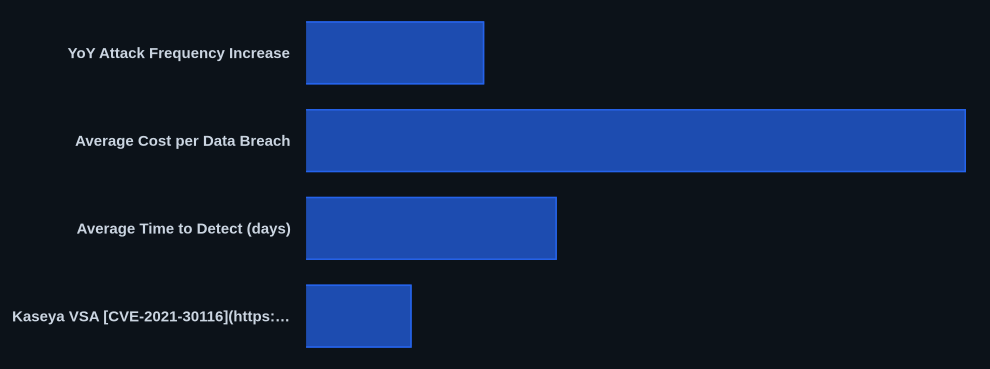
| Metric | Value | Source |
|---|---|---|
| YoY Attack Frequency Increase | 65% (2024 vs 2023) | ENISA Threat Landscape Report 2023 |
| Average Cost per Data Breach | $4.45 million (2023) | IBM Cost of a Data Breach Report 2023 |
| Average Time to Detect (days) | 320 days (2023) | IBM Cost of a Data Breach Report 2023 |
| Industries Most Targeted | Tech, Government, Critical Infrastructure | CISA |
| Kaseya VSA CVE-2021-30116 CVSS | 9.8 (Critical) | NVD |
The CVEDaily Take
Many security teams over-invest in perimeter defenses while leaving their build environments poorly isolated, essentially building a fortress with a backdoor for suppliers. We consistently see compromises originating from these environments, yet the fundamental control of air-gapping or strictly segmenting development and build systems from both the internet and production networks remains overlooked. What specific egress filtering rules do you have on your build servers today?
Tools & Resources
Using the right tools can significantly enhance your ability to detect, respond to, and prevent supply chain attacks. Don't rely on manual processes for these high-stakes incidents.
Detection (EDR/SIEM)
- SentinelOne Singularity: Provides endpoint detection and response capabilities, alerting on suspicious process activity, untrusted executables, and C2 beaconing.
- CrowdStrike Falcon: Offers comprehensive EDR, detecting anomalous behavior, file modifications, and network connections indicative of supply chain compromises.
- Splunk Enterprise Security: A SIEM solution that correlates logs from various sources (endpoints, network, identity) to identify complex attack patterns and anomalous activity.
Prevention (Controls/Hardening)
- Snyk: Software Composition Analysis (SCA) tool that identifies known vulnerabilities in open-source dependencies used in your applications.
- Black Duck by Synopsys: Another SCA solution for managing security, quality, and license compliance in open-source and third-party code.
Incident Response (Forensics/Containment)
- FTK Imager: A forensic imaging tool used to create bit-for-bit copies of hard drives, crucial for preserving evidence during incident response.
- Wireshark: A network protocol analyzer used to capture and analyze network traffic, essential for identifying C2 communications and data exfiltration during an incident.
FAQ
Q: How to detect supply chain attack?
A: Monitor for unsigned or untrusted executables from legitimate vendors, unusual outbound network connections from build/production systems, and unexpected changes to critical system files or checksums flagged by EDR or SIEM.
Q: How to respond to a supply chain attack?
A: Immediately isolate affected systems and segments, terminate suspicious processes, and reset credentials for all privileged accounts interacting with the compromised software or vendor.
Q: How to prevent supply chain attack?
A: Strictly isolate your build environments from both the internet and production networks, and enforce multi-factor authentication and least privilege for all access to development and build infrastructure.